by James J. Winchester
http://www.mediafire.com/file/4zznundtmge/NIETZSCHES_AESTHETIC_TURN__WINCHESTER.pdf
http://books.google.com/books?id=Z50XxFecTzMC&printsec=frontcover&dq=nietzsche+aesthetic+turn&ei=tVfxSu6AIJH-zQSUsqhC&hl=tr#v=onepage&q=&f=false
Showing posts with label derrida. Show all posts
Showing posts with label derrida. Show all posts
Wednesday, November 4, 2009

Monday, December 29, 2008
Derrida & Chérif - Islam and the West [made in istanbul]

[scars of différance presents]
Islam and the West:
A Conversation with Jacques Derrida
(Religion and Postmodernism Series)
By Mustapha Cherif
University Of Chicago Press
In the spring of 2003, Jacques Derrida sat down for a public debate in Paris with Algerian intellectual Mustapha Chérif. The eminent philosopher arrived at the event directly from the hospital where he had just been diagnosed with pancreatic cancer, the illness that would take his life just over a year later. That he still participated in the exchange testifies to the magnitude of the subject at hand: the increasingly distressed relationship between Islam and the West, and the questions of freedom, justice, and democracy that surround it. As Chérif relates in this account of their dialogue, the topic of Islam held special resonance for Derrida—perhaps it is to be expected that near the end of his life his thoughts would return to Algeria, the country where he was born in 1930. Indeed, these roots served as the impetus for their conversation, which first centers on the ways in which Derrida’s Algerian-Jewish identity has shaped his thinking. From there, the two men move to broader questions of secularism and democracy; to politics and religion and how the former manipulates the latter; and to the parallels between xenophobia in the West and fanaticism among Islamists. Ultimately, the discussion is an attempt to tear down the notion that Islam and the West are two civilizations locked in a bitter struggle for supremacy and to reconsider them as the two shores of the Mediterranean—two halves of the same geographical, religious, and cultural sphere. Islam and the West is a crucial opportunity to further our understanding of Derrida’s views on the key political and religious divisions of our time and an often moving testament to the power of friendship and solidarity to surmount them.
NEW LINK (and I think it is the only one that works)
mediafire link: thanks enes for the pdf, in this time of extreme unsociability
rapidshare link
+
Derrida interview on Holocaust
Monday, December 8, 2008
Kierkegaard's Instant: On Beginnings by David J. Kangas
Kierkegaard's Instant: On Beginnings
(Studies in Continental Thought)
by David J. Kangas
In Kierkegaard's Instant, David J. Kangas reads Kierkegaard to reveal his radical thinking about temporality. For Kierkegaard, the instant of becoming, in which everything changes in the blink of an eye, eludes recollection and anticipation. It constitutes a beginning always already at work. As Kangas shows, Kierkegaard's retrieval of the sudden quality of temporality allows him to stage a deep critique of the idealist projects of Fichte, Schelling, and Hegel. By linking Kierkegaard's thought to the tradition of Meister Eckhart, Kangas formulates the central problem of these early texts and puts them into contemporary light--can thinking hold itself open to the challenges of temporality?
one of the best books ever written on kierkegaard
(Studies in Continental Thought)
by David J. Kangas
In Kierkegaard's Instant, David J. Kangas reads Kierkegaard to reveal his radical thinking about temporality. For Kierkegaard, the instant of becoming, in which everything changes in the blink of an eye, eludes recollection and anticipation. It constitutes a beginning always already at work. As Kangas shows, Kierkegaard's retrieval of the sudden quality of temporality allows him to stage a deep critique of the idealist projects of Fichte, Schelling, and Hegel. By linking Kierkegaard's thought to the tradition of Meister Eckhart, Kangas formulates the central problem of these early texts and puts them into contemporary light--can thinking hold itself open to the challenges of temporality?
one of the best books ever written on kierkegaard
On Being With Others: Heidegger, Wittgenstein, Derrida
On Being With Others: Heidegger, Wittgenstein, Derrida
by Sim Glendinning
On Being With Others is an outstanding and compelling work that uncovers one of the key questions in philosophy: how can we claim to have knowledge of minds other than our own? Simon Glendinning's fascinating analysis of this problem argues that it has polarized debate to such an extent that we do not know how to meet Wittgenstein's famous challenge that "to see the behavior of a living thing is to see its soul". This book sets out to discover whether Wittgenstein's remark can be justified by drawing on both the analytic and continental traditions.
link
by Sim Glendinning
On Being With Others is an outstanding and compelling work that uncovers one of the key questions in philosophy: how can we claim to have knowledge of minds other than our own? Simon Glendinning's fascinating analysis of this problem argues that it has polarized debate to such an extent that we do not know how to meet Wittgenstein's famous challenge that "to see the behavior of a living thing is to see its soul". This book sets out to discover whether Wittgenstein's remark can be justified by drawing on both the analytic and continental traditions.
link
Friday, May 9, 2008
Derrida and Husserl: The Basic Problem of Phenomenology
Derrida and Husserl: The Basic Problem of Phenomenology
by Leonard Lawlor
# Paperback: 280 pages
# Publisher: Indiana University Press (June 1, 2002)
Book Description
Leonard Lawlor investigates Derrida's writings on Husserl in order to determine Derrida's transformation of the basic problem of phenomenology from genesis to language. To do so, he lays out a narrative of the period during which Derrida devoted himslef to formulating and interpretation of Husserl, from approximately 1954 to 1967. On the basis of the narrative, certain well known Derridean concepts are determined (in relation primarily to Husserl's phenomenology): deconstruction, the metaphysics of presence, diffŽrance (and Derrida's initial concept of dialectic), the trace, and spectrality.
About the Author
Leonard Lawlor is Dunavant Distinguished Professor of Philosophy at the University of Memphis. He is author of Imagination and Chance: The Difference between the Thought of Ricoeur and Derrida and co-editor (with Fred Evans) of Chiasms: Merleau-Ponty's Notion of the Flesh. He is a founding editor of the journal Chiasmi International: Trilingual Studies Concerning the Thought of Merleau-Ponty.
link
by Leonard Lawlor
# Paperback: 280 pages
# Publisher: Indiana University Press (June 1, 2002)
Book Description
Leonard Lawlor investigates Derrida's writings on Husserl in order to determine Derrida's transformation of the basic problem of phenomenology from genesis to language. To do so, he lays out a narrative of the period during which Derrida devoted himslef to formulating and interpretation of Husserl, from approximately 1954 to 1967. On the basis of the narrative, certain well known Derridean concepts are determined (in relation primarily to Husserl's phenomenology): deconstruction, the metaphysics of presence, diffŽrance (and Derrida's initial concept of dialectic), the trace, and spectrality.
About the Author
Leonard Lawlor is Dunavant Distinguished Professor of Philosophy at the University of Memphis. He is author of Imagination and Chance: The Difference between the Thought of Ricoeur and Derrida and co-editor (with Fred Evans) of Chiasms: Merleau-Ponty's Notion of the Flesh. He is a founding editor of the journal Chiasmi International: Trilingual Studies Concerning the Thought of Merleau-Ponty.
link
Friday, March 28, 2008
French Philosophy in the Twentieth Century by Gary Gutting

French Philosophy in the Twentieth Century
by Gary Gutting
Paperback: 432 pages
Publisher: Cambridge University Press; 1 edition (May 21 2001)
French philosophers have a reputation as some of the most perplexing. American readers tend to dismiss them with a huff or venerate them over cigarettes and coffee. Gary Gutting does neither. His approach in French Philosophy in the Twentieth Century is scholarly, judicious, and clear. The result is an exceptional look at a rich philosophical tradition. Gutting is one of the world's leading authorities on the work of Michel Foucault, and his depth on the century's other Gallic thinkers is comparable. The book is more than a general survey; it is a careful history of ideas, as well as an excellent series of essays on the main French thinkers of the last 100 years.
Gutting devotes much of his time to the half dozen giants of recent French thought: Henri Bergson, Jean-Paul Sartre, Simone de Beauvoir, Maurice Merleau-Ponty, Foucault, and Jacques Derrida. Of course, there are legions of other influences--such as Marcel, Saussure, Lévi-Strauss, Lacan, Kristeva, Lyotard, Deleuze, Irigaray, Levinas--and these get attention too, though in fewer pages. Gutting weaves the book together with a narrative history that accounts for the influences of literature and German thought. In addition, the carefully selected chapter epigraphs do more than supplement the text; they are windows into the vivid philosophy of Marcel Proust's literature. --Eric de Place
run 75mb's
Saturday, March 22, 2008
Derrida - Margins of Philosophy

Margins of Philosophy
by Jacques Derrida
Alan Bass (Translator)
# Paperback: 330 pages
# Publisher: University Of Chicago Press; 2nd Printing edition (January 1, 1985)
"In this densely imbricated volume Derrida pursues his devoted, relentless dismantling of the philosophical tradition, the tradition of Plato, Kant, Hegel, Nietzsche, Husserl, Heidegger—each dealt with in one or more of the essays. There are essays too on linguistics (Saussure, Benveniste, Austin) and on the nature of metaphor ("White Mythology"), the latter with important implications for literary theory. Derrida is fully in control of a dazzling stylistic register in this book—a source of true illumination for those prepared to follow his arduous path. Bass is a superb translator and annotator. His notes on the multilingual allusions and puns are a great service."—Alexander Gelley, Library Journal
TABLE OF CONTENTS
Translator's Note
Tympan
Différance
Note on a Note from Being and Time
The Pit and the Pyramid: Introduction to Hegel's Semiology
The Ends of Man
The Linguistic Circle of Geneva
Form and Meaning: A Note on the Phenomenology of Language
The Supplement of Copula: Philosophy before Linguistics
White Mythology: Metaphor in the Text of Philosophy
Qual Quelle: Valéry's Sources
Signature Event Context
go
don't know why I put rublev there, may be, it is.
Derrida - Eyes of the University: Right to Philosophy 2

Eyes of the University: Right to Philosophy 2
(Meridian: Crossing Aesthetics)
by Jacques Derrida
Jan Plug (Translator)
# Paperback: 328 pages
# Publisher: Stanford University Press; 1 edition (September 3, 2004)
Completing the translation of Derrida’s monumental work Right to Philosophy (the first part of which has already appeared under the title of Who’s Afraid of Philosophy?), Eyes of the University brings together many of the philosopher’s most important texts on the university and, more broadly, on the languages and institutions of philosophy.
In addition to considerations of the implications for literature and philosophy of French becoming a state language, of Descartes’ writing of the Discourse on Method in French, and of Kant’s and Schelling’s philosophies of the university, the volume reflects on the current state of research and teaching in philosophy and on the question of what Derrida calls a “university responsibility.”
Examining the political and institutional conditions of philosophy, the essays collected here question the growing tendency to orient research and teaching towards a programmable and profitable end. The volume is therefore invaluable for the light it throws upon an underappreciated aspect of Derrida’s own engagement, both philosophical and political, in struggles against the stifling of philosophical research and teaching.
As a founding member of the Research Group on the Teaching of Philosophy and as one of the conveners of the Estates General of Philosophy, Derrida was at the forefront of the struggle to preserve and extend the teaching of philosophy as a distinct discipline, in secondary education and beyond, in the face of conservative government education reforms in France. As one of the founders of the Collège International de Philosophie, he worked to provide a space for research in and around philosophy that was not accepted or legitimated in other institutions. Documenting and reflecting upon these engagements, Eyes of the University brings together some of the most important and incisive of Derrida’s works.
go
Alter Ego by Robert Crockett
Derrida - Acts of Literature

Acts of Literature
by Jacques Derrida
# Paperback: 472 pages
# Publisher: Routledge; 1 edition (November 20, 1991)
Acts of Literature, compiled in close association with Jacques Derrida, brings together for the first time a number of Derrida's writings on literary texts. The essays discuss literary figures such as Rousseau, Mallarmé, Joyce, Shakespeare, and Kafka, and comprise pieces spanning Derrida's career. The collection now includes a substantial interview with him on questions of literature, deconstruction, politics, feminism and history, and Derek Attridge provides an introductory essay on deconstruction and the question of literature, with suggestions for further reading.
These essays examine the place and operation of literature in Western culture, and are highly original responses to individual literary texts. They highlight Derrida's interest in literature as a significant cultural institution and as a peculiarly challenging form of writing, with inescapable consequences for our thinking about philosophy, politics and ethics.
go
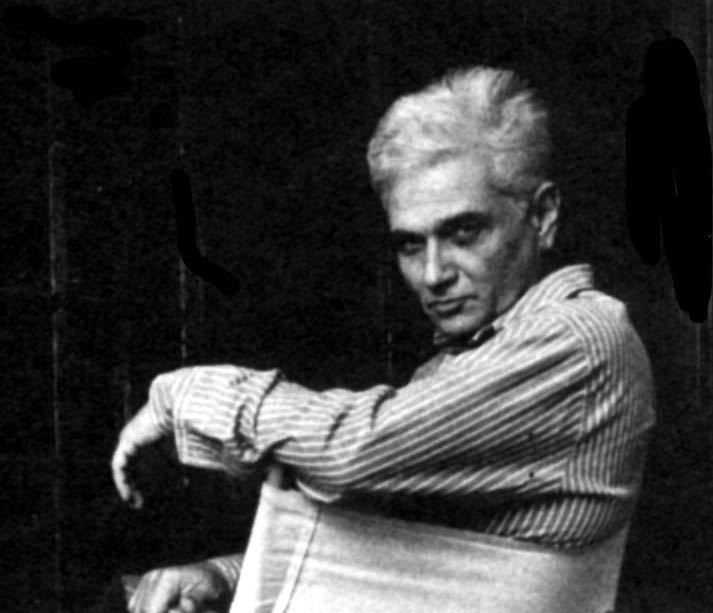
screenshot from Ken McMullen's "Ghost Dance" (1983)[it's the movie Derrida starR-ing]
Monday, February 11, 2008
Derrida - Signeponge=Signsponge

Signeponge=Signsponge
by Jacques Derrida
Format: Hardcover, 160pp
Publisher: Columbia University Press
Pub. Date: December 1985
. .. ... .
Derrida - Of Grammatology

Of Grammatology
by Jacques Derrida (Author)
Gayatri Chakravorty Spivak (Translator)
Paperback: 456 pages
Publisher: The Johns Hopkins University Press; Corrected edition (January 8, 1998)
Jacques Derrida's revolutionary theories about deconstruction, phenomenology, psychoanalysis, and structuralism, first voiced in the 1960s, forever changed the face of European and American criticism. The ideas in De la grammatologie sparked lively debates in intellectual circles that included students of literature, philosophy, and the humanities, inspiring these students to ask questions of their disciplines that had previously been considered improper. Thirty years later, the immense influence of Derrida's work is still igniting controversy, thanks in part to Gayatri Spivak's translation, which captures the richness and complexity of the original. This corrected edition adds a new index of the critics and philosophers cited in the text and makes one of contemporary criticism's most indispensable works even more accessible and usable.
classic - vow what a word, pfff
Derrida - Given Time: I. Counterfeit Money
Given Time: I. Counterfeit Money
by Jacques Derrida (Author)
Peggy Kamuf (Translator)
Paperback: 182 pages
Publisher: University Of Chicago Press (September 1, 1994)
Is giving possible? Is it possible to give without immediately entering into a circle of exchange that turns the gift into a debt to be returned? This question leads Jacques Derrida to make out an irresolvable paradox at what seems the most fundamental level of the gift's meaning: for the gift to be received as a gift, it must not appear as such, since its mere appearance as gift puts it in the cycle of repayment and debt.
Derrida reads the relation of time to gift through a number of texts: Heidegger's Time and Being, Mauss's The Gift, as well as essays by Benveniste and Levi-Strauss that assume Mauss's legacy. It is, however, a short tale by Baudelaire, "Counterfeit Money," that guides Derrida's analyses throughout. At stake in his reading of the tale, to which the second half of this book is devoted, are the conditions of gift and forgiveness as essentially bound up with the movement of dissemination, a concept that Derrida has been working out for many years.
For both readers of Baudelaire and students of literary theory, this work will prove indispensable.
helali hoş olsun
Derrida - The Ear of the Other: Otobiography, Transference, Translation
The Ear of the Other: Otobiography, Transference, Translation
by Jacques Derrida (Author)
Christie McDonald (Editor), Peggy Kamuf (Translator), Avital Ronell (Translator)
"Originally published in French in 1982, this collection is a good representation of the range of Derrida's working styles."-South Atlantic Review "No writer has probed the riddle of the Other with more patience and insight than Jacques Derrida. . . . By rigorously interrogating the writings of major Western figures, Derrida not only forces a rethinking of the nature of reading and writing but calls into question basic as-sumptions about ourselves and our world. . . . The Ear of the Other will be especially useful to people who have little or no prior acquaintance with Derrida's work. . . . Through a careful reexamination of Nietzsche's autobiography Ecce Homo, Derrida elaborates some of the far-reaching implications of twentieth-century reinterpretations of human subjectivity."-Mark C. Taylor, Los Angeles Times Book Review. "Ably translated. . . . The long 'Roundtable on Autobiography' . . . is authentic philosophical discussion, illuminating not only the preceding lecture but Derrida's work as well."-Choice.
Paperback: 190 pages
Publisher: University of Nebraska Press; New Ed edition (December 1, 1988)
hey cowboy!
Wednesday, February 6, 2008
Lacoue-Labarthe - Typography: Mimesis, Philosophy, Politics

Typography: Mimesis, Philosophy, Politics
(Meridian: Crossing Aesthetics)
by Philippe Lacoue-Labarthe
Jacques Derrida (Introduction)
Christopher Fynsk (Translator)
Paperback: 308 pages
Publisher: Stanford University Press; 1 edition (January 1, 1998)
Philosopher, literary critic, translator (of Nietzsche and Benjamin), Philippe Lacoue-Labarthe is one of the leading intellectual figures in France. This volume of six essays deals with the relation between philosophy and aesthetics, particularly the role of mimesis in a metaphysics of representation.
Comment [1997]
“Typography is a book whose importance has not diminished since its first publication in French in 1979. On the contrary, I would say, it is only now that one can truly begin to appreciate the groundbreaking status of these essays. The points it makes, the way it approaches the questions of mimesis, fictionality, and figurality, is unique. There are no comparable books, or books that could supersede it.” —Rudolphe Gasché,
State University of New York, Buffalo
“Lacoue-Labarthe’s essays still set the standards for thinking through the problem of subjectivity without simply retreating behind insights already gained. But this book is much more than a collection of essays: it constitutes a philosophical project in its own right. Anybody interested in the problem of mimesis—whether from a psychoanalytic, platonic, or any other philosophical angle—cannot avoid an encounter with this book. Lacoue-Labarthe is a philosopher and a comparatist in the highest sense of the word, and the breadth of his knowledge and the rigor of his thought are exemplary.” —Eva Geulen,
New York University
Review
“In demonstrating how mimesis has determined philosophical thought, Lacoue-Labarthe provokes us into reconsidering our understanding of history and politics. . . . Together with the introduction, these essays are essential reading for anyone interested in Heidegger, postmodernism, and the history of mimesis in philosophy and literature.” —The Review of Metaphysics
salute!
[photo by Arif Aşçı]
BONUS TRACK
Sylvia Plath - On the Decline of Oracles
Tuesday, December 25, 2007
Derrida - Archive Fever: A Freudian Impression

In Archive Fever, Jacques Derrida deftly guides us through an extended meditation on remembrance, religion, time, and technology—fruitfully occasioned by a deconstructive analysis of the notion of archiving. Intrigued by the evocative relationship between technologies of inscription and psychic processes, Derrida offers for the first time a major statement on the pervasive impact of electronic media, particularly e-mail, which threaten to transform the entire public and private space of humanity. Plying this rich material with characteristic virtuosity, Derrida constructs a synergistic reading of archives and archiving, both provocative and compelling.
"Judaic mythos, Freudian psychoanalysis, and e-mail all get fused into another staggeringly dense, brilliant slab of scholarship and suggestion."—The Guardian
"[Derrida] convincingly argues that, although the archive is a public entity, it nevertheless is the repository of the private and personal, including even intimate details."—Choice
parallel campaign
Friday, December 14, 2007
Heidegger Reexamined - H. Dreyfus (ed.)

Heidegger Reexamined
by Hubert L. Dreyfus (Editor), Mark Wrathall (Editor)
thank you Routledge
1408 pages
This collection of facsimile reprints brings together the most important recent scholarship examining the major stages in Heidegger's philosophical career. The first volume focuses on Heidegger's major work, Being and Time , as well as Heidegger's essays and lecture courses produced during the genesis of Being and Time, and shortly after its publication. The second volume covers the period from shortly after the publication of Being and Time up to the Letter on Humanism - that is, the period of Heidegger's notorious 'turn'. Volume three addresses the 'late' Heidegger: his thought from the 1940s until his death in 1976. It focuses on language and poetry, his renewed encounter with pre-Socratic philosophy, his development of the doctrine of the fourfold of earth, sky, mortals, and divinities, and his repeated attempts to radicalize his earlier accounts of Being and unconcealment. The fourth and final volume focuses on Heidegger's significance for contemporary issues in philosophy. Articles in this volume explore Heidegger's relevance to particular areas such as philosophy of mind and language, and relate Heidegger's thought to the philosophy of other contemporary philosophers like Wittgenstein, Searle, Davidson, Rorty, Levinas and Derrida.
to begin with being with-in
Fearless yet, if he must, man stands, and lonely vol 1
Before God, simplicity protects him, vol 2
No weapon does he need nor subterfuge vol 3
Until God's being "not there" helps him. vol 4
Hölderlin
Sunday, December 2, 2007
Derrida - a documentary

DERRIDA
official site
Kirby Dick: Kirby Dick is an award-winning Los Angeles filmmaker. His most recent film, THIS FILM IS NOT YET RATED, premiered at the 2006 Sundance Film Festival. His previous film, TWIST OF FAITH, about clergy sexual abuse, was nominated for an Academy Award. Earlier films include DERRIDA, winner of the Golden Gate Award at the San Francisco Film Festival, and CHAIN CAMERA, which premiered at the Sundance Film Festival. In 1997 he directed the internationally acclaimed SICK: THE LIFE AND DEATH OF BOB FLANAGAN, SUPERMASOCHIST, which won the Special Jury Prize at the Sundance Film Festival and the Grand Prize at the Los Angeles Film Festival.
Amy Ziering Kofman: DERRIDA marks Amy Ziering Kofman’s directing debut. She most recently produced the critically acclaimed feature documentary TAYLOR’S CAMPAIGN, which followed the race for a seat on the Santa Monica City Council by one of its homeless residents.
watch now
there are many videos about Derrida here
Routledge Philosophy Guidebook To Derrida On Deconstruction

Jacques Derrida is one of the most influential and controversial philosophers of the last fifty years. Derrida on Deconstruction introduces and assesses:
* Derrida's life and the background to his philosophy
* the key themes of the critique of metaphysics, language and ethics that characterize his most widely read works
* the continuing importance of Derrida's work to philosophy.
This is a much-needed introduction for philosophy or humanities students undertaking courses on Derrida.
an introduction for beginners. to begin. to beg. in. derrida. dada.
Saturday, November 17, 2007
Blanchot & Derrida - The Instant Of My Death

This volume records a remarkable encounter in critical and philosophical thinking: a meeting of two of the great pioneers in contemporary thought, Maurice Blanchot and Jacques Derrida, who are also bound together by friendship and a complex relation to their own pasts. More than a literary text with critical commentary, it constitutes an event of central significance for contemporary philosophical, literary, and political concerns.
The book consists of The Instant of My Death, a powerful short prose piece by Blanchot, and an extended essay by Derrida that reads it in the context of questions of literature and of bearing witness. Blanchot’s narrative concerns a moment when a young man is brought before a firing squad during World War II and then suddenly finds himself released from his near death. The incident, written in the third person, is suggestively autobiographical—from the title, several remarks in the text, and a letter Blanchot wrote about a similar incident in his own life—but only insofar as it raises questions for Blanchot about what such an experience might mean. The accident of near death becomes, in the instant the man is released, the accident of a life he no longer possesses. The text raises the question of what it means to write about a (non)experience one cannot claim as one’s own, and as such is a text of testimony or witness.
Derrida’s reading of Blanchot links the problem of testimony to the problem of the secret and to the notion of the instant. It thereby provides the elements of a more expansive reassessment of literature, testimony, and truth. In addressing the complex relation between writing and history, Derrida also implicitly reflects on questions concerning the relation between European intellectuals and World War II.
her nefs ölümü tadacaktır
Derrida - Memoirs of the blind

In this brilliant essay, Jacques Derrida explores issues of
vision, blindness, self-representation, and their relation to
drawing, while offering detailed readings of an extraordinary
collection of images. Selected by Derrida from the prints
and drawings department of the Louvre, the works depict
blindness—fictional, historical, and biblical. From Old
and New Testament scenes to the myth of Perseus and the
Gorgon and the blinding of Polyphemus, Derrida uncovers in
these images rich, provocative layers of interpretation.
For Derrida drawing is itself blind; as an act rooted in
memory and anticipation, drawing necessarily replaces one
kind of seeing (direct) with another (mediated). Ultimately,
he explains, the very lines which compose any drawing are
themselves never fully visible to the viewer since they exist
only in a tenuous state of multiple identities: as marks on
a page, as indicators of a contour. Lacking a "pure"
identity, the lines of a drawing summon the supplement of the
word, of verbal discourse, and, in doing so, obscure the
visual experience. Consequently, Derrida demonstrates, the
very act of depicting a blind person undertakes multiple
enactments and statements of blindness and sight.
Memoirs of the Blind is both a sophisticated
philosophical argument and a series of detailed readings.
Derrida provides compelling insights into famous and lesser
known works, interweaving analyses of texts—including
Diderot's Lettres sur les aveugles, the notion of
mnemonic art in Baudelaire's The Painter of Modern
Life, and Merleau-Ponty's The Visible and the
Invisible. Along with engaging meditations on the history
and philosophy of art, Derrida reveals the ways viewers
approach philosophical ideas through art, and the ways art
enriches philosophical reflection.
An exploration of sight, representation, and art,
Memoirs of the Blind extends and deepens the
meditation on vision and painting presented in Truth and
Painting. Readers of Derrida, both new and familiar, will
profit from this powerful contribution to the study of the
visual arts.
< at ille, ut erat, capite velato, "Sine sine" inquit 'fruatur diutius tropaeo Fortuna quod fixit ipsa.' > from my dear Apuleius
Subscribe to:
Posts (Atom)


