Showing posts with label economics. Show all posts

Friday, September 28, 2007

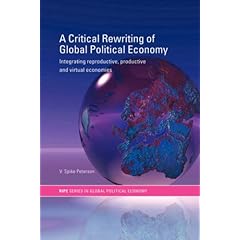
A Critical Rewriting of Global Political Economy - peterson


A Critical Rewriting of Global Political Economy: Integrating Reproductive, Productive and Virtual Economies by V. Spi Peterson - Routledge

Moving beyond a narrow definition of economics, this pioneering book advances our knowledge of global political economy and how we might critically respond to it.

Two features of the global economy increasingly determine everyday lives worldwide. The first is explosive growth in financial markets that shapes business decision-making and public policy-making, and the second is dramatic growth in informal and flexible work arrangements that shapes income-generation and family well-being. These developments, though widely recognized, are rarely analyzed as inextricable and interacting dimensions of globalization. Using a new theoretical model Peterson demonstrates the interdependence of reproductive, productive, and virtual economies, and analyzes inequalities of race, gender, class, and nation as structural features of neoliberal globalization.

Presenting a methodologically plural, cross-disciplinary and well-documented account of globalization, the author integrates marginalized and disparate

hocam onu geç de burslar ne zaman yatacak

Thursday, September 20, 2007

Companion to the History of Economic Thought


Companion to the History of Economic Thought (2003).


Assembling contributions from top thinkers in the field, this Companion offers a comprehensive and sophisticated exploration of the history of economic thought. The volume has a threefold focus: the history of economic thought, the history of economics as a discipline, and the historiography of economic thought. The essays in the first part focus on the history of economic ideas, with topics ranging from ancient, medieval, and Islamic thought, to Marxian, Utopian, and postwar thought. The second part explores important historiographical topics, including the sociology of economics, methodology, exegesis, and textuality.Each essay serves as a complex introduction to the chosen topic, and gathered together they provide an extensive synthesis of the field as a whole. The volume is an essential resource for anyone researching or studying the history of economic thought, and will also serve as an excellent text for courses in this area


Economics - The Basics


economics - The Basics (Routledge)


Economics: The Basics provides a fascinating introduction to the key issues in contemporary economics. With case studies ranging from the coffee plantations of El Salvador to the international oil industry and the economic slowdown in Japan, it addresses fundamental questions such as:*Must increasing wealth for some mean increasing poverty for others? *Does producing more food for humankind mean we drive other species to extinction? *Is it true that, if we buy less coffee, farm incomes from Brazil to Kenya take a beating? *Is granting people property rights the best way to preserve fish and wildlife stocks? *Do we really have to choose between low unemployment and low inflation?Comprehensive and easy to read, this accessible guidebook is essential reading for anyone who wants to understand how economics works and why it is important.

http://www.snapdrive.net/files/494742/kutu1/economiccs%20-%20The%20Basics%20%28Routledge%29.pdf

Thursday, August 30, 2007

the protestant genome and the spirit of capitalism

I've started reading A Farewell to Alms, a book about the economic history and macrosociology of the last two thousand years. It received an enthusiastic write-up in the New York Times (here), and I think its publication date might have been accelerated as a result.

The moral and political implications of the book's argument, either if it is true or if it comes to be regarded as true, are so breathtaking as to be hard to understate, especially in a hastily written blog post by someone who is moving.

The argument, most briefly, is that part of what led to the Industrial Revolution was a more longstanding improvement of the species over the preceding several hundred years, and, although the book is coy about saying this improvement could be either "cultural" or "genetic," it's clear that author's inclination is "genetic." The seemingly obvious implication if that were true--although I am uncertain from the 30-odd pages I've read so far whether the author will actually connect the dots he draws right there on the page--is genetic variation among people with ancestry from different parts of the world on traits pertinent to socioeconomic attainment. Good to have ancestry from the regions of the world that were the leaders of the Industrial Revolution or otherwise socially close to it, and bad to be from regions that were not close. In this respect, the argument could be interpreted as providing the historical backstory for The Bell Curve. So, it's important, especially given that it is by an economist and all the recent hoopla for economics as the enterprise that has the apparatus to uncover hidden insights into social affairs and the independent-mindedness to speak unpopular "truths."

As I said, I haven't read enough of the book to be able to begin to evaluate its evidence, and moving isn't exactly allowing great focused cognitive space for reading. I'm approaching the book with a lot more skepticism than the author of the NYT article. I know I post perhaps surprisingly little about the substance of social science on this blog, but it doesn't get more substantive than the history of human organization and the causes of social inequalities, so I'm putting y'all on alert about this book if you haven't heard about it.

Wednesday, August 22, 2007

a better title might have been: re-discover your inner economist

I read the first six chapters of Discover Your Inner Economist by the economist and popular blogger Tyler Cowen today. I don't read his blog, but given how much people enjoy it, I was expecting the book to be better. Indeed, I kept reading despite not feeling I was getting much out of it because I kept presuming it would get better. It didn't.

While reading it, I was reminded of the line in Ghost World where Enid says some kitsch performer has gone from being "Past being so bad it's good to being bad again." In this case, one of the main parts of book's overall argument is to go past being counterintuitive to where it is intuitive again. Earlier popular economics writers like Steven Landsburg have created a stage in which another economist talking about how much of the world of interpersonal relationships and intrapersonal striving is not, in fact, like buying bananas at the supermarket can be called channeling one's Inner Economist, instead of, well, one's Humanity. That is, sometimes Cowen is arguing to a popular audience against standard economics and more toward the view the popular audience would have if it hadn't paid attention to some of the excesses of standard economics in the first place.

Apparently also, if you have a Ph.D. in economics, you can give whatever life advice and theories about human nature that you have and pass it off as manifesting economic expertise. Much of the book is about Cowen's vague ideas about the human need for "control." The last anecdote that made me decide I couldn't justify spending any more time with the book began:
On a more personal level, a willingness to give up control can make us better teachers. When we teach our children how to drive, we like to pretend they will never do anything stupid. We give them a lecture about the long list of things they should never do.

My approach is different. I taught Yana, my then-fifteen-year-old stepdaughter, how to drive. One day I started with: "The first thing we are going to do is hit the curb. Drive over the curb, just not too fast." This is the best way to learn where the curb is. Yana is going to find the curb anyway, sooner or later, so let this learning occur under safe circumstances.
Some people might find these expositions more interesting or amusing than I did, but they also provoked this recurrent sense that we were straying far for a book that said it was going to be about incentives. He has this whole chapter about how to appreciate art better, parts of which were interesting, but even then I kept wondering how particular points were "economic." It's as if anything that evinces wisdom in a social setting is to be understood as channeling your Inner Economist.

* This column by Landsburg in Slate singlehandedly stunted my growing interest in economics for almost a year, by making an enterprise that I was coming to better appreciate suddenly seem ludicrous (the stunting abated when I realized that Landsburg was not the ambassador of mainstream economics he presents himself as being).

Monday, August 6, 2007

it has always seemed to me that one of the main things that would be fun about having two kids is getting to do experiments on them

Robert Frank, Falling Behind, page 54:
I came to this view in part because of an experiment I did years ago with my two oldest sons when they were five and seven years old. The experiment took three days. On day one, I poured each of them a full glass of orange juice. On day two, I poured each only half a glass. Then, on day three, I poured David (then age seven) seven-eighths of a glass and Jason (then age five) only three-quarters of a glass. (I am not sure that a human subjects committee would approve this experiment today.)

You can guess what happened. On the first two days, each drank his juice without comment. In particular, neither asked on day two why he'd gotten only half as much as the day before. But things played out differently on day three. Jason looked first at his own glass, then over at his brother's, then back at his own, his face registering growing signs of distress. It was obvious that he was struggling not to react. But finally he blurted out, "That's not fair; he always gets more than me."

Saturday, May 12, 2007

video killed the ratio star

Check out Chris's post about the Harvard Economics Department's graduate recruitment video and associated parodies. I was maybe thirty seconds into the real video before I realized that it was not, itself, some kind of joke ("Whoa, they really found someone who looks like Ed Glaeser... Wait, that really is Ed Glaeser, you wouldn't think he would have such a spectacular ironic sense of humor... Wait, this isn't supposed to be funny.")

Wednesday, March 28, 2007

freaks and geeks

I uploaded a recent article in the New Republic on Freakonomics and economists fretting about the rise of cute little studies in their discipline. My stance, which I did not do an especially good job of articulating in this panel of Freaknomics at the Eastern Sociological Society meetings, is that sociology should, at least from a strategic standpoint, be on the side of the freakonomists in their battle against the structural-modellers in economics, because the former stakes out a position that is far more congenial to prevailing tendency of sociologists to be stronger with understanding data and process than they are at math.

Update: Link fixed.

Saturday, March 17, 2007

so, how was the conference?

me, at easterns
(me, presenting at the Eastern Sociological Society meetings)

The most common problem with giving talks at conferences is that one doesn't actually get an audience, and one is left talking almost or entirely only to the other panelists.* This leads one to feel like presenting is pointless, that one is producing a good no one else is actually interested in consuming, and various related issues that cause existential and morale crises in academics. Alternatively, one can sometimes get good attendance at a talk, but then one is dealing with this stochastic process where each additional person at a talk increases the probability that someone in the audience will be a crank or twit that provides some kind of irksome distraction that is then does much to decrease the value of the session.**

At the Eastern meetings, I gave two presentations: one fell into the first category above, and one--the panel on Freakonomics--fell into the second. The main session vandal for the second was this guy who was apparently the spouse of a sociologist, but I somehow missed this and spent much of the time when he would talk thinking, "How can this guy be a sociologist and know so little about social science?" Anyway, fellow sociologists: if you want to bring your spouse (or child, or pet) along to a presentation, that's fine, but just like if you were going to a restaurant or movie theater, try to have them behave. If he is doing things like interrupting other audience member's points with asides where everyone is supposed to raise their hand if they've read Freaknonomics, that's not behaving.

Another person in the audience wanted the panel to discuss whether Freakonomics was "the son of the Bell Curve," which I regarded as being too beyond ridiculous to know how to address and yet seemed to resonate with some other people in the audience. I suppose maybe I should consider it a victory that no analogies to the Nazis were drawn.

* I haven't had this problem with any panels I've been on, but one consequence of the rise of internet in hotels is that one can't necessarily even count on the attention of fellow panelists.

** One may be more likely at ill attended talks to be on a panel with someone who is a crank or twit and does much to compromise the panel for everyone, especially if they go on for twice their allotted time with a presider who just lets them.

Sunday, February 25, 2007

let's be clear: your discarded do-si-dos are not doing the underclass any favors

In response to my last post, one commenter wrote:
Many (all?) Girl Scout councils have a cookie share program that allows you to buy boxes from girls, but have the cookies sent to a charity. The troop chooses the food pantry, shelter, or wherever they want to send the cookies. The girls can still go to horse camp.
First, I don't want to seem anti-Girl Scout. I have friends with various kinds of close connections to Girl Scouts, I think they are a great organization, especially since they do not promote homophobia like their othergender counterpart, etc..

However, and no offense to the commenter: It's unclear even if cookies were entirely free that one is doing the world a favor by stocking any food pantry or shelter with additional cookies. Americans below the poverty line, as a group, evince some of the poorest dietary decision-making anywhere on the planet, due to a complex variety of reasons but certainly not helped by boxes of free cookies. Regardless, there is no such thing as a free cookie, and the same money used to buy cookies could be used to: (1) donate the profit from the cookies to the Girl Scouts, (2) donate the wholesale cost of the cookie to the organization that would get the cookies as a donation and (3) give the savings from deducting the donation from one's taxes to whatever organization one prefers.

Can you really not make a charitable donation to the Girl Scouts and just have that count toward whatever cookie quota a given scout has toward sending her troop to horse camp? Does everything have to be translated into the currency of cookies for it to be part of the sales drive?

It says something about my social networks that I have no recollection of ever personally having been directly asked by a Girl Scout to buy cookies. I don't even think I've ever been directly asked by a parent of a Girl Scout either, although I've been in places where people have put up a signup sheet on a bulletin board (sometimes with an explicit note like, "I'll participate in your kid's fundraising drive if you participate in mine.") When I do, however, my response will not be to fork over cash to fight the War On Poverty with Thin Mints.

Tuesday, February 13, 2007

and here i was hoping it would be titled 'get your freak on'

freaky panel

I just looked at the preliminary program for the Eastern Sociological Society meetings in Philadelphia next month. I'm participating in a panel on the book Freakonomics--sort of like an "Author Meets Critics" session, only without the author. I'm not sure if the name of the panel is what I would have chosen, or, at least, I hope it doesn't mean I have to strive to be any more freaky than I already am.

Saturday, January 6, 2007

you don't have to be an economist to see the problem...

"I am required by law to negotiate with you over the price of this car. I am also required, at the end of the day, to buy this car. I see that the sticker price is $23,000. How about we start the negotiations at $17,000?"
"How about we end the negotiations at $23,000?"
"Um, $19,000?"
"$23,000."
"The law says I have to buy this car! $21,000 is not my final offer!"
"$23,000."
"Okay, $23,000."

This, as far as I can tell, is what the Democrats are offering as their plan for how the government will use its "power" to negotiate lower prices for prescription drugs with Medicare. NYT has critics making the point here.

That said, my guess is the government will be able to negotiate lower prices, which will be partly apparent [lower prices compared to what?] and partly real, just so this plan can be called a success and there will be no pressure to enact a plan where the government has true leverage and could force a much stronger deal.

It's a little like invading a foreign country without enough troops to do the job properly, except that, over the long-term, more Americans will be killed by suboptimal drug policy than by the war in Iraq.

To clarify: (1) some negotiation can't be worse than the Republican plan allowing no negotiation, but (2) this is still much better from the perspective of the pharmaceutical industry than what the Democrats could have done. Given how much money the pharmaceutical industry spent trying to defeat Democrats, it does make one wonder if part of the purpose is to neutralize this lobby by being ungenerous but not unfriendly toward them.

Monday, December 11, 2006

an engine, not a camera. and not just any old engine, either.

Okay, so I was touting Donald MacKenzie's An Engine, Not a Camera, even before orgtheory.com announced its symposium on it. Yesterday Kieran put up a post of journal-article quality and length about the book. Reading that caused me to write my own post. Not a response to Kieran's--especially since I haven't finished reading it--but some of my own thoughts on the relationship between economic theory and the world-at-large by way of an extended analogy. The issue is one I've been trying to think through even before reading MacKenzie, but has certainly been influenced by it. Since it's a longish post of limited interest to people who read my blog to see if I've written about bacon night, conversations about raw butter, or short short fiction about dead babies, I've used the Magic Weblog Wayback Machine to post it here instead. The post does include a rousing conclusion about what I currently regard as the inexorable direction our world has been and will continue to be headed.

Two brief updates after further reading: (1) I finished reading Kieran's post and his discussion of "game-changing tricks" is pretty intimately related to (and far more eloquently stated than) how I mean to be thinking of that part of what "performativity" is about. My broader thinking is something like stapling the idea of "game-changing tricks" to the Boyd and Richerson concept of "work-arounds" and having "performativity" emerge as the rabbit out of a much grander hat than just financial markets; (2) I also re-read my dead babies story linked above and it made me wish I had re-enrolled in short short fiction. That class was so much fun.