Showing posts with label indonesia. Show all posts

Saturday, November 20, 2010

Gamelan Semar Pegulingan Saih Pitu ~ The Heavenly Orchestra Of Bali [CMP, 1991]


01. Gending Lasem, Saih Selisir 23:13
02. Gending Tembung, Saih Tembung 18:55
03. Gending Tabuh Gari, Saih Selisir 10:25
04. Gending Unduk, Saih Baro 10:06

Producer - Kurt Renker , Walter Quintus
Recorded By - Walter Quintus

Recorded at Pura Batur, Kamasan, Bali, September 1991

'Semar Pegulingan gamelans were originally royal ensembles and used a seven-tone scale. Later, various different ensembles with the same name developed, all of them pitched higher and with a brighter, more delicate sound than gong gede. This group is one of the few remaining seven-tone Semar Pegulingan gamelans. Its music seems almost weightless, slower and less insistently virtuosic than modern styles.' ~ John Storm Roberts

more mellow than the previous creative music productions publication & likely headier as a result. this must be the 'weightless' factor jsr spake about in the blurb above. it's raining like crazy here & the kool breezes make these tunes owl the more evocative. heavenly

Tuesday, November 16, 2010

Kusuma Sari - Gamelan Batel Wayang Ramayana [CMP, 1990]


1. Tabuh Petegak 11:17
2. Pemungkah 11:40
3. Gending Petangkilan 3:28
4. Gending Bendu Semara 21:20
5. Batel Adeng 7:27
6. Gending Meganada 4:59
7. Gending Batel 5:39
8. Tabuh Penyuwud 2:53

Ensemble - Kusuma Sari
Conductor, Performer - Pan Menga
Directed By [Artistic Director] - I. Nyoman Wenten
Performer - I. Ketut Artama , I. Ketut Narga , I. Ketut Senter ,
I. Nengah Widia , I. Nyoman Astina , Mangku Pembungan , Pak Teri ,
Pan Jigeh , Pan Selamet , Pan Sipon , Pan Tarmi
Photography - Ute-Elke Schneider
Producer - Kurt Renker , Mark Nauseef
Recorded By, Producer - Walter Quintus

Recorded at Pura Dalem Pembungan temple, Sading, Bali, August 1989

'From cremation ceremonies to a tooth filling at the local dentist, Balinese gamelan ensembles provide invaluable musical accompaniment to an endless variety of secular and religious activities; the island's many dance and theatrical performances based on the Hindu Ramayana epic are some of the most important. The gamelan batel specializes in accompanying the shadow [wayang] theater shows based on various parts of the Ramayana text [a tradition dating back over 1,000 years]. This stellar CMP recording from 1989 features the batel group Kusuma Sari in a live Ramayana performance, taped at an open temple pavilion in Sading, a town just north of the Balinese capital of Denpasar. The program includes musical backdrops for everything from sorrowful scenes to the monkey dance of Meganada -- there's even some music to accompany patrons while they exit the theater. Even if you already have a few gamelan titles, this wayang Ramayana recording will certainly make a nice addition to your world music collection.' ~ stephen cook, amg

i believe stevie's review sums up the proceedings here eloquently enuff, so i'm not gonna get too deep er nuffin. merely one of several under-represented indonesian joints i intend to drop soonish, this particular document hailing from the fine cmp imprint outta deutschland. i endeavour to hear every recording of this variety i can lay my ears on & while these sounds aint nuttin new per se [centuries olde in fact], eat's a belly noice sloice indeed. encoded at a resonant 192, specifically to piss off bit-racists, puritanical audio-pedophiles & other undesirables. more jive from this label lives just hither. please enjoy

Saturday, November 13, 2010

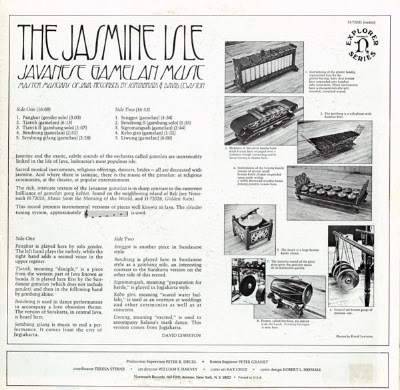
The Jasmine Isle: Javanese Gamelan Music [Nonesuch, 1969] FLAC/320 kbps


A1. Pangkur (Gender Solo) 3:03
A2. Tjatrik (Gamelan) 6:13
A3. Tjatrik II (Gambang Solo) 1:07
A4. Bendrong (Gamelan) 2:51
A5. Sembung Gilang (Gamelan) 2:28

B1. Senggot (Gamelan) 4:34
B2. Bendrong II (Gambang Solo) 1:35
B3. Sigromangsah (Gamelan) 2:44
B4. Kebo Giro (Gamelan) 1:32
B5. Liwung (Gamelan) 6:00

Master Musicians Of Java Recorded By Suryabrata & David Lewiston

'Jasmine and the exotic, subtle sounds of the orchestra called gamelan are inextricably linked in the life of Java, Indonesia's most populous isle. Sacred musical instruments, religious offerings, dancers, brides-all are decorated with jasmine. And where there is jasmine, there is the music of the gamelan: at religious ceremonies, at the theater, at popular entertainment. The rich, intricate texture of the Javanese gamelan is in sharp contrast to the extrovert brilliance of gamelan gong kebjar, found on the neighboring island of Bali. This record presents instrumental versions of pieces well known in Java' ~ liners

When musique lovers talk of Gamelan music, they generally refer to Balinese Gamelan music, some important types of which came from Java to Bali around 14th or 15th century after Islam had taken root in Java. In the Western world, Balinese Gamelan music is more popular and more known than Javanese Gamelan. Although Balinese music has obvious similarities with Javanese, it as well evolved quite differently from it.

The term 'gamelan' is a Javanese word meaning 'orchestra,' referring to the instruments that make up the ensemble. Although we find similar types of music and ensemble all around Southeast Asia, as in Thailand and Cambodia, for example, gamelan music as it is known today is particular to four nearby islands: Java, Madura, Bali, and Lombok.

This is a sublime recording of Javanese gamelan in the 'loud' style [mainly bronze]. This is not to say the pieces are loud: they form exactly the kind of rippling, smoothly flowing sound for which the Javanese gamelan is famous. The complexity is just somewhat less daunting, consisting of the skeleton melodic line carried by the sarons. The bonang, bonang panerus & peking form patterns on top of it, the piece is supported by the gongs & kenong and led by the kendang.'

an olde friend reminded me of this one recently & it's oh so sweet. Javanese Gamelan sorta sounds like the sizzurp slurpin step sister to the Balinese variety. likewise love dem crickets in the background. i decided to have another weekly theme here at der warbler, at least where my posts are concerned. expect several Indonesian treats in thee forthkommen daze.

in extremely rare circumstances, owl upload FLAC fer someone. this thyme it's only cos i goofed & falsely advertised the original post of this mess as 320 when in fact it appears to have been a lowly 192 rip :) who cares rite? anyhu, as much as i despise repeating myself, here goes a mufuggin 320 upgrade. it might even sound better too. the fuccin FLAC is fer fluc-elitist erik, so enjoy it punk

Friday, November 5, 2010

VA ~ Golden Rain - Balinese Gamelan Music, Ketjak: The Ramayana Monkey Chant [Nonesuch, 1969] 320 kbps


Gamelan Gong Kebjar

A1. Gde Purana - Golden Rain [Hudjan Mas] 5:50
A2. I Mario - Bumblebee [Tumililingan] 9:50

Ketjak

B1. Unknown Artists - The Ramayana Monkey Chant 22:08

Orchestra - Gong Kebjar [tracks: A1, A2]
Recorded By - David Lewiston

'Hujan Mas' [Golden Rain] is credited to Gde Purana but was composed in the 1950s or 1960s by either Gde Merdana [?-1965] or I Wayan Gandera [1933-2002]'


recently had a request for some kecak & although i have a few other recordings, this seemed like an obvious front-runner as side B was sampled for Fellini's 'Satyricon' in 71 & again in 1980 by The Pop Group on 'For How Much Longer Do We Tolerate Mass Murder?', et al. anyhu, i haven't seen this around at 320 so here ya go. oh & there's some really fast gamelan kebjar schtuff on the flip. video clip is from baraka circa 92

Saturday, October 9, 2010

Inedit - Gambuh. Balinese Musical Drama


Gambuh. Balinese Musical Drama by the Kedisan Ensemble
(Gambuh. Drame musical balinais par l'ensemble de Kedisan)
Inedit W 260094, recorded 1999, CD released 2000

Gambuh came into being in the 16th century, and it is the ancestor and the basis of all artistic forms which developed in Bali in the following centuries, both in terms of dance and musical accompaniment by gamelan ensembles.

When the Dutch finally managed to colonise Bali at the beginning of the 20th century – they had already dominated the rest of the archipelago for three hundred years – the princely courts began to decline. The 8 Balinese kings were one by one forced to submit to the colonial power and gambuh, due to a lack of patrons, was almost forgotten.

Very fortunately, village communities (banjar) decided to act so that this noble and ancient art form would not be completely lost. Thanks to them, there was a gambuh revival after World War II. Although it had become less accessible to the general public due to the language barrier, the stilted nature of the plot and the dialogue, gambuh, the root form of all of the arts of Bali, was nonetheless revived in some villages.

Little by little, as the village communities took over from the royal courts, gambuh changed its function: it is now performed for temple feasts (odalan) which occur every 210 days according to the Balinese ritual calendar.

Thursday, September 9, 2010

West Java ~ Tembang Sunda - Ida Widawati & L.S. Malati Ida Ensemble - Sundanese Sung Poetry [Inedit]

Originally posted by øשl in the early days of the blog, but track 2 was actually a rip of the entire CD as one track. So here's a proper version:


West-Java [Java-ouest] - Tembang Sunda
Ida Widawati and L.S. Malati Ida Ensemble
Inedit W 260056, recorded 1993, CD released 1994

Tembang sunda is a style of classical vocal music that originated in the Sunda province of highland west Java. Unlike Sundanese gamelan music, tembang sunda was developed in the court during the Dutch colonial period [mid-19th century]. The traditional vocal portion is sung free verse poetry, the instrumental accompaniment being performed on zither and bamboo flute.

øשl's comment [taken from his original post]:
this is one of the best joints i been lucky enough to hear owl year, but then i say that about everything. i knew it was gonna be good, like everything sundanese & classical from west java is, but dam the fidelity is superb. i been sick for a minute now but am convinced this musique brought my fever down dramatically. when the two ladies seen seated above sing in unison, i break out in goosebumps, which is unusual for an owl. hype hype hype. this is a headswirler. i won't attempt to contribute my typically attention deficient $.02 about this particularly poetic musical tradition & instead refer u to the enclosed pdf booklet, lovingly included in this dynomite package.

Sunday, June 20, 2010

Dancers of Bali ~ Gamelan of Peliatan, 1952


1. Overture - Kapi Radja (Melody from North Bali)
2. Angklungan
3. Tumulilingan (Bumblebees sip honey)
4. Baris
5. Gambangan (Ancient Melody)
6. Kebyar
7. Gender Wayang: Angkat-Ankatan (Music for Shadow play)
8. Legong (New York studio recording)
9. Legong [London live]

Recorded originally on September 25, 1952.
Under the direction of Anak Agung Gde Mandara


This is a recording of the music played during the first tour of Balinese musique & dance in the USA in 1952. The show caused a sensation. The group, who had never been out of their remote village of Peliatan, near Ubud, left Indonesia on 21 August 1952. First they went to London, where they were a great success.

In September, they flew on to New York. The Fulton Theatre, Broadway, was sold out for seven straight nights. Everyone courted them. Richard Rodgers, who put on South Pacific with its famous Bali Hai song, came to the show. Ed Sullivan televised parts of the Bumblebee Dance and the Monkey Dance to an audience of 30 million. The American comic actor Joe E. Lewis commented to Ed Sullivan, `I think they were on something.' Then they were off to Boston, Philadelphia, Newark, Washington, Cleveland, Cincinnati, St Louis, Chicago, Las Vegas and Los Angeles.

World Arbiter has reissued the original Columbia Records LP Dancers and Musicians of Bali. The performances were the first modern recordings made of a gamelan orchestra. It is lively, loud and frenetic; 66 minutes 16 seconds digitally restored, originally recorded in September 1952. The 6 minutes' Kebyar composition, which accompanied the Kebyar Duduk dance, is very different from the version used today and therefore historically interesting. dig deeper

Saturday, June 12, 2010

VA ~ Music of Indonesia 20: Indonesian Guitars [Fugwaze]


01. Kemayoran ~ Grup Bamba Puang
02. Stambul Naturil ~ Usman Achmad
03. Terang Bulan (excerpt) ~ Sahilin And Siti Rohmah
04. Ludu Pambuhang ~ Yohanes Terpanjang (Haingu)
05. Sungguh Terpaksa ~ La Podding And La Mamma
06. Los Quin Tallu-tallu ~ Grup Bamba Pung
07. Nasib Mak Kualon ~ Usman Achmad
08. Langgam Di Bawah ~ Sinar Bulan Purnama Orkes Kroncong Mutiara
09. Kolo Kot Matani Band ~ Teleu Nekaf
10. Nasib Muara Kuang ~ Sahilin And Siti Rohmah
11. Ludu Parinna ~ Ataratu
12. Fajar Di Atas Awan ~ Suarasama


Recorded in Indonesia by Philip Yampolsky 1990-97

Guitars are everywhere in Indonesia. Most Indonesian guitars are the standard acoustic instrument: a waisted flat body, a wooden soundboard, a long fretted neck, and six strings. Urban popular music may also use electric rock guitars and Hawaiian guitars. In some rural areas of eastern Indonesia, homemade instruments may be of crude construction, without frets and with only four strings, but if they approximate the size and waisted shape of the standard guitar, we consider them guitars for our purposes. Guitars occur in a small number of genres of Indonesian music, but they are prominent nevertheless, since some of the genres in which they figure-pop, dangdut, kroncong-are known throughout the country. They are used only in entertainment music and what we may call religious popular music. Their most common use is to accompany informal singing of popular songs, church songs in Christian communities, and regional or national folksongs (lagu rakyat). These are taught in school or are generally known, but are not perceived as originating in commercial popular music.essential upgrade, now boastin betta bits n' booklet. resonant

Monday, May 24, 2010

VA - Indonesia: Java - Music of the Theatre [Unesco,1985] recordings from 1968/70


VA - Indonesia: Java - Music Of The Theatre
Auvidis/Unesco
D8078
1985/99

1. Radio Yogyakarta Musicians - Langen Mandra Wanara
[Entertainment On The Song Of The Monkeys] 30:33
  • Leader [Director] - K.R.T. Wasitodipuro
  • Narrator [Dalang] - R.S. Bandjaransari
  • Vocals - Djalal , Draptodihardjo , Pusposworo
  • Vocals [Waranggana] - Nyi Mursinah , Nyi Suratni

2. Pura Mangkunagaran - Langen Driyan
[Entertainment For The Heart] 29:27
  • Chorus Master - Soejati Mintoraras
  • Leader [Director] - Sundoro Mintoeno Widyatmodjo

Recorded in 1968 [traque 1] & 1970 [traque 2]
Includes a 6 page booklet of notes in English & French

these recordings help make the concept of thyme obsolete. most atmospherique & transportational schtuff. thanks again to zwan & his lovely family