Cardboard sleeve [mini LP] reissue from Takeshi Terauchi featuring 24 bit remastering
check the last half of this track :)
'A completely ass-kicking reissue of Japanese guitar maestro Takeshi Terauchi and his band Blue Jeans' 1965 LP Let's Go Eleki-Bushi! For the uninitiated, Terauchi is pretty much Japan's first guitar hero, and the "eleki" style -- a dizzying hybrid of post-Ventures surf guitar mixed with touches of Japanese enka & minyo music and even a bit of flamenco -- was the primarily instrumental precursor to the more rock/pop-oriented Group Sounds movement which would follow the first appearance of the Beatles at Budokan in 1966. The Blue Jeans consisted of three guitarists, a bassist, and two drummers, with the overall sound here reminiscent of a group of jacked-up electric shamisen players throwing down more whammy action than an episode of Press Your Luck. A few of the cuts add the odd vocal chant or the sounds of crying children, and the energy level on display is satisfyingly high throughout. This is the sort of record that plays as a satisfying whole but also serves up plenty of mixtape fodder; put one of these cuts on a mix for someone and you're most likely handing them a copy of the entire record next time you see them. Lock your apartment doors, tune up your air guitar, and start that Secret Apartment Dance Party! Highest recommendation!'' ~ other music
aye reckon that sums it pretty well. ventures-esque surf sounds collide with traditional japanese folk strains, featuring an army of guitars & plenty of woozy organ. some trad vocals even turn up on 'saitaro' [tr: 6]. another playfully exotic reish from king records, 320 er FLACK. evenfurtherstill
Drums – Yo-Chan Guitar, Performer [Dub-hey Guitar Playing Machine], Artwork By – Ootake Performer [Etc.] – EYE Recorded By – OG Hayashi
Recorded at LM [Osaka] November 16-17, 1996 Mastered at Hara Studio April 3, 2006 Artwork made in 1994
i could listen to this beautiful mess fer hours & i spoze i have. shambolic, trance-inducing spurgle n' glorp from a neon nudist colony/commune somewhere in japan, with member[s] of boredoms relentlessly kickin out the unhinged, leftfield, instrumental no wave jams, mufuggers. aged 15 years young, but somehow more fresh n' forward-thinking than anything created tomorrow. wall of skronk skraggle meets ritual, puke-eating, no neck, crash worshipy space spunk. is that an electro-jews-harp i hear? trippertronically defiant of description, 320 heady hymns later, or fuggin FLACK fer the fussy. furthermore
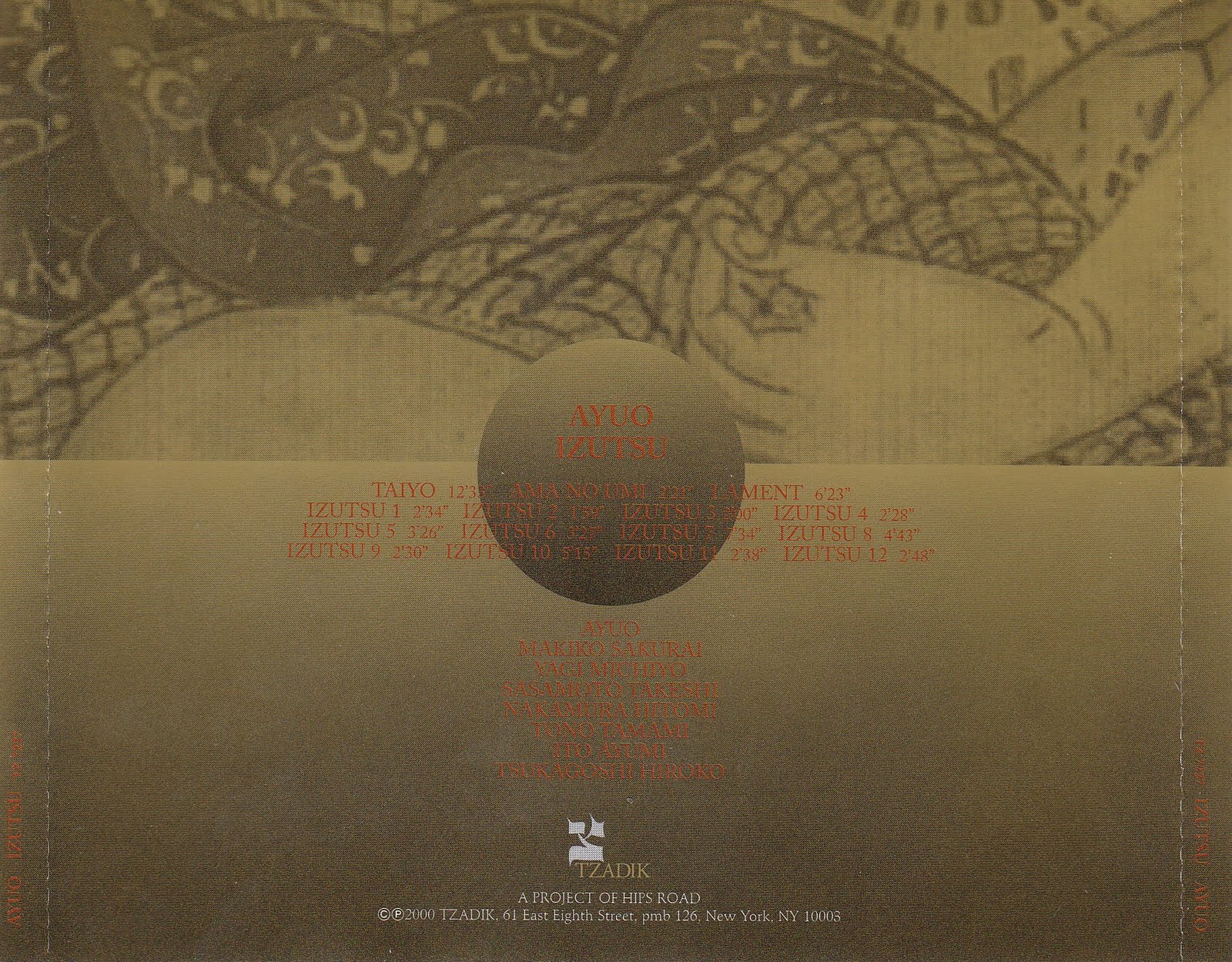
'This work is a type of opera based on the great Noh play Izutsu, written by Zeami in the late 14th century. Ayuo has employed the use of hurdy-gurdy, Celtic harp, something he calls "sitar-guitar," Dharma-vina, and traditional gagaku instruments that come from the royal court music of Japan and Korea. But it is the vocals of Makiko Sakurai that pull these disparate elements into a whole so haunting and beautiful that it feels otherworldly at times. Sakurai hovers and swoops, weeps and cries, and philosophically intones over the proceedings. It doesn't matter that it's in Japanese (there are some translations); the emotions inherent in these pieces are shot through with sincerity and empathy. Each utterance is a vibration against eternal silence while acknowledging its eternal presence. There are places of musical and vocal interplay, such as on the opening chant, which lasts a bit over 12 minutes, or the shimmering, sadly beautiful "Izutsu 4," where double-tracked vocals and a Celtic harp pine to each other in sorrow. It feels more like a prayer than an aria with accompanying chorus, and perhaps it is. Ayuo has written a masterpiece of modern music that, while rooted in a Japan he admits he has never seen but only imagined, is its own country, a territory that unites the mind and the heart in sound, thought, and word. It is absolutely stunning; a classic of new music. [A note to store owners and record buyers: never mind where to classify it, just play it in store and it will sell itself.] ~ AMG
happy holydaze. very engaged in the physical realm but here goes another contempo japanese ensemble featuring diverse instrumentation & lovely melodies; the brilliant tzadik debut from ayuo & his crew. 320 kbps + skans n' such. fanx to the originilluminator
01. 埋葬歌 - Maisōka [Music for Burial] 10:59 02. 印 I - Shirushi I [Sigil I] 1:57 03. 火葬歌 - Kasōka [Music for Cremation] 8:31 04. 印 II - Shirushi II [Sigil II] 2:28 05. 嘆きの川辺 - Nageki no Kawabe [Kokytus] 12:46 06. 印 III - Shirushi III [Sigil III] 2:20 07. 鳥葬歌 - Chōsōka [Music for Aerial Sepulcher] 7:40 08. 印 IV - Shirushi IV [Sigil IV] 2:41 09. 水葬歌 - Suisōka [Music for Burial in Water] 10:38
a special treat this moonlit eve; kindred kosmonaut of the flavourful Play It Again, Max blawg has lovingly bestowed upon our unsuspecting ears, not none, but two Trembling Strain albums! first up comes their achingly beautiful sophomore joint, featuring familiarly funereal death rattles from Pneuma, heard previously on Anthem to Raise the Dead, with additional vocal bliss from some sweet siren. once again T-Strain utilize a great many trad folk instruments from several divergent kultures in an exceptionally haunting way. i believe the theme of this album is the four elements, earthairfirewater. the pitifully pixelated cover art shamelessly scavenged from rym has since been redeemed by an anonymous sympathizer, so you may wish to save the image above fer yer own arkhives. we're still on the prowl for their fourth album Tower to boot, so kindly assist us if you can. 320 heartfelt fanx Again, Max fer the essential hookup. highest imaginable recommendation
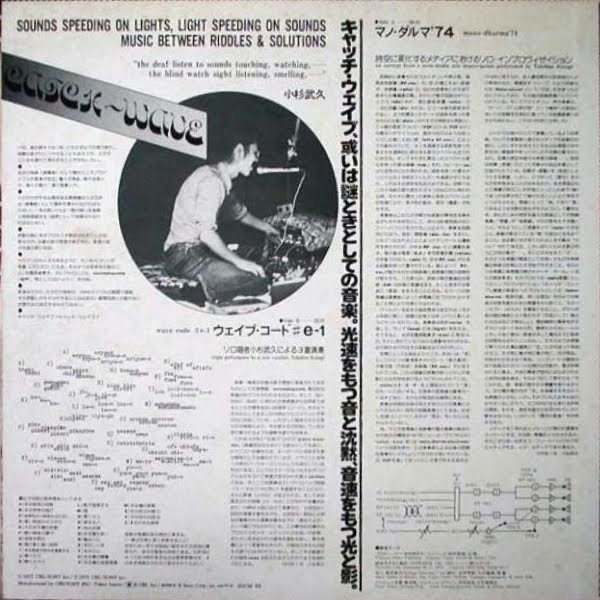
Recorded Date: September 16, 17, 1974. Location: CBS/Sony Studio No. 1.
'I'm really happy to present this artist to the archives because I consider him as one of the greatest in contemporary experimental electronic music. After being in touch with the fluxus movement during his early 60's years, Takehisa Kosugi formed the neo-shamanic pych-freafout droning ensemble Taj Mahall Travellers. Published in 1975 Catch Wave figures among his first solo efforts. The music delivers a rather a similar ectatic musical voyage to Taj Mahall Travellers' esoteric improvisations but in this solo project, Kosugi focuses his interest on voluminous deep electronic textures. Different frequences and electronic tones accompany his ethereal, minimal amplified violin improvisations. The result is astonishing, a sonic poetry, constantly beautiful and beatific. The two epic performances published on Catch Wave represent cosmic- psychedelica at its best. Mano Dharma features magical, intergalactic, supernatural programming strings and buzzing spaced out drones. Put on a high volume and played on a good hi fi sound system, this composition will propulse you in an other galaxy. Wave Code takes back the same schema with the add of cosmic, mad-LSD voices and noises that finally progress into a ritual-like electronic amplified chant. A fantastic, attractive, abstract instrumental listening. Mesmerizing & so recommended. ' Phillipe, Prog Archives
another blawgland upgrade, this one rates rather high around here. something of a forerunner to canti illuminati. congrats if you're just finding out. 320 sounds speeding on lights, light speeding on sounds, music between riddles & solutions
01. Cold Was the Ground 02. Blues Trip #1 03. Blues Trip #2 04. Blues Trip #3 05. Utusimi 06. Holy Letter 07. Ben Ares Blue 08. Blues Trip #4 09. Troll 10. Blues Trip #5 11. Kiev
7" A1. Azrini B1. Harvest
All tracks composed and arranged by L except [1], composed by Blind Willie Johnson L [Hiroyuki Usui] ~ 6-string, 12-string, bottleneck, bass, vibes, drums, assorted percussion, tam-tam, organ, harmonium, didjeridu Taku Sugimoto: electric guitar [9] Masaaki Motoyama: cello [6] Engineered and produced by L
'L is the moniker of Hiroyuki Usui, one-time drummer for Fushitsusha and member of Marble Sheep. Recorded in 1989-90 and subsequently self-released with abysmal distribution, the venire is often serene, but the roiling white-heat psychedelia of Fushitsusha is present but sublimated; electric instruments, when present, vie with harmonium, didjeridu, cello and various assorted percussion, all creating a sonic blend in which every individual sound can be heard with stunning clarity. Even field recordings of muffled voices, waves and thunder – sounds that can easily be buried – are heard as stark backdrops against the silence. When the brew does reach boiling point, as in several of the five pieces called 'Blues Trip,' the tam-tam and kettle drum eruptions are momentary, transient microcosms of emotion which then submerge again into the uneasy calm.' ~ dusted
'Holy Letter is a barely-circulated masterpiece of deeply felt self-expression. Recorded in 1989/1990 by Hiroyuki Usui, Holy Letter beautifully captures the spirit and substance of a half-dozen of the key sub-underground pillars of sound. Working with guitar, vocals, vibes, harmonium, bass, drums, cello, field recordings, digeridoo, and more, Usui-san blends delicate folk, psychedelia, and experimental sounds into a mostly subdued but undeniably glowing suite. The layered but careful instrumentation on tracks like the epic 'Holy Letter' and 'Troll' backs the alternately plain-spoken and crooning vocals perfectly. Odd touches like snatches of throat singing and bowed vibraphone leap out of the mix at just the right time. There are overt references to the blues [the first track is an oblique cover of 'Cold Was The Ground'] - but other than the occassional slide guitar touch, the connection is overwhelmingly in the timeless feeling and atmosphere. I can hardly think of anything else like 'Holy Letter' but suffice to say if you like Richard Youngs, Popol Vuh, Six Organs of Admittance, Tim Buckley, acid-folk, japanese underground - anything like that - this is an essential purchase. Really, I'm not doing it justice.' ~ press hype
4 track superhero 'L' dropped this hazy vision of way out loner folk when i was still listening to honeywell erryday. at some point in the late neindeez, a wisened sage thoughtfully floated me a cassette with this album on one side & the black vial on the flip. still one of the best tapes anyone has ever made a bra. amazing how fresh it still sounds. here goes me 320 rip of the album & a scrounged rip of the accompanying [comparatively mediocre] 7" . oh, vhf re-issued this nugget awhile ago & that version can still be found on the cheap & even has an extra track. moody lo-fi fun
1. Funeral March — 8:19 2. In Dreams, We Are Together (Again I) — 9:06 3. Condlence Alarm — 1:13 4. Nothing Lasts Forever — 7:42 5. Fu-ka — 5:34 6. In Mourning in a Rain — 4:49 7. From the Window of a Pallid Tower — 4:17 8. What the Bird Told Me — 7:41 9. At Marsh — 5:40
'Trembling Strain is the project of musician Pneuma, whose real name according to sources I've read is Satoru Takazawa [apparently, he works in the field of psychiatry by day]. The aptly titled Anthem to Raise the Dead is a captivating work that springs from some deep, unconscious well, weaving within its 54 minutes a world of desolation and dread.
You've heard the old saying 'Less is more.' Nobody knows how to employ that adage as effectively in their arts as the Japanese. One immediately thinks in listening to this of the minimalist sound designs also characteristic of some Japanese horror films—not only the more recently successful Western imports such as The Grudge, but stretching back to older classics like Kwaidan—where percussive cracks, booms, and rattles are metered out to set the listener's hairs perennially on edge.
Yet at the same time throughout this work there is a rooted, ascetic spiritual element, and it wouldn't be too unreasonable to describe the band as an Asian kindred spirit to Popol Vuh. The band combines an array of stringed and percussion instruments [including the Japanese biwa] with vocal and organic sounds to produce elegant canvasses that seem to reach back throughout the centuries and to the departed lives that lived in them. This sense of spirituality gives the album a considerable degree of heart and dimension.
Tracks such as 'Funeral March' and 'From the Window of a Pallid Tower' are the pieces most in keeping with the title, and both make you feel immediately like you've been sealed inside some ancient Japanese crypt. The former piece opens with the heavy thud of a deep drum, then continues with the emergence of a sparse rhythm, the comfortless clang of chimes and wind noises, and zombie-gasps of the dead. The latter is an unsettling dirge with cello and doom-laden vocals, sounding like the Dead Can Dance having a nightmare. 'In Dreams We Are Together' follows the same expanded instrumental structure as 'Funeral March,' though is more melancholic in mood rather than sinister. It features a similar ritualistic beat, but replaces the various other percussions and ambience with a melodic stringed instrument and an androgynous, ghostly vocalist delivering a tormented aria to embrace the listener.
The band also includes several tracks that are amelodic and emphasize purely textural elements, yet are still very much in keeping with the mood of the album. For example, 'Condlence Alarm' [sic] from the title track suite is just that—a shrieking minute's worth of horns wailing to lament the dead. 'In Mourning in Rain' features what sounds like someone dumping a mass of pebbles onto a floor, together with shaker percussion and a female voice humming away tentatively.
On the entirely other end of the spectrum, 'What the Bird Told Me' is one of the most beautiful and accessible pieces on the album. It is also one of the few moments of repose, being a spotless interweaving of dulcimer, harp, and guitar amidst natural water sounds.
This may be a bit too spacious and thinly decorated for some, and if you like lots of notes and formal structure over atmosphere, this might not be for you. However, I find this to be a very potent album from a sadly under-mentioned band. How rare to get these albums, which from the start wholly abandon the surface to go in directly for something deeper, unspoken, and primitive.' ~ Joe McGlinchey
i really dug this band. i wish i still had more of their albums but they were lost in the whirlwind. this is their debut released in 1994, which remains a very potent & evocative expression. some ritual sounding schtuff
The Japanese Koto - Ayako Lister Arc Music EUCD 1195, recorded in London 1990, CD released 1995
1. Maritsuki (Bouncing a Ball) 2. Midare (Disarray) 3. Sarashifu Tegoto 4. Chidori No Kyoku (The Song of the Plover) 5. London No Yoru No Ame [London in a Rainy Night] 6. Kojo No Tsuki Hensokyoku [Moon-Lit Ruined Castle] 7. Furin (Windchime) 8. Keshi No Hana (Puppy Flowers)
01. Tanchame [Tanchame Dance] - Sadao China 02. Tinsagu the Balsamine Flower - Shunzo Tsukiji & Rika Kamimura 03. Kadiku [A Courtship Dance Song] - Sadao China 04. Kajade Fu [A Celebration] - Nakamura Tsukasa, Higa Yasuharu 05. Tima Tu [A Gossip in Tima Village] - Masao Shimabukuro 06. Inside Akata Shrine in Shuri] - Shunzo Tsukiji & Rika Kamimura 07. Atchame Guwa [A Cute Little Walking-Style Dance] - Sadao China 08. Tako Yama [The Tako Pass] - Sadao China 09. Nubui Kuduchi [Journeying up to Kagoshima] - Nakamura Tsukasa, Higa Yasuharu 10. Bujo [A Haughty Tax Officer] - Masao Shimabukuro 11. Shukke'e Bushi [A Love Song] - Masao Shimabukuro 12. Kana-Yo Bushi [My Dear Kane] - Masao Shimabukuro 13. Nishinjo Bushi [At the North Entrance to the Pleasure Quarters] - Sadao China 14. Umi Nu Chinbora [You Playboys!] - Sadao China 15. Nakuni [A Lyrical Song] - Sadao China 16. Toshin Doi (A Chinese Ship Is Coming - Sadao China
'Music Of Japanese People [King Records, Japan] is another series from the seemingly bottomless well that is the King Record catalogue. This series features the musique of King's own country, Japan. Music Of Okinawa includes the ubiquitous Sadao China, master singer and sanshin player along with less well known but equally great performers...' - rootsworld
someone wanted some okinawan musique & this is one of my recent favourites. Sadao China & Masao Shimaburukuro are both 'Living National Treasures' of Japan & i believe they're both vocally accompanied here by Sadao China's prodigés Nenes, a female quartet who fuse traditional & contempo styles. 320 hearts to iheartu