Showing posts with label polyphony. Show all posts

Monday, November 15, 2010

Cameroon ~ Baka Pygmy Music - Musical Atlas v. 21, Unesco Collection [EMI Italy / Odeon, 1977] 320 kbps


3C 064-18265

A1. Music For The Buma Dance (Musique Pour Accompagner La Danse Buma)
A2. Hut Song - Chanson De Hutte
A3. Orycterope & Pangolin (Sung - Fable - Fable Chantee)
A4. Song For Gathering Mushrooms (Chanson Pour La Cueillette Des Champignons)
A5. Song To Atract Game (Chanson Pour Attirer Le Gibier)
A6. Music For The Nganga Dance (Musique Pour Accompagner La Danse Nganga)

B1. Lullaby - Berceuse
B2. The Water Drum - Le Tambour D'eau
B3. The Humming Of The Bees - Le Bourdonnement Des Abeilles
B4. Music For The Buma Dance Musique Pour Accompagner La Danse Buma

Recordings & text by Simha Arom and Patrick Renaud, 1975

Featured here are several superb field recordings by ethnomusicologist Simha Arom, whose documentation of pygmy polyphony continue to be pivotal points of reference for contemporary composers. György Ligeti, whose fascination with 'the other' as a source of musical inspiration stated:

Having never before heard anything quite like it, I listened to it repeatedly & was then, as I still am, deeply impressed by this marvelous polyphonic, polyrhythmic music with its astonishing complexity. For composition, [Arom’s research] opens the door leading to a new way of thinking about polyphony, one which is completely different from the European metric structures, but equally rich, or maybe, even richer than the European tradition.' source

Highly inventive and constantly changing, the vocal polyphony and the polyrhythmic sounds of hands and drums are prodigious achievements which astonish contemporary composers. The art of the Pygmies is fascinating for its ingenuity on all occasions, even when children play in the river and clap their hands rhythmically on the surface of the water.

a superlative snapshot of everyday life in the baka pygmy realm circa 1975. at this stage in my development, i've heard enough pygmy musique to be able to discern what i consider the really remarkable recordings & this one's a bona fide head swirler, friend. i figure if more folks played 'water-drums', fings might start looking up for our species. remerciements à zwan et l'idiot. 320 polyphonic portals to pygmy paradise

Friday, November 12, 2010

Jacky Micaelli - Corsica Sacra: Sacred Songs of Corsica [Auvidis]


Corsica Sacra - Sacred songs of Corsica
Auvidis B 6842, released 1996

Jacky Micaelli, voix haute et solo
Jean-Étienne Langianni, voix basse
Marie-Ange Geronimi, voix haute

These traditional songs are hauntingly sorrowful, like the Lament for Jesus from Easter week, or searing celebrations, like the Sanctus from the mass for the dead, or the evocative Corsican national anthem Dio Vi Salvi Regina to the glory of the Virgin Mary.

Sunday, October 10, 2010

Corsican polyphony - Sacred songs: Nebbiu - Tempvs Fvgit


Corsican polyphony - Sacred songs: Nebbiu
(Corse - Chants sacrés Nebbiu)
Tempvs Fvgit (Tempus Fugit)
Long Distance 0460103 / Harmonia Mundi distribution
Recorded 2002, CD released 2003

Tempus Fugit caused a sensation at the 2002 Calvi Festival of Polyphonic Music. The group was singled out not only for its unusual vocal technique, but also for its innovative repertoire from the Nebbiu region of Corsica, the result of research by the ethno-musicologist Corinne Bartolini, with harmonizations by Antoine Tramini. This new CD includes prayers for Holy Week, a 16th century Genoese processional song and the Vultum Tuum Mass, a Roman office from the very earliest times with a slight Byzantine touch, conceived as a depiction of the Virgin's face in sound.

01. Veni sancte spiritus
02. L'orme sanguine
03. Suda sangue
04. Perdono
05. Stabat Mater
06. Miserere
07. Velum Templi
08. Vexilla Regis
09. Christus vincit
10. Alleluia no nobis
11. Messe Vultum tuum - Introitu
12. Messe Vultum tuum - Kyrie
13. Messe Vultum tuum - Agnus De
14. Miserere

Friday, August 27, 2010

Vocal Polyphonies of Taiwan Aborigines [Inedit]


Vocal Polyphonies of Taiwan Aborigines - Ami, Bunun, Paiwan, Rukai
(Polyphonies vocales des aborigènes de Taïwan -
Ami, Bunun, Païwan, Rukaï)
Inedit W 260011, recorded 1988, CD released 2000

Sunday, July 4, 2010

Chants de l'oreé de la forêt ~ Polyphonies des Pygmées Efe


Songs from the edge of the forest ~ Efe Pygmies Polyphony
Fonti Musicali FMD185, 1990

1 Deux chants d'initiation des garçons ~ two boys' initiation song
2 Luma [ensemble de sifflets]
3 Chant avant la collecte du miel ~ song before honey gathering
4 Chant de collecte du miel ~ honey gathering song
5 Bou [arc à bouche] ~ mouth bow
6 Chant de chasse à l'éléphant ~ elephant hunting song
7 Chants d'initiation des jeunes filles ~ the young girls' initiation songs
8 Danse pendant l'initiation des jeunes filles ~ dance during young girls' initiation
9 Musiques du rituel de Tore ~ musique for the ritual of tore
10 Duo de likembe ~ duet of likembe
11 Chant et likembe ~ song & likembe

Enregistrê par Didier Demolin dans l'Ituri en 1987
Field Recordings by Didier Demolin in Ituri, 1987


one of the most consistently rewarding collections of vibrant pygmy song. these guys have been popping up owl over the place in recent daze. bi-lingual booklet lovingly included. 320 αγκαλιές to dear brother Janas

Friday, June 18, 2010

Laver Bariu ~ Songs from the City of Roses [Globe Style]


01. Vitori May Your Mother Be Blessed
02. I'll Love You as Long as I Live
03. I'll Take a Gun and Go Hunting
04. Pogonishte Permetare
05. Little Leaf
06. Our Bride in the Dance
07. Lokum With Sugar
08. Dance of Tirana
09. Oh Dear, Bad Raki
10. Old Women's Dance
11. The Many Petalled Rose/O Basil
12. The Permet Bagpipe
13. Emigration Song-Weep, Maro
14. The Face Smiles


Usta Laver Bariu : clarinet, voice, leader
Lefter Nurka : accordion, voice
Ifran Ponoçi : llaute, voice
Ilir Durralliu : second clarinet, voice
Alban Zeqiri : def, voice
Drini Kanani : singer (male)
Evgjeni Culli : singer (female)

Rec. in Përmet, Albania
16 & 17 April 1994
Laver Bariu is arguably the best known Albanian clarinetist of the last half century and an important figure in the development of urban folk music in the south-eastern Albanian region of Toskëria. Born in the southern town of Përmet, Laver was exposed to Përmeti folk music traditions from a young age via his father Bari Nurka, a well known local singer and llautë player. As a youngster he resorted to making his own instruments from any handy materials that he could find and his keenness and passion for music did not go unnoticed by his father. In 1935 the family moved to the eastern town of Korçë, at that time a vibrant and important centre of Tosk Albanian music and culture. Here he mingled with a far wider selection of singers and musicians and gained his first experience of playing in different groups and ensembles.

By the time his family returned to Përmet in 1944, Laver was ready to begin a full-time career as a musician and band leader. He played llautë with Vangjel Leskoviku's ensemble for a year or so before forming his own ensemble. Despite inevitable changes in personnel this ensemble remained active for the next six decades. Along with the Lela Family, Laver Bariu was largely responsible for promoting the Përmet style of urban folk music to the point where it has almost come to symbolise Tosk folk music in general.

He has been recorded several times by Radio Tirana and has also appeared on Albanian television. Foreign engagements were understandably restricted but following the collapse of Communism Laver Bariu was able to record a couple of CDs for labels based outside of Albania, one of which - Songs From the City of Roses - was widely available in the West, having been recorded in Përmet by Ben Mandelson in 1994.

There are two central points for this recording, each inseparable yet distinct. One is the instrumental music, which has echoes of the Balkans, Greece, southern Italy, and the Middle East. This is the music of clarinetist Laver Bariu and his ensemble of accordion, reeds, and percussion. The second element is the singing, a true polyphonic style, with multiple singers moving freely and apart above a single droning voice. The combination is quite unique, with instruments and voices improvising and mimicking one another, creating complex and rich sounds. There are moments where the drone of the accordion and the wail of the clarinet create a soaring, modern sound, only to be pulled down to rich earthiness by the voices. Recorded by the Globestyle team in 1994, these live-to-digital recordings are wonderful documents of a remarkable musique. Laver Bariu was appointed an 'Artist of Merit' in 1979.


320 thx to espilos

Albanie: Polyphonies Vocales et Instrumentales ~ recordings by Bernard Lortat-Jacobs & Beniamin Kruta, 1983-88


C.N.R.S.-Musée de l'homme, LDX 274897
LE CHANT DU MONDE, 1988
Enregistrement Bernard Lortat-Jacob en collaboration avec Beniamen Kruta 1983-1988

01 What Have Ianina's Eyes Seen ~ Albanian Men's group from Vlorë
02 Legend Of The Walled-In Woman ~ Albanian Men's group from Vlorë
03 At The Peshkëpi Pass ~ Men's Choir from Tepelene
04 Song for Odriçan ~ Men's Choir from Tosk
05 For Freedom And The Flag ~ Men's Choir from Tosk
06 By The Riverside ~ Men's choir from Tosk
07 May You Live As Long As This Earth ~ Choir from Gjirokaster
08 Konofat's Song ~ Women's Choir from Permet
09 Song Of Emigration ~ Women's Choir from Permet
10 Kaba ~ Gypsy musicians from Tosk
11 Kaba preceding a dance ~ Gypsy musicians from Tosk
12 Carter Leading The Caravan ~ Women's Choir from Permet


'Until very recent times the folk music of Albania has remained, even to the specialists, more obscure than the songs of the Eskimos or the highlanders of New Guinea" (Lloyd 1968). So wrote British folklorist A. L. Lloyd in 1968. Twenty years later, scholars outside Albania know little more about that country's music as there continues to be a scarcity of both recordings and writings in languages other than Albanian. The release on the Chant du Monde label of a compilation devoted entirely to music from southern Albania should therefore attract considerable interest among ethnomusicologists. This is the first scholarly release of vocal music from Albania to be issued since Lloyd's recording on Topic (1966). It includes ten examples of polyphonic singing, as well as two instrumental improvisations, all recorded with excellent clarity and balance by Bernard Lortat-Jacob and colleagues from the Centre National de la Recherche Scientifique and the Ministere des Relations Extkrieures of France. All performers had participated in 1983 in the National Folkloric Festival in the city of Gjirokaster and so may be assumed to be among the most highly regarded singers and instrumentalists within their districts. Their highly polished, often spectacular renditions represent something close to an ideal for the styles of their respective areas. Albanians distinguish two major subdivisions among themselves: Ghegs in the north of the country, Tosks in the south. While most Gheg music is monophonic, the singing and instrumental music of Tosk communities is in a variety of polyphonic styles. This release focuses specifically on Tosk polyphony, presenting songs in two out of three of the major regional styles. One of these, known as the 'Lab' style [Nos. 1, 2, 3, and 7], is found in the districts of Vlore, Tepelene, Gjirokaster, and Sarande, and it generally features two to three soloists plus a syllabic drone sung by a group. Songs are homophonic in texture and closely resemble those of Greeks from the Pogoni district of Epirus. In contrast, the 'Tosk' style [Nos. 4, 5, 6, 8, 9, and 10] features two soloists whose lines overlap and interweave above a choral drone sung to a vowel sound. This style is found in the region extending north of the Lab region to the river Shkumbin, as well as among Tosks.

Yugoslavia, and is shared with some Slavic and AromAn communities in the same region.' The two instrumental selections [Nos. 11 and 12] are also from the 'Tosk' region. They are both of the genre kaba,a type of nonmetric improvisation paralleling the Epirut Greek 'miroloi' that is performed most often by Gypsy musicians. Lamentably the three women's songs are all from the same area within the 'Tosk' region, and they are in much the same style. The disc therefore provides a much better introduction to the range of men's singing styles in southern Albania than of women's' ~
Ethnomusicology: Journal of the Society for Ethnomusicology no. 34 ed. 3 pg. 488

Thursday, May 27, 2010

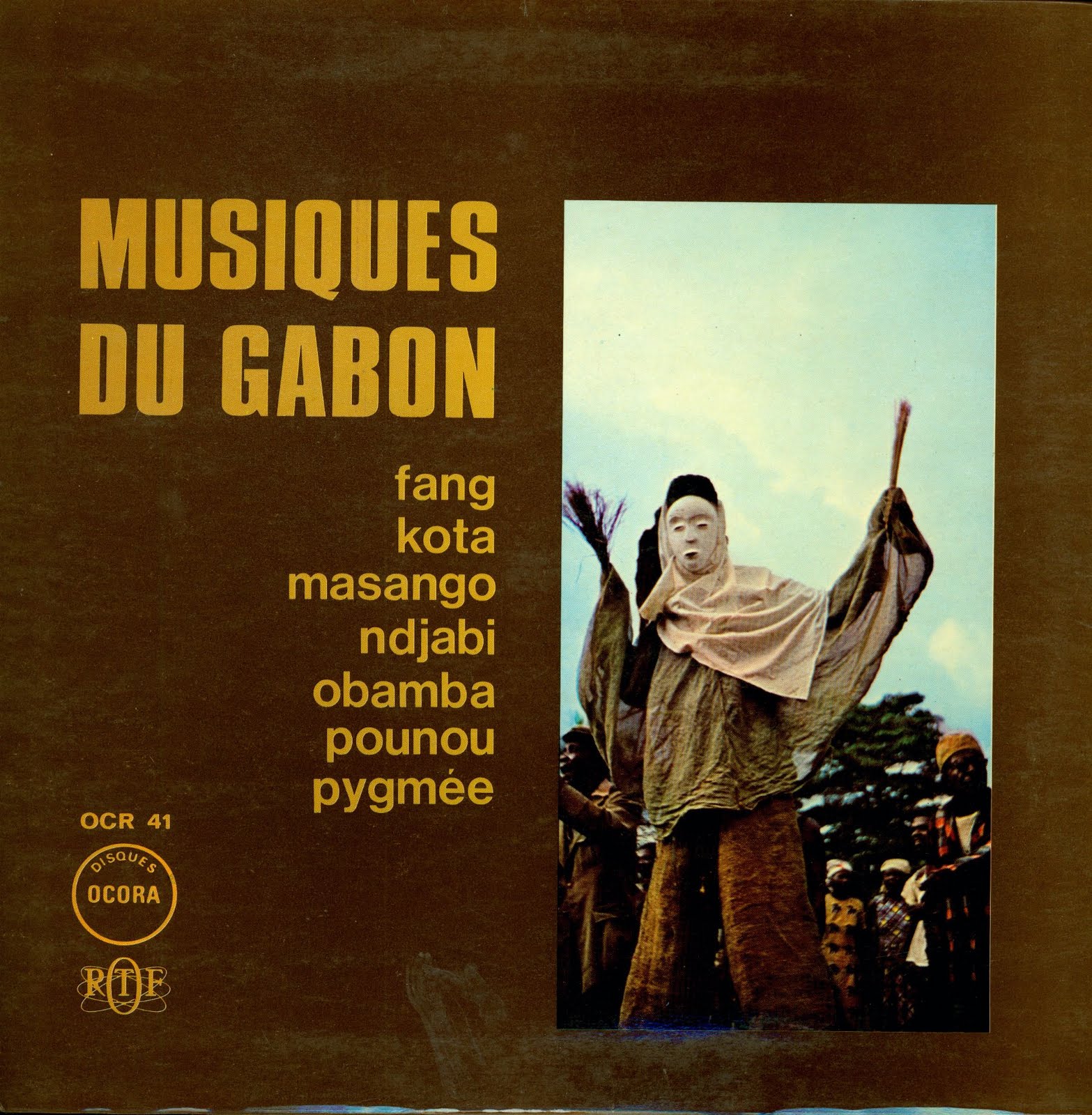
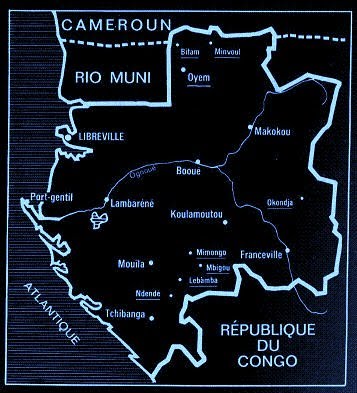
Musiques du Gabon LP [Ocora 41] field recordings by Michel Vuylsteke in 1967


Face A
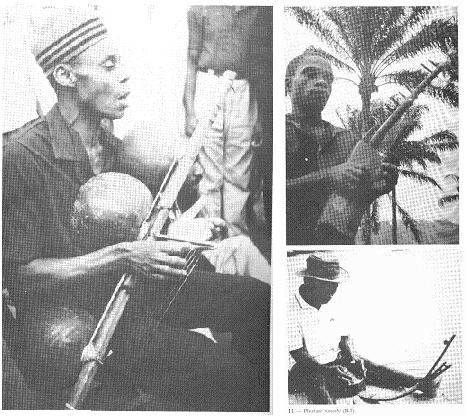
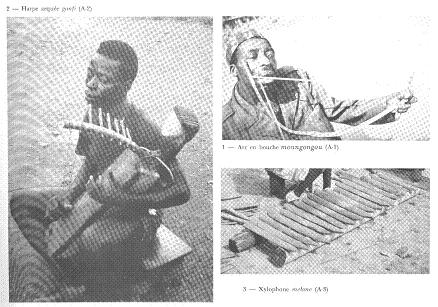
01 Massango ~ bwiti moungongo [mouth-bow] workout by Celestin Mondjo
02 Massango ~ bwiti funereal dirge ft. gonfi [curved harp], polyphony & bottles
03 Xylophone ~ melane [xylophone] orchestra
04 Fang ~ melane orch. w/ girl choir shaking metal nias [rattles]
05 Fang ~ epique song w/ mvet [harp zither] & choral accompaniment
Face B
06 Obamba ~ walking song w/ hand claps!!!! yes!!!
07 Ndjabi ~ male group songs tracing movements of masked genie on stilts
08 Pounou ~ epique song featuring bsambi [blow-lute] & antiphonique chorus
09 Kota ~ Obanga rites w/ eba [antelope horn] & massokwe [vegetable husk anklets]
10 Pigmee ~ pygmy song accom. by gonfi [curved harp] for bwiti dance
11 Pigmee ~ female polyphonique pygmy yodelling for kosse dance


the Bwiti & Obanga are both secret societies of Gabon & the associated songs they sing & play for their various festivals, rites & even seemingly humdrum activities are utterly mindblowing. another consistently superb ocora. thanks & praise to op