nuttin new bout the presence of this sinistral slice o' cosmic italo baroque prawg to the greater bog o' sphere, save fer the fact that my rip of the thang reigns supreme
A1 Introduction 4:30 A2 La Mort D'Orion 8:20 A3 Où L'Horizon Prend Fin 1:55 A4 Salomon L'Hermite 5:45 A5 Final 3:15
B1 Vivent Les Hommes 7:35 B2 Enchaînement 1:15 B3 Ils 3:40 B4 Paradis Terrestre 5:25 B5 Elégie Funèbre 4:00
Lyrics By, Music By, Arranged By [Orchestrations] - Gérard Manset Voice [Avec Les Voix De] - Anne Vanderlove , Giani Esposito
'Gérard Manset's 3rd album, 'La Mort d'Orion' might best be described as a modern rock symphony, featuring extremely sophisticated arrangements and some wonderfully rousing string crescendos. Released in 1970, 'La Mort d’Orion' proved to be both a critical and commercial triumph. Indeed Manset’s album went on to sell over 20,000 copies [a remarkable feat for such a strange and innovative album] & French critics showered it with rave reviews.' ~ ???
super weird & disorienting orchestral french psych opera recorded in 1969. great for cosmic death trips & astrologically unsound funeral parties. occasionally reminiscent of like wtf gainsbourg or jacques brel on brown acid. originally dropped by mutant sounds, this is a superior sounding 320 upgrade ripped from the original vinyl by radiooloron. merci
'The album is made up of just 4 pieces. One sidelong and three that are around 5 minutes. The sidelong opener "Sequenze E Frequenze" features plenty of Battiato's signature VCS3 & vocals. At first it sounds like it might fit perfectly on either of the previous two albums, until this drops away and a single thump of percussion becomes a static backdrop for walls of beautiful pulsating feedback, twinkling piano & synth washes. Definitely more abstract than his previous work, it lacks none of the creativity, grace and attention to minute detail that makes his compositions so enthralling. The shorter tracks are also great. 'Aries' has some fantastic horn playing and 'Aria Di Rivoluzione' is a classic. Battiato delivers an impassioned vocal performance over a ponderous, spacey rhythm with more great horn work.'
'All in all, the album has a very 'holy' feel to it, a spiritual feel. It's like an ancient archeological find, a piece of art that is soothing and unsettling. It's about texture, ambiance, and mood....it is not about rock and roll songs. A masterpiece in my humble opinion.' ~ source
polycarb remaster of me favourite battiato joint, ripped at a robust 320. the other one owlready lives here. the mood on this album is spacier, slightly more mellow & maybe even spiritual? the man has a lovely singing voice & aint shy about using it effectively. even the occasional saxophone sounds good in this context. i have no insightful words, this record should prolly just be experienced. initially heard it on a sunday morning, coming down
'This very interesting recording of experimental/avant-garde/prog released by Franco Battiato in 1973, is one of two proggish albums he made in the early 1970's [the other being Fetus, 1972]. Given the complexity of this music, it is inconceivable that Battiato could have ever been a pop star, yet he was before 1972. He pretty much threw the pop approach out the window for this recording however, which consists largely of experimental passages on synthesizers including the VCS 2 [this is a new one for me] and the VCS 3, in addition to a tiny bit of pipe organ on Il silenzio del rumore. With regard to synthesizers, every band member with the single exception of the drummer plays one form of the VCS or the other. Furthermore, even though the VCS3 was used more as a sound generator than a melodic instrument, the tones employed are smooth, lush & clean. The pieces on the album are arranged such that tracks 1-4 form a suite of sorts that starts with a recording of classical music [it sounds like a waltz] over which Battiato provides spoken word passages in Italian [spoken word passages also close the suite]. The four pieces alternate heavily rocking sections of drums/bass/guitar, with experimental passages played on synths. Plancton starts of with some spacey sounds on the VCS3 and then gradually, acoustic guitar is incorporated along with some gloomy vocal parts. The closing segment of Plancton is heavily influenced by Italian folk music albeit with the added twist of odd sounds generated on the VCS3 [notice a pattern here?]. The title track Pollution provides more of the same, and at 8'48" is the longest piece on the album. The closing track is a personal favorite and just consists of heavily echoed/delayed, very sad and gothic sounding classically influenced synth lines [it almost sounds like a choir but not quite], on top of which Battiato half sings/half weeps his way through the piece [which ultimately gives way to his completely breaking down in fits of sobbing]. Highly recommended to all fans of Italian prog and experimental rock.' ~ jeff park
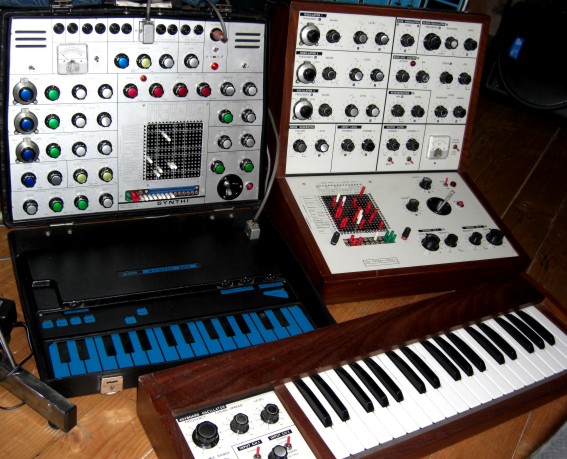
one of my favourite albums from this genuis of Italo psychedelique analog prog. if you thought the ems vcs3 or 'putney' was only capable of Hawkwind & Pink Floyd style signal processing, gleeps & gloops, hear they shine in owl their harmonically capable glory. happy & honoured to bring the definitive320version of this monster to the greater interwebs. give a hute, don't pollute :)