Showing posts with label rumania. Show all posts

Wednesday, September 29, 2010

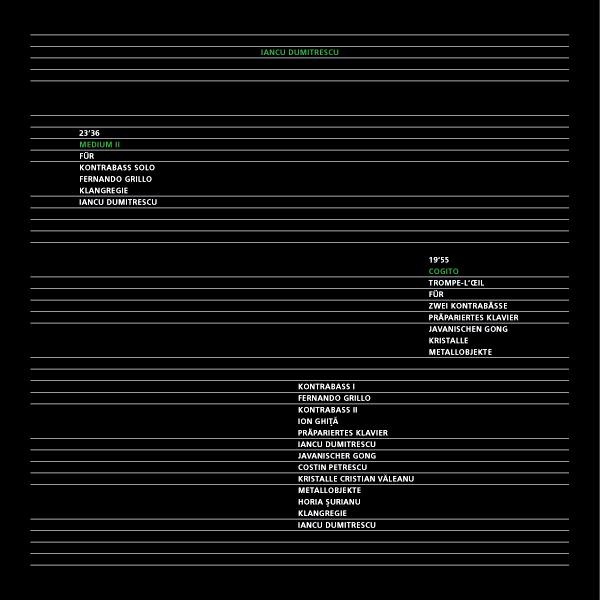
Iancu Dumitrescu ~ Medium II / Cogito [Edition RZ, 1987]


A - Medium II [23:38]
B- Cogito, Trompe L'Oeil [19:57]

Leader, Prepared Piano, Composed By - Iancu Dumitrescu
Double Bass - Fernando Grillo
Double Bass - Ion Ghiţă
Gong [Javanese] - Costin Petrescu
Crystal - Cristian Văleanu
Metal Objects - Horia Şurianu

first released in 1981

Medium II composed 1978-1979 for double-bass solo.
Cogito composed 1981 for two double basses, prepared piano, Javanese gong, crystals & metal objects.

'The music of Iancu Dumitrescu explores the ultimate sense of sound, guiding the listener through new spheres of sonic adventure, a kind of cryptical music. Based on the idea of 'acousmatic', a socratic term meaning the intimate exploration of sonic phenomenon, his musique takes its formal models from the very structure of sound with a perfect relationship between micro & macro-structure. This phenomenological approach to the act of composing implies at the same time a very good confidence in the intuitive dimension of discovery. The young generation of Romanian composers headed by Iancu Dumitrescu have a unique position through their development of the spectral sound musique, using almost only acoustical instruments. Dumitrescu & his colleague Horatio Radulescu have awakened new attention to this hitherto unknown Romanian musique.' ~ liner notes

'In Medium II, the sounds produced by the double bass explore the edge between tones and noise, and yet an everpresent tonal center is provided by the notes produced by the open strings, giving the excursions into higher tones something of the feel of a raga. The rhythms of the piece remind me at times of the breathing of some great beast or of the surge of the ocean through a tidal cave. The addition of more instruments in Cogito introduces further tonal centers and still more timbral complexity, with considerably more sound energy in higher registers.

Dumitrescu describes Medium II as the hidden, mysterious reverse of Cogito, and suggests that the two works could even be played simultaneously. If you have the right media-playing software, you may be able to arrange such a performance for yourself. Personally, I tremble at the thought.' ~ avant garde project

in preparation fer halloween, here goes some spooky spectral moves. these pieces are very similar to those found here, but more effective in this capacity methinks. no owl is an island. 320 thanks to someone. further

Tuesday, August 31, 2010

Romania ~ The Real Tradition of Transylvania [Ocora, 1979]


Ocora - Romania. The real tradition of Transylvania
[Roumanie - La Vraie Tradition de Transylvanie]
Ocora C 559070, recorded 1974-79, CD released 1989

A survey of the musical folklore of Transylvania, presenting flutes and double flutes, bagpipes, songs and violins.
A pioneering disc when it was first made in the 1970s as it highlights real peasant music from Maramures and Transylvania when sanitised folklore was prevalent. It features some excellent ensembles, bagpipes and a violin with a horn, and from Maramures there's a track from Gheorghe Covaci, the son of a fiddler Bartók recorded in 1913.

Thursday, July 1, 2010

Toni Iordache ~ Sounds of a Bygone Age vol. 4 [Asphalt Tango]


01. Variatiuni pe tema "Foaie verde si-o craita"
02. Grea mi-e doamne, inima [Gabi Lunca vox]
03. Sirba de la medgidia
04. Cantec de ascultare si breaza
05. Intr-o joi de dimineata [Romica Puceano vox]
06. Balada haiduceasca
07. Ca la breaza
08. Omul bun n-are noroc [Gabi Lunca vox]
09. Cantec de masa
10. As munci la plug si la coasa [Romica Puceanu vox]
11. Cantec de ascultare al lui stoican batrinul
12. Geamparale de la babadag
13. Tinerete,tinerete [Romica Puceanu vox]
14. Doina transilvania


Toni Iordache [December 17, 1942 – February 1988] was a Romani-Romanian lăutar and one of the most famous cimbalom [Romanian: ţambal] players in the world & was nicknamed the Paganini of the cimbalom.

Toni was born in the Bâldana village, near Bucharest, and began learning the instrument when he was four from his father. Some years later his family would move to Bucharest in the Herăstrău neighborhood, where many famous lăutari lived. There, Toni continued to learn from Mitică Ciuciu, who was a famous cimbalom player in his days.

At 12, he was employed at the National Radio Orchestra of Popular Music, through contest. Later, he would become a member of the Ciocârlia National Ensemble, the primary popular ensemble in the country. With the Ciocârlia Ensemble, Toni Iordache would tour the world: many European countries, the USA and also Asian countries. In between tours, he would play at weddings, being the most sought after lăutar of his days. Often, after landing at the airport he would drove directly to a wedding where the other musicians were waiting for him.

Among others, he played with Ion Petre Stoican, Romica Puceanu, Gabi Luncă, Ion Onoriu, Ionică Minune and also with the well-known pan flute (nai) player Gheorghe Zamfir.

Toni Iordache remained known among aficionados especially for his work as a lăutar. His solos were very complex, but also clear and beautiful and his improvisations were full of imagination. He was not only a very virtuoso player [he was measured in Paris to be able to play 25 notes per second], but also a very sophisticated one, with a high emphasis on touché, playing the slow pieces with great sensibility. He was able to play two melodic lines simultaneous at high tempos and knew how to use the full capacities of the cimbal. r.i.p. Toni Iordache 1942-1988


a wicked ţambal collection featuring several vocal cameos from Romica Puceanu & Gabi Luncă. 256 tanx to the og uploada

Saturday, May 29, 2010

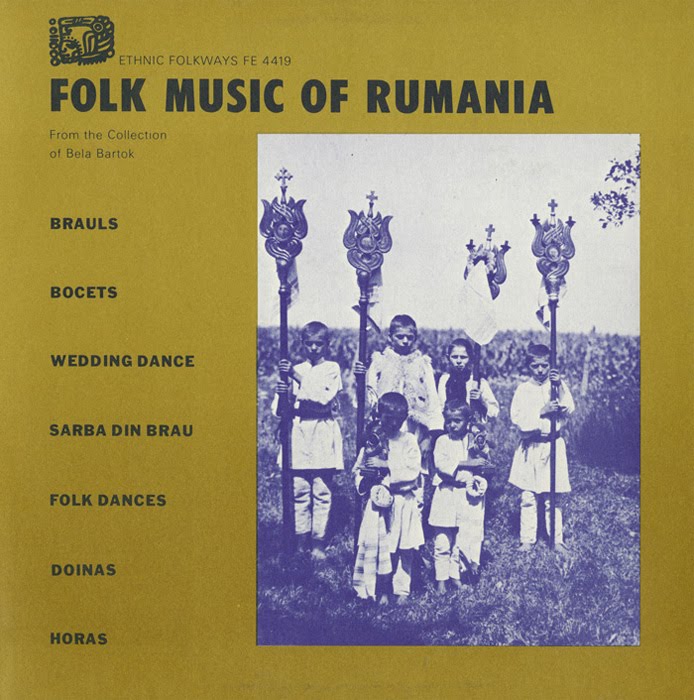
VA - Folk Music of Rumania: Bela Bartok Collection LP [Folkways, 1951]


VA - Folk Music of Rumania
From the collection of Bela Bartok
Ethnic Folkways [FW 4419, 1951]

01 Folk Dance in Hora Style (Orchestra) - Untraced
02 Folk Dance in Hora Style (Orchestra) - Untraced
03 Love Song; Doina - Untraced
04 Tragic Romance; Doina - Untraced
05 Lament for Dead Mother; Bocet - Untraced
06 Lament for Dead Husband; Bocet - Safra Bion Racu
07 Braul; Sarba Din Brau; Village Folk Dance (Orchestra) - Untraced
08 Wedding Dance - Untraced
09 Braul - Ion Papuc
10 Lament for Dead Husband; Bocet - Untraced
11 Lament for Dead Brother; Bocet - Untraced
12 Hora; Girl's Song - Untraced
13 Lament for the Dead; Bocet - Leontina Niga and Triganuca Nemciu

the romanian national dance is the hora. it is a circular dance with many varieties & 1, 546 known names. the musicains play in the middle of a circle & the dancers sing the verses repeatedly. the dance has become symbolic of national brotherhood & unity.

an important place in rumanian folk music is held by the laments for the dead, the designation for which is boget. the women who are called to the funerals to bewail the dead are called bogitorre. relatives sometimes sing the lament but there are professional wailers who possess a rich repertory of laments. mostly they're sung sans acompaniment but sometimes the voice is supported by a counterpoint flute.

the professional musician who for centuries has stored & continues to store the treasure of romanian folk music is the laotar or folk violinist who is also his own vocalist. a group of lauotars forms a taraf. these musicians are not to be confused with gypsy fiddlers & although a great them are gypsies. the musique they play is rumanian folk music. the word lauotar is derived from lauta meaning lute. their musicianship is highly developed & the best of these performers are true artists in their field.

the laoutar loves, plays & preserves with deep devotion the folk music of rumania. it was he who gave the collectors of folk music most of the material which enabled composers & musicologists to study this vast treasure of songs & dances which became the foundation of the work of practically every rumanian composer from the middle of the 18th century to this day.

i heard about these recordings many moons before i finally laid me ears on em. very fortunate i did. awesome fiddlin, pipin wedding songs, lovelorn ballads & mournful laments for the dead; can't go wrong. liner notes lovingly enclosed. daps to lemmy caution