Showing posts with label hindustani classical vocal. Show all posts

Monday, January 24, 2011

Pandit Bhimsen Joshi ~ Rest In Infinity


February 4, 1922 - January 24, 2011

Obituary


along with cap'n beefheart who we lost earlier this month, bhimsen joshi was the most highly venerated contemporary vocalist in this treehaus. he had often been quoted as saying that he was only truly happy whilst singing, & earlier today, he finally departed this mortal coil for the eternal land of song. indeed, our own previous drops displaying joshi's vocal prowess come highly recommended & please don't miss the unprecedented tribute poppin off at Anthems for the Nation of Luobaniya • 罗巴尼亚国歌 from whence you may mainline several of his impossibly rare vinyl joints. further still

Sunday, October 31, 2010

Zia Fariduddin Dagar ~ Le Chant Dhrupad [Espérance, 1985]


Inde Vol. 15 [ESP 8413]

A. Raga Bhimpalasi - Alap, Jor [I]
B. Raga Bhimpalasi - Jor [II], Jhala, Bandish [Chautal]

'Zia Fariduddin Dagar is an Indian classical vocalist in the Dhrupad tradition, the oldest existing form of north Indian classical music & part of the Dagar dynasty of musicians. He was born in Udaipur, Rajasthan in India on 15 June 1932, where his father, the great Ustad Ziauddin Khansahib was the court musician of Maharana Bhupal Singh of Udaipur. He was taught dhrupad vocal & vina by his father. After his father’s demise, he continued learning under his elder brother, Late Ustad Z M Dagar, the foremost rudra vina player of 20th century. He taught at the Dhrupad Kendra, Bhopal, along with his elder brother, Ustad Zia Mohiuddin Dagar for 25 years.

Ustad Zia Fariduddin Dagar represents the 19th generation of the musical tradition of the Dagar family that is believed to have preserved and nurtured Dhrupad for 20 generations. He has done much for popularizing dhrupad music by his numerous concerts and workshops & performed widely in India and abroad, receiving the Tansen Samman from the Madhya Pradesh government & for Hindustani Music-Vocal, the 1994 Sangeet Natak Akademi Award. In 2005, he was presented with the Lifetime Achievement Award by the North American Dhrupad Association.


He has a remarkable command over microtones [swara-bheda] and various gamakas, and is noted for his gradual development of alap through vilambit, madhya and drut laya (slow, medium and fast tempo). He is probably the only person alive to be able to demonstrate all the five geetis mentioned in the Sangita Ratnakara namely, Shuddha, Bhinna, Gaudi, Sadharani(which is dagarwani of today) & Vegasura(which is popular in south India). He is the most influential dhrupad vocalist in India after the senior Dagar Brothers [Ustads N. Moinuddin & N. Aminuddin Dagar]

Nowadays, he stays & teaches at the Dhrupad Gurukul near Panvel, which was built by his elder brother Ustad Z. M. Dagar. He continues to perform widely in India and abroad. His students include the acclaimed Ritwik Sanyal, Pt.Pushparaj Koshti, Pt.Nirmalya Dey, Gundecha Brothers, Pt.Uday Bhawalkar & his nephew Baha'ud'din Mohiuddin Dagar.' ~ wiki

totally noodle-baking rendition of rag bhimpalasi from this stalwart of dhrupad on the superb Disques Espérance imprint out of France. i can't comprehend why so many folks' interest in hindustani vocal musique begins & ends with Pandit Pran Nath, when the rabbit-hole goes sooo much deeper. if you suffer similarly from this myopia, i highly recommend you try the links in the text of this post & this one too. the fidelity is fantastique. highest imaginable recomendation. 320 heartfelt धन्यवाद to dmatlb ji

Sunday, September 26, 2010

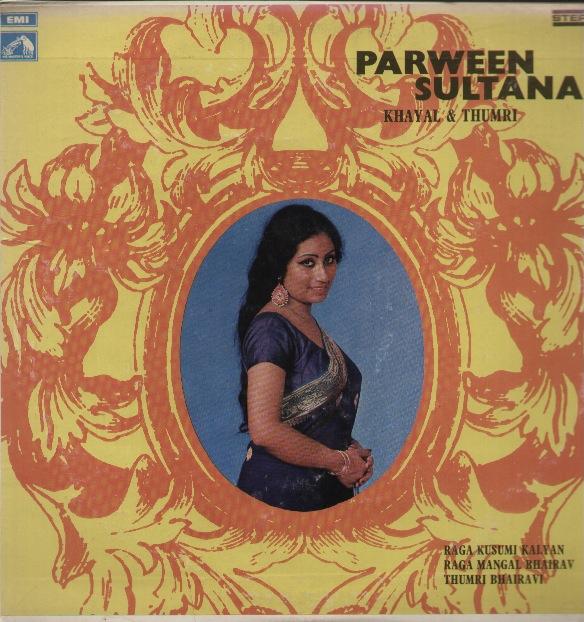
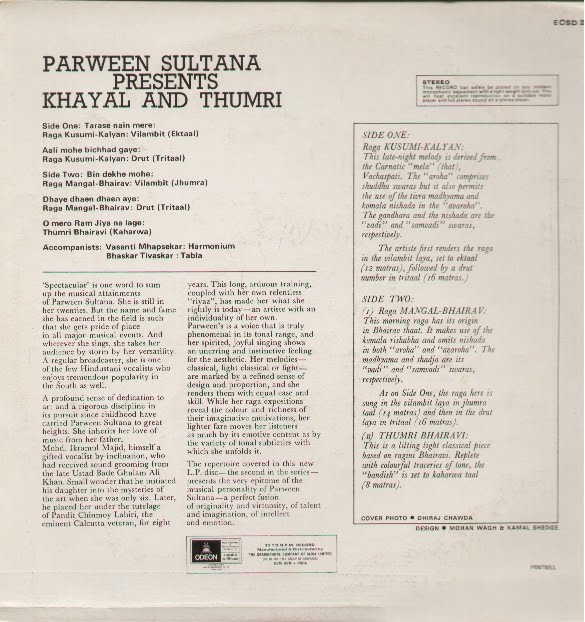
Parween Sultana ~ Khayal & Thumri [Odeon, 1973]


a1. raga kusumi kalyan
b1. raga mangal bhairav
b2. thumri bhairavie


Parveen [or Parween] Sultana [born 1950] is a Assamese Hindustani classical singer of the Patiala Gharana. She is among the foremost classical vocalists in India and is known as Queen of Classical Vocal. Her father, the late Ikramul Mazid was her first guru and he was very strict with her. She later went to Kolkata to learn to learn music under the guidance of the late Pandit Chinmoy Lahiri & from 1973, became a disciple of Ustad Dilshad Khan of the Patiala Gharana. With him, she acquired a new dimension to her singing, giving it the required mastery of ragas & voice culture. She was conferred the Padmashree in 1976. She is the youngest ever recipient of this award.

a rare & early microgroover from this child prodigy who made her first professional recording when she was only 15 & blossomed into the ultimate soprano in contempo icm. another 320 rip for the few folks who actually dig hindustani classical vocal. yawl my peeps

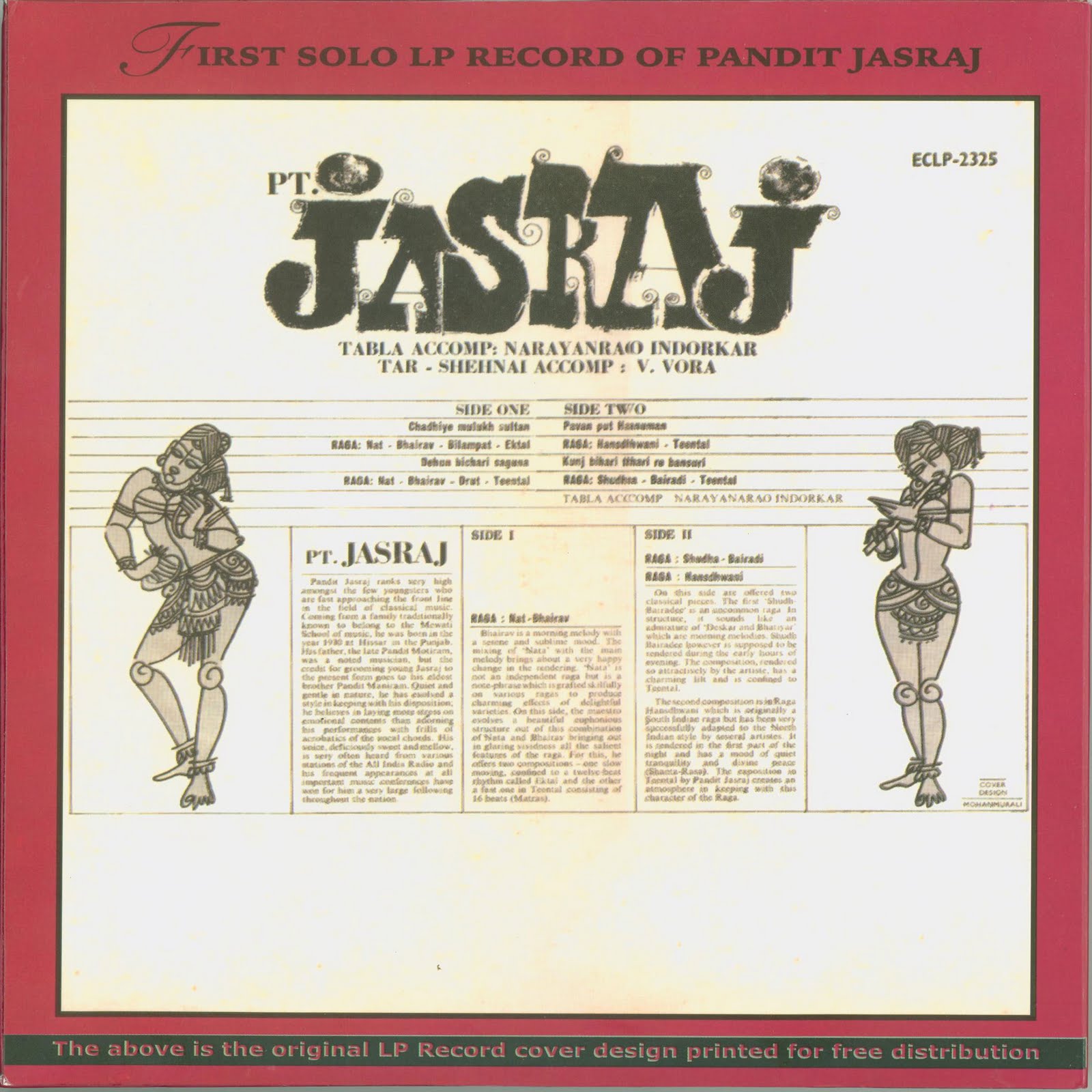
Pandit Jasraj पंडित जसराज ~ First LP Record [HMV, 1966]


ECLP-2325

a1. raga nat ; bbhairav, khayal vilambit

b1. raga shudha ; bairandi teentaal
b2. raga hansdhwani teentaal

vox ~ pandit jasraj
tabla ~ narayanarao indorkar
tar-shehnai ~ v. vora


from the flipside of lp:
'Pandit Jasraj ranks very high amongst the few youngsters who are fast approaching the front line in the field of classical musique. Coming from a family traditionally known to belong to Mewati School of Musique, he was born in the year 1930 at Hissant in Punjab. His father, the late Pandit Motiram was a noted musician, but the credit for grooming young Jasraj to the present form goes to his eldest brother Pandit Maniraum. Quiet & gentle in nature, he has evolved a style in keeping with his disposition: he believes in laying more stress on emotional contents than adorning his performanes with frills of acrobatics of the vocal chords. His voice, deliciously sweet & mellow, is very often heard from various stations of the All India Radio & his frequent appearances at all important musique conferences have won for him a very large following throughout the nation.'

this saregama 'replica' of the 1st jasraj joint fer hmv in the six six sixties really clears the air. 320 entrancing emanations

Monday, September 20, 2010

N. Moinuddin & N. Aminuddin Dagar डागर बन्धु ~ A Musical Anthology Of The Orient, volume 18: India III. Dhrupad [Bärenreiter Musicaphon,1965]


A1. Asawari: Alaap & Dhrupad composition 'Ana Sunai' [24.19]

B1. Bhairavi: Alaap & Dhrupad composition 'Jagata Janani' [21.19]
  • B2. Pakhawaj solo: Dhamar Taal (4.48)

Moinuddin & Aminuddin Dagar - vocals
Raja Chhatrapati Singh - pakhawaj
Suraiya Dagar - tanpura

'The 1940s saw the meteoric rise of Nasir Moinuddin & Nasir Aminuddin as the Senior Dagar Brothers—two of the brightest stars in the Dhrupad firmament. Within themselves they not only transformed the centuries olde art of Dhrupad singing but also breathed new life into the form of duet or 'jugalbandi' singing. Previously jugalbandi in the field of classical music had degenerated into a competition between the two singers where each tried to outdo the other in exhibitionism. Moinuddin and Aminuddin on the other hand brought back the concept of a harmonious synchronization between the two singers. In a typical performance by the Senior Dagar Brothers, the honey rich voice of Aminuddin will draw the audience into a deep meditative mood by gradually descending the notes of the lower octaves and Moinuddin would dazzle the listeners with his alankars or ornamentations in the upper octave. After having established Dhrupad in a pedestal of glory in India, they were invited to perform abroad. The two brothers visited Russia and Japan mezmerising the audience of both East and West with their divine music. Their music proved to be so charming that Alain Danielou the renowned musicologist and the then director of UNESCO invited them to tour Europe and perform under the UNESCO banner in Berlin Venice and Paris. In 1964 the European audience listened enthralled to their singing and newspaper after news paper declared the glory of Dhrupad and of the Senior Dagar Brothers. A review of their performance published in Le Monde of Paris dated 17 November 1964 perhaps best expresses the mood of the western audience: '...we will remain under the deep impression of an art of such greatness and intensity that... we feel touched and moved to the deepest of our being.' Ustad Nasir Moinuddin Dagar died soon after this concert in 1966. Aminuddin who had regarded his brother as his greatest guru and his father substitute was left completely devastated but he continued his journey as a solo performer.' ~ wiki

'This is the famous disque that it is said to have played a great role in the propagation of dhrupad in the western world. It was probably one of the first [if not the first] exposure of the style to the european continent and the impact was immense. Danielou took both the Dagars on a tour, with great success, be it even among a handful of people, and this proved to be the start of a great journey of this dignified and noble style in the realm of Europe. Alain Danielou was the general editor of the collection [commissioned by UNESCO] and for the indian volumes [4 in all] he also recorded the performances and assembled the programmes.' ~ hrempe

done waited many moons for this transcendental treasure to appear & it finally landed on our digital doorstep by virtue of the benevolent dmatlb earlier this eve. tanx kindly for the crucial vinyl rip, friend. the sounds are intoxicating. 320 blessings be upon ye. dig deeper

Thursday, May 27, 2010

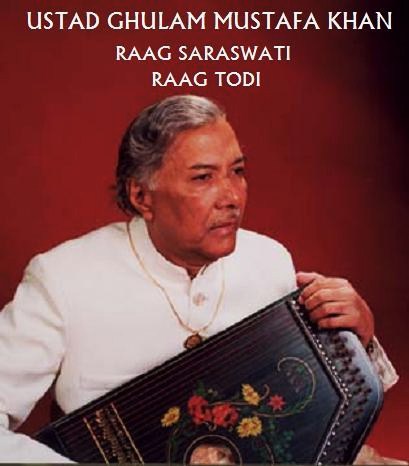
Ghulam Mustafa Khan - Saraswati, Bhupali Todi [HMV] 1975


01. Saraswati
  • Vilambit Ektal: More man bhaye
  • Drut Trital: Sagan aaye
02. Bhupali Todi [Zakir Hussain tabla]
  • Vilambit Khyal: Nisdin tumharo dhyan [ektal]
  • Drut Khyal: Hamari Jaye Kahiye [tintal]


Endowed with an exceptionally melodious and sensitively adaptable voice, Ghulam Mustafa Khan‘s music gives witness to the rigorous traditional training that he received from his distinguished gurus. He hails from a family steeped in North Indian Classical vocal music culture, his forefathers being some of the most prized court musicians honoured and celebrated by the Kings and Maharajas in a musical lineage that goes back to more than 150 years.

Ghulam Mustafa Khan has brought these traditions into the present with great effect, and added his own personal traits. Born over seven decades ago, on March 3, 1931, in the Badayun city of Uttar Pradesh, Ghulam Mustafa Khan was initiated into music by his father, Ustad Waris Hussain Khan. Later he was groomed under Ustad Fida Hussain Khan, and then later his son Nissar Hussain Khan.

Ghulam Mustafa Khan belongs to an illustrious school of music known as ‘Sahaswan Rampur Gharana‘. This Gharana has produced an abundance of khayal singers since the time of its founder Ustad Inayat Hussain Khan (1849-1919).

Khayal, in Urdu meaning imagination, is the most popular genre of North Indian classical vocal music, designed to give the singer optimum scope for improvisation. Originating in the courts of the Moghul emperors as a less rigid alternative to the Dhrupad style, it has evolved into a remarkably flexible form that allows an artist’s individuality considerable rein. Even within the past five decades the form has undergone many changes, and the tradition of innovation continues through pioneers like Ghulam Mustafa Khan.

Khayal has several schools following different style traditions. Most of these Gharanas have been built around certain families or specific locations like Gwalior and Rampur. Gharanas traditionally followed the Guru-Shishya system of instruction in which direct, one-on-one teaching and personal supervision meant a clearer and therefore deeper understanding, of both the traditions of that Gharana, of the raga, and of the role of a particular style in exploring and presenting that raga. As Inayat Hussain, the founder of the gharana, hailed from Sahaswan and was trained and lived in Rampur, this gharana came to be called Rampur Sahaswan.

It’s always been a struggle for khayal singers to establish themselves on the world music scene, because of the barrier of language. In fact, the lyrical content of the khayal while certainly enhancing the beauty of the presentation is regarded as secondary to the ability of the performer to improvise within the framework of the specific raga. The emphasis on lyrical content varies from artist to artist, many of the texts of khayal are written in an ancient form of Hindi known as Brij Bhasha. Khayal has also had a profound influence on instrumental music. Many instrumentalists point out that Indian music IS vocal music, and that the instrument should sing in the style of khayal.

Ghulam Mustafa Khan’s contribution goes beyond his own performance. He has trained and moulded some of India’s finest film singers including Manna Dey, Sonu Nigam and Hariharan. He was awarded the Padma Shree in 1991 by the Indian Government in recognition of his service to Indian music heritage.
i had some other posts in mind before we touched upon Ghulam Mustafa Khan & these two encroyably head-swirling renditions from 1975, but because they're so near & dear to my heart at the moment, i share them now. this musique has been my food for the past several weeks & i been utterly losing myself in these transcendental sounds a couple o' thymes each day. if you've enjoyed any of the hindustani vocal musique posted in the past or were innearested but didn't quite know where to sink your feet, i simply insist that you hear this. likely my favorite recordings in this domain at the moment & after all the disorienting weirdness from various locales, this is what centers me most. able to hold mood-altering notes for an eternity & unfurl superlectric taans, the virtuosity he displays here glistens like the iridescent plumes of some spectral space peacock whilst spatially enhancing the room & expanding my meristem. both ragas are sung in praise of saraswati, the hindu goddess of musique & learning, who's depicted just above entrancing flora & fauna with her trusty gramophone. 320 hearts & hugs to Ambrose Bierce. yr aim is true

Pandit Dinkar Kaikini - Sagar [Legendary Legacy]


Dinkar Kaikini
Sagar
Legendary Legacy Promotions Pvt. Ltd.
2004

1 Rag: Darbari 47:26
2 Rag: Paraj 10:18
At the tender age of seven, Dinkar Kaikini attended a concert that was to change his life forever. In one evening, he had the rare opportunity of hearing three greats of a Golden Age in Hindustani Sangeet: Ustad Alladiya Khan, Ustad Faiyaz Khan and Ustad Abdul Karim Khan. Upon hearing Ustad Faiyaz Khan, the young boy knew that he must devote his life to this art form and to the particular style of Faiyaz Khan Saheb himself. And thus began a lifelong journey dedicated to the mastery, propagation and furthering of Hindustani Raagsangeet.

His first guru was Pandit Karekatte Nagesh Rao, a veteran exponent of the Patiala Gharana. He then trained under Pandit Omkarnath Thakur of the Gwalior Gharana for a couple of years. He was about eleven years old when he joined Marris College, Lucknow, where he received the heart of his taalim from his Guruji, Pandit S.N. Ratanjankar, disciple of Pandit Vishnu Narayan Bhatkhande and Ustad Faiyaz Khan. Along with other shishyas, like S.C.R. Bhatt, Chidanand Nagarkar and K G Ginde, Kaikini spent his formative years receiving the rigorous training that helped him develop a keen sense of aesthetics as well as a passion for teaching and imparting knowledge. As a grand finale to this, he received the prestigious Bhatkhande Gold Medal for Khayal singing in 1943, following his performance in the final Bachelor of Music examination.

Dinkar Kaikini`s career as a musician is a testament to his limitless creativity: it exhibits a profound versatility and commitment to the art. He devoted his life to performing, composing and teaching. His performing career started in 1946 and has flourished since. He has toured internationally, including the US, UK, Canada, Singapore, Malaysia and Europe. He has served as an ambassador for Hindustani music, not only as a performing musician, but also as an educator. In 1974, he was selected by the Government of India to represent the Hindustani classical music tradition in the Soviet Union, Yugoslavia, and East Germany, where he gave performances and lecture demonstrations at Universities and cultural centers. He gave a second similar tour in the US, performing extensively in the academic communities.

He also held prominent positions in the music field. He spent long years with All India Radio, starting in 1954, first as composer and then Producer. He was also Assistant Director for the Directorate, Ministry of Information and Broadcasting. This was followed by a long tenure as Principal at Bharatiya Vidya Bhavan`s Music and Dance School, Mumbai. As Principal, Kaikini furthered his longstanding belief in promoting music through education and awareness.

Throughout his life, Kaikini was a prolific composer, having composed hundreds of compositions in styles like khayal, dhrupad, dhamar, thumri and bhajan, as well as several new ragas. His compositions have also been pioneering: he has composed for large choruses and set music for films and the ballet production, `Discovery of India` with Pandit Ravi Shankar.

In recognition of his tremendous contribution to music, the honours that have come his way have been numerous. These include the Sangeet Natak Akademi Award, the Tansen Award, Sangeet Ratna (Swar Sadhana Samitee, Mumbai), Sharangdev Award (Sur Singar Samsad) and the ITC Award, to name just a few
Pt. Dinkar Kaikini left this world for the eternal land of song the morning of January 23, 2010. there are only a few recordings available of the musical legacy he left behind, so let us honour his memory when we listen to these brilliant renditions that make thyme evaporate before your very ears. rest in peace Pandit Dinkar Kaikini. thx & praise to hrempe