Showing posts with label intangible cultural properties. Show all posts

Thursday, March 3, 2011

VA ~ Hollerin' [Rounder, 1976]


RR 0071

A1. Leonard Emanuel - Old-timey Holler/Ditty 2:17
A2. Leonard Emanuel - Old Georgie Buck 1:28
A3. Leonard Emanuel - The Whale Swallowed Jonah 2:19
A4. H.H. Oliver - Distress Holler/Getting Up Holler/How Dry I Am/Amazing Grace 2:30
A5. H.H. Oliver - Rafting Logs Down Neuse River 3:45
A6. H.H. Oliver - Hollerin' on the Way to See a Girl/Lulu's My Darling/Calling Cows, Mules, Hogs 2:15
A7. Paul Parker - Calling for Water/Getting Up Holler/Calling Dogs/Calling Cows 3:09
A8. Leonard Emanuel - Blow the Horn Blow 2:40
A9. Leonard Emanuel - Freckle-faced Liza Jane/I Wish I Was Single Again 3:54
A10. Leonard Emanuel - Hoot Owl Fight/Mocking a Fox/A Cornered 'Coon 1:02
A11. Leonard Emanuel - Field Call And Answer/Distress Call/Calling Hogs, Cows and Dogs 2:19
A12. Leonard Emanuel - The Great Judgement Morning/Ditty 3:10

B1. O.B. Jackson - Shortnin' Bread/Old-timey Hollers/Calling Cows 2:22
B2. O.B. Jackson - Lonesome Valley/Distress Holler 2:05
B3. O.B. Jackson - Santa Claus Is Coming to Town/Big Fat Turkey/Happy Birthday to You 1:58
B4. Dewey Jackson O.B. Calls Dewey/Turpentine Woods Holler/What A Friend We Have In Jesus/Cows in the Corn 3:35
B5. O.B. & Dewey Jackson - I Shall Not Be Moved/The Old Grey Goose 1:14
B6. Dan McLamb & His 3-Legged Dog Percy - Holler 0:40
B7. Paula Brown - Farm Hollers 1:49
B8. Bert Brown - Calling Dogs 0:31
B9. Floyd Lee - Old-time Hollers 3:18
B10. Floyd Lee - Lulu's My Darling/Hollerin' In An Automobile 1:34
B11. Floyd Lee - Distress Holler/Stopping A Rabbit with a Holler/Old-timey Holler 3:24
B12. Henry Parsons - Rolling Waters Holler/Quit That Tickling Me/Sheltered In The Arms of God 4:04

recorded by Bill Nowlin & Bill Phillips [1975] & Mark Wilson [1976]

Recorded in 1975 and 1976 in Spivey's Corner, North Carolina, home of the annual National Hollerin' Contest, Hollerin' is folk music at its most basic. A practice born of the need to communicate over distance, Hollerin' has developed into a distinctive, stylized folk art. Hear the masters of Hollerin' in their natural element. Lots of fun to play loud & on repeat until something extraordinarily violent happens. Nonbelievers need only peep the recently unearthed clip below. youngster smiles with hogs in the background at 9:20 :) 320 thx to the originilluminators

Tuesday, September 7, 2010

VA ~ Just A Closer Walk With Thee C90


SIDE I.

01. Eddie South ~ La Rosita [1927]
02. Le Stelle di Mario Schifano ~ Molto Alto
03. Josef Hassid ~ Hebrew Melody
04. Oscar Aleman ~ Russian Lullaby
05. Chosen Gospel Singers ~ Prayer for the Doomed
06. Staple Singers ~ I Had A Dream
07. Yesterday's Obsession ~ The Phycle
08. Small Faces ~ Don't Stop What You're Doin'
09. Can ~ The Empress & the Ukraine King
10. Lemon Kittens ~ Chalet D'Amour
11. Ewa Demarczyk ~ Czarne Anioly
12. Continental Coets ~ Let's Live for the Present
13. Gibby Simms & Eddie South Orchesta ~ Sighs & Tears 1926

SIDE II.

14. Tuxedomoon ~ No Tears
!5. Jandek ~ Nancy Sings
16. Croatian Folk ~ Always Take A Bandit Seriously
17. V. Ivanova & M. Kokareskova ~ Iovano Iovanka
18. Albert Ayler ~ Our Prayer
19. Peter Blegvad ~ Actual Frenzy
20. Dirty III ~ Some Summers They Drop Like Flies
21. Magic Dragon ~ White Monkey Under The Volcano
22. Pavlos Bekaris - Chalasia Mou [1950]
23. Gary Atkinson ~ Wanderin Soul
24. Amadores del Arpa ~ Panteonero [gravedigger]
25. Turner Junior Johnson ~ Meet Me in Jerusalem


a good friend who shares my love for the strange, macabre, sanctified, psychedelique & spooky asked me to make her a tape recently. there's nothing too obscure here, mostly olde favs i thought she should know about. i utilized the most pristine sounding audio sources for every tune to get that paint-peeling fidelity & upon playbach thought it sounded wicked good, but yer scrutiny is certainly welcome. originally the theme was gonna be death, prayer, redemption, lamentations... fun schtuff, but the concept was pretty much abandoned when i found it too limiting. so ultimately it's just another mixtape, albeit one that sounds superb. oh, the girls on the cover are the original Hilton sisters, Daisy & Violet. they were very talented conjoined twins & the toast of the vaudeville circuit of yore in san antonio, texas. anyhu, a [mostly] 320 rip :) enjoy

Thursday, August 5, 2010

VA ~ String Of Pearls: Jewels Of The 78rpm Era 1918-1951 [Mississippi/Canary, 2009]


Side A
1. Refik Bey - Chataraban Taxim [Turkish, 1927]
2. Ban-nhac Than-kinb - Tieng ai Tram Bong [Vietnamese, 1930s?]
3. Rosa Eskenazi - E Kardia Mou Theli [Greek, ca. 1950]
4. Lord Fly - When Mi Look Upon Janie So; Ada; Time So Hard [Jamaican, 1952]
5. John Halik - Malo Kolo [Serbian, ca. 1945]
6. La Nina de los Peines - Saeta: Pilatos por no dejar [Spanish, 1927]
7. Shalom Katz - Eil Malei Rachmim [Romanian, 1946]

Side B
1. Amelita Galli-Curci - Crepuscule [Italian/French, 1918]
2. Nji Raden Hadji Djoehla - Tjimpelang [Sundanese, ca. 1930]
3. Zaki Mourad - Biftikarak Eh Yefidak, pt. 2 [Egyptian, early 1920s]
4. unknown chorus - Harvest Dance [Zuni, 1941]
5. unknown group - Huculka & Kozachok [Hutzul, 1940s]
6. Ustad Abdul Karim Khan - Malkauns: Piran Jani Dekhi, vilambit [Hindustani, 1935]
7. Reuben Sarkisian - Hallay [Armenian, ca. 1950]


'Compilation selected by former True Vine record shop owner Ian Nagoski from his personal collection of obscure international 78s. This is a joint issue with Canary Records [CR-01], Nagoski's own label, manufactured and distributed by Mississippi Records. Includes music from Constantinople, Milano, Bucharest, Uttar Pradesh, Armenia, Sunda, Thrace, Jamaica, Serbia, Cairo, Huilotita, Seville, Hue, Aleppo, Rajastan, the Carpathians, a Zuni reservation, and more. Full notes, Black Mirror-style, opening with the quote from Gail Holst-Warhaft: "The role of the spiritual intermediary, like the polyphonic character of the lament, affords both license and protection to the individual. The dead may themselves lament through their intermediaries." Dedicated to Jason DiEmilio [1973-2006]

another collection of impossibly rare & random 78's from a myriad of regions, thrown together on a vinyl platter for our illumination. folkways started it in the 50's & pat conte's secret of musuem of mankind series on yazoo brought the same kinda sensibilities to the digital age. in 50 years thyme we seem to have come full circle with the 'offical' renewed interest in vinyl [though it never really went away]. unlike other mississippi 78 rpm joints, none of these tunes appear to be readily available anywhere else [that i am aware of] & the spectacular performances make this one truly precious. if there are any copies still around, i suggest snapping one up. my family loves this record. thanks to the original rippa. enjoy

Thursday, May 27, 2010

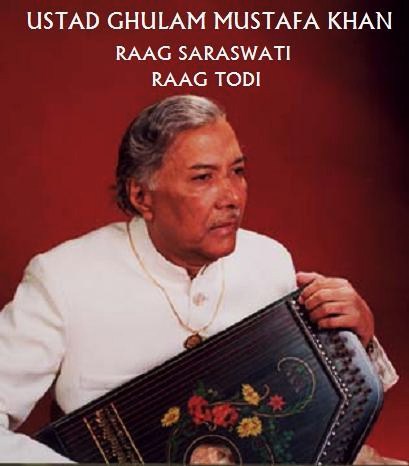
Ghulam Mustafa Khan - Saraswati, Bhupali Todi [HMV] 1975


01. Saraswati
  • Vilambit Ektal: More man bhaye
  • Drut Trital: Sagan aaye
02. Bhupali Todi [Zakir Hussain tabla]
  • Vilambit Khyal: Nisdin tumharo dhyan [ektal]
  • Drut Khyal: Hamari Jaye Kahiye [tintal]


Endowed with an exceptionally melodious and sensitively adaptable voice, Ghulam Mustafa Khan‘s music gives witness to the rigorous traditional training that he received from his distinguished gurus. He hails from a family steeped in North Indian Classical vocal music culture, his forefathers being some of the most prized court musicians honoured and celebrated by the Kings and Maharajas in a musical lineage that goes back to more than 150 years.

Ghulam Mustafa Khan has brought these traditions into the present with great effect, and added his own personal traits. Born over seven decades ago, on March 3, 1931, in the Badayun city of Uttar Pradesh, Ghulam Mustafa Khan was initiated into music by his father, Ustad Waris Hussain Khan. Later he was groomed under Ustad Fida Hussain Khan, and then later his son Nissar Hussain Khan.

Ghulam Mustafa Khan belongs to an illustrious school of music known as ‘Sahaswan Rampur Gharana‘. This Gharana has produced an abundance of khayal singers since the time of its founder Ustad Inayat Hussain Khan (1849-1919).

Khayal, in Urdu meaning imagination, is the most popular genre of North Indian classical vocal music, designed to give the singer optimum scope for improvisation. Originating in the courts of the Moghul emperors as a less rigid alternative to the Dhrupad style, it has evolved into a remarkably flexible form that allows an artist’s individuality considerable rein. Even within the past five decades the form has undergone many changes, and the tradition of innovation continues through pioneers like Ghulam Mustafa Khan.

Khayal has several schools following different style traditions. Most of these Gharanas have been built around certain families or specific locations like Gwalior and Rampur. Gharanas traditionally followed the Guru-Shishya system of instruction in which direct, one-on-one teaching and personal supervision meant a clearer and therefore deeper understanding, of both the traditions of that Gharana, of the raga, and of the role of a particular style in exploring and presenting that raga. As Inayat Hussain, the founder of the gharana, hailed from Sahaswan and was trained and lived in Rampur, this gharana came to be called Rampur Sahaswan.

It’s always been a struggle for khayal singers to establish themselves on the world music scene, because of the barrier of language. In fact, the lyrical content of the khayal while certainly enhancing the beauty of the presentation is regarded as secondary to the ability of the performer to improvise within the framework of the specific raga. The emphasis on lyrical content varies from artist to artist, many of the texts of khayal are written in an ancient form of Hindi known as Brij Bhasha. Khayal has also had a profound influence on instrumental music. Many instrumentalists point out that Indian music IS vocal music, and that the instrument should sing in the style of khayal.

Ghulam Mustafa Khan’s contribution goes beyond his own performance. He has trained and moulded some of India’s finest film singers including Manna Dey, Sonu Nigam and Hariharan. He was awarded the Padma Shree in 1991 by the Indian Government in recognition of his service to Indian music heritage.
i had some other posts in mind before we touched upon Ghulam Mustafa Khan & these two encroyably head-swirling renditions from 1975, but because they're so near & dear to my heart at the moment, i share them now. this musique has been my food for the past several weeks & i been utterly losing myself in these transcendental sounds a couple o' thymes each day. if you've enjoyed any of the hindustani vocal musique posted in the past or were innearested but didn't quite know where to sink your feet, i simply insist that you hear this. likely my favorite recordings in this domain at the moment & after all the disorienting weirdness from various locales, this is what centers me most. able to hold mood-altering notes for an eternity & unfurl superlectric taans, the virtuosity he displays here glistens like the iridescent plumes of some spectral space peacock whilst spatially enhancing the room & expanding my meristem. both ragas are sung in praise of saraswati, the hindu goddess of musique & learning, who's depicted just above entrancing flora & fauna with her trusty gramophone. 320 hearts & hugs to Ambrose Bierce. yr aim is true