Showing posts with label raga. Show all posts

Thursday, February 24, 2011

T.K. Ramamoorthy ~ Fabulous Notes & Beats of the Indian Carnatic-Jazz [1969, EM, 2011]


EM1091LP

A1. Gowla
A2. Ranjani
A3. Begada
A4. Mohana
A5. Natta

B1. Udaya Ravu Chandrika
B2. Byag Maya Malava Gowla
B3. Sahana
B4. Kanakangi
B5. Rasikapriya


Musicians taking part in this recording:

[Indian Instruments]

Veena ~ Ch. V. Kameswara Sharma
Gotuvadayam ~ D. Kittapa
Flute ~ K. Sanjeevi
Tabla tharang ~ N.V. Moorthy
Tape ~ J. Dass
Conch [senku] ~ Kuppuswamy
Ghatam ~ S. Narayana Iyer
Mridangam ~ C.P.S. Bhaskar
Chandai & sudha madhalam ~ N.C. Narayanan
Tabla ~ P.S. Lakshmanan
Jalra ~ P. Rajiah
Buyl bul Thara ~ Abubaker

[Western Instruments]

Bass clarinet ~ Varadharajan & Ganesan
Saxophone ~ Erric & Willy Horn
Piano ~ S. Ramalingam alias Babu
Guitar ~ Sadanadan
Double bass ~ P.I. Johnson
Trmpet ~ Newzealand
Drums ~ Tony D'Costa
Bongo ~ P.S. Lakshmanan


'Sly, syncretic combination of Carnatic raga & bachelor-pad lounge. Gossamer background blends worthy of any Esquivel record, snazzy licks on unique instruments, and a lilting, almost blushing sense of swing. Ramamoorthy is a violin player from Tamil Nadu. Like many large cities, Chennai has it's own film industry: Kollywood- named after the neighborhood where the studios are, Kodambakkam. Traditionally, it's known as a center for regional language movies (Telugu, Malayalam, etc), and by far the most famous composer from the area is Ilaiyaraaja. From 1952-65, Ramamoorthy was the elder songwriting partner of the more famous harmonium player and 'King of Light Music' MS Viswanathan (who seems to've played a fast Mort Shuman to his salt-of-the-earth Doc Pomus). Ramamoothy is still around, and recently gave expert singing advice (while wearing a kurta & missing half his teeth) on the Tamil answer to American Idol.' ~ weirdo

perch merch

likely me fav reish this year, which sez a lot i fink. this slab achieves errything you might hope to hear from such a promising title & remains uniquely true to carnatic melodies. one of john zorn's personal faves too, apparently. 320 snakey rips later

Sunday, January 30, 2011

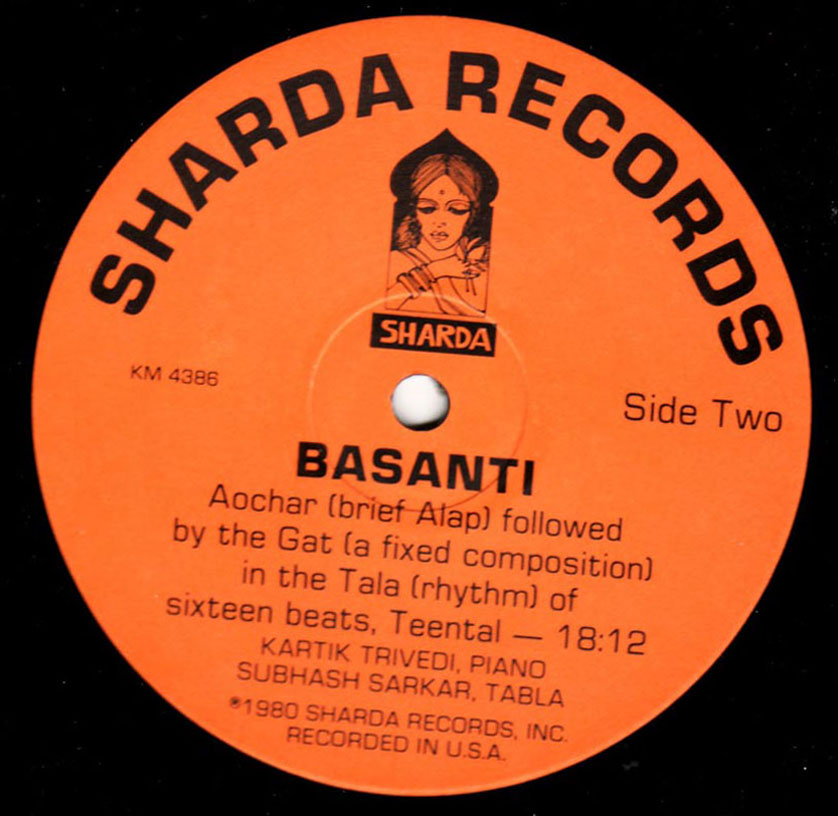
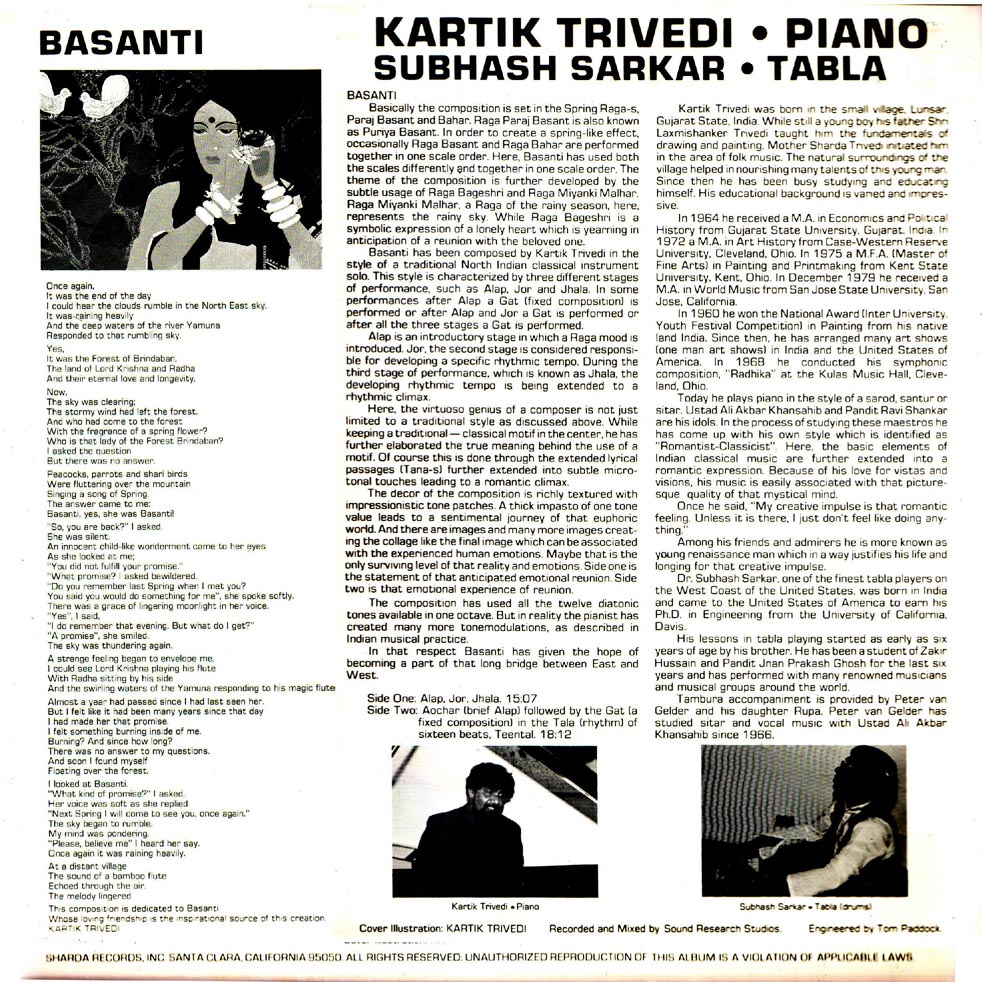
Kartik Trivedi ~ Basanti: Indian Raga Music On Piano [Sharda, 1980]


KM 4386

A. Alap, Jor, Jhala
B. Aochar, Gat in Teental

Kartik Trivedi ~ Piano, Cover Illustration
Subhash Sarkar ~ Tabla

this precious recording was shamelessly swiped from raga blog, who tirelessly endeavor in furthering the evolution of our species. i love piano when it's applied to eastern scales. 320 rips courtesy of jc-l w/ my own scrounged imagery

Sunday, November 28, 2010

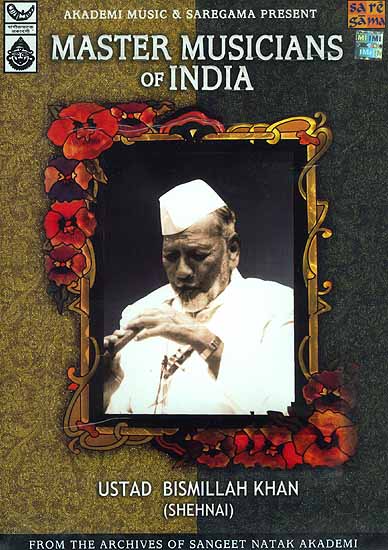
Ustad Bismillah Khan ~ Master Musicians of India [Saregama]


01. Raga Purvi - Vilambit Ektaal - Drut Teentaal
02. Benarasi Dhun

i'm taking a road trip for a bit, so no new drops for a minute. there are several wonderful recordings of the biz floating about on the intertubes, but this one is particularly fine to my ears. recording date unknown, but likely from the late 50's. sleepeth knotteth

Sunday, September 26, 2010

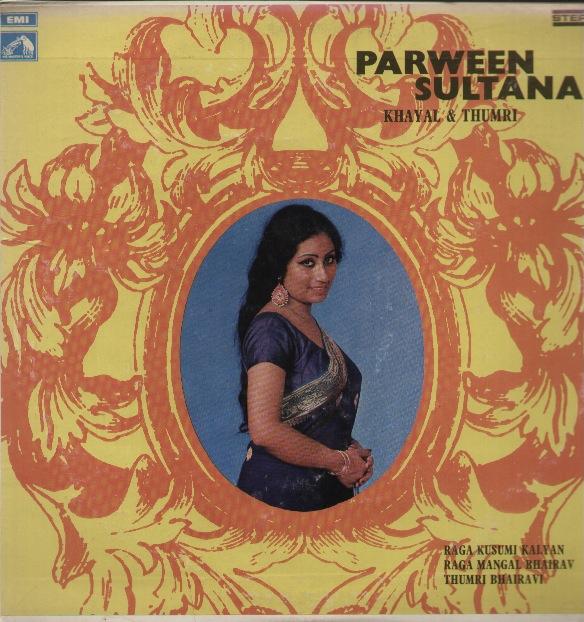
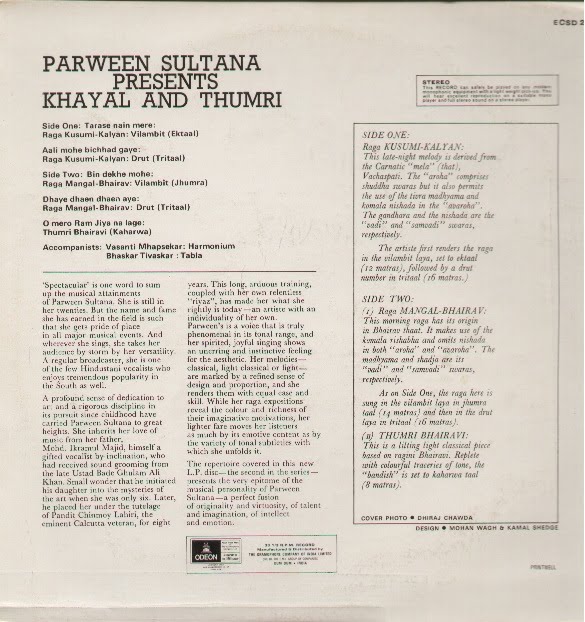
Parween Sultana ~ Khayal & Thumri [Odeon, 1973]


a1. raga kusumi kalyan
b1. raga mangal bhairav
b2. thumri bhairavie


Parveen [or Parween] Sultana [born 1950] is a Assamese Hindustani classical singer of the Patiala Gharana. She is among the foremost classical vocalists in India and is known as Queen of Classical Vocal. Her father, the late Ikramul Mazid was her first guru and he was very strict with her. She later went to Kolkata to learn to learn music under the guidance of the late Pandit Chinmoy Lahiri & from 1973, became a disciple of Ustad Dilshad Khan of the Patiala Gharana. With him, she acquired a new dimension to her singing, giving it the required mastery of ragas & voice culture. She was conferred the Padmashree in 1976. She is the youngest ever recipient of this award.

a rare & early microgroover from this child prodigy who made her first professional recording when she was only 15 & blossomed into the ultimate soprano in contempo icm. another 320 rip for the few folks who actually dig hindustani classical vocal. yawl my peeps

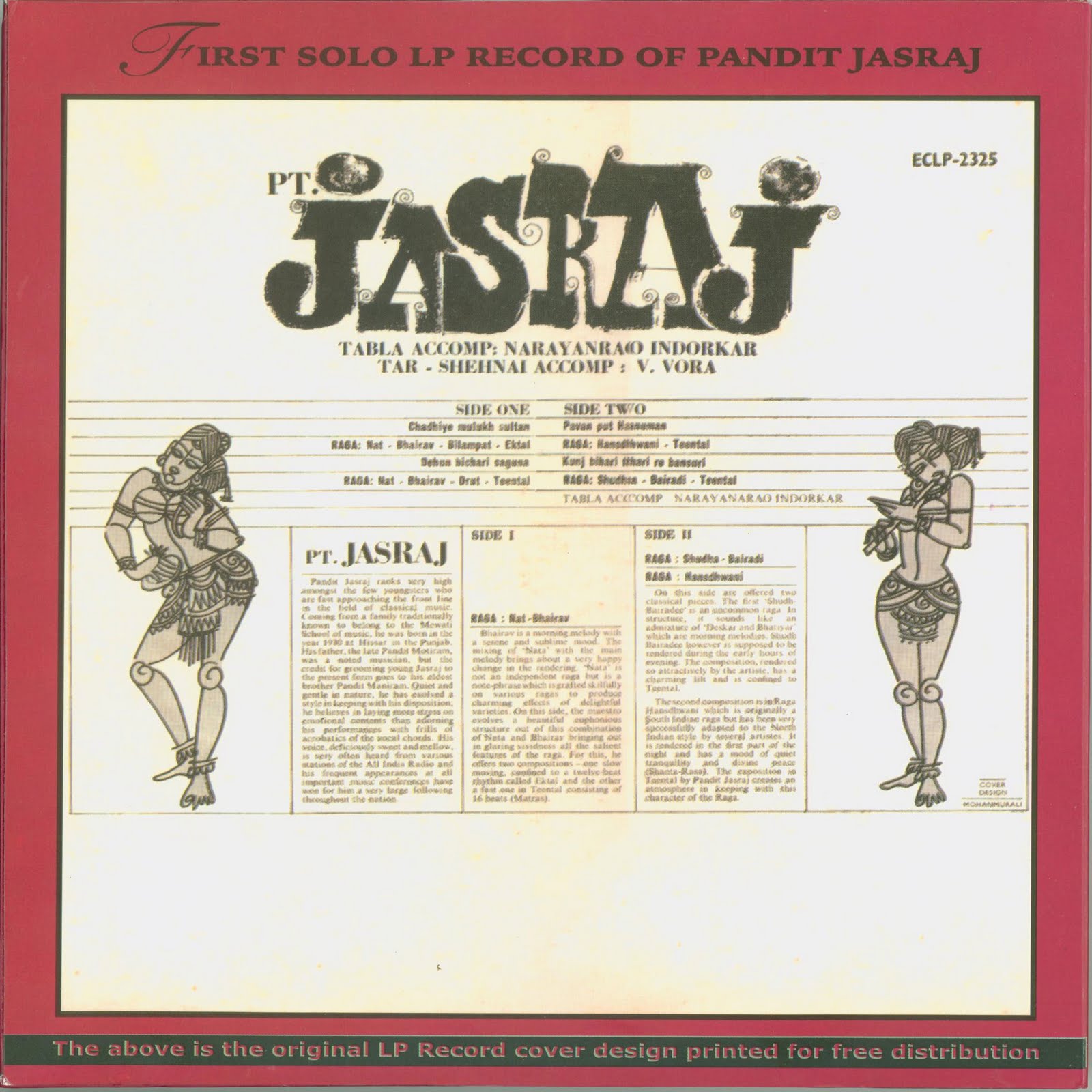
Pandit Jasraj पंडित जसराज ~ First LP Record [HMV, 1966]


ECLP-2325

a1. raga nat ; bbhairav, khayal vilambit

b1. raga shudha ; bairandi teentaal
b2. raga hansdhwani teentaal

vox ~ pandit jasraj
tabla ~ narayanarao indorkar
tar-shehnai ~ v. vora


from the flipside of lp:
'Pandit Jasraj ranks very high amongst the few youngsters who are fast approaching the front line in the field of classical musique. Coming from a family traditionally known to belong to Mewati School of Musique, he was born in the year 1930 at Hissant in Punjab. His father, the late Pandit Motiram was a noted musician, but the credit for grooming young Jasraj to the present form goes to his eldest brother Pandit Maniraum. Quiet & gentle in nature, he has evolved a style in keeping with his disposition: he believes in laying more stress on emotional contents than adorning his performanes with frills of acrobatics of the vocal chords. His voice, deliciously sweet & mellow, is very often heard from various stations of the All India Radio & his frequent appearances at all important musique conferences have won for him a very large following throughout the nation.'

this saregama 'replica' of the 1st jasraj joint fer hmv in the six six sixties really clears the air. 320 entrancing emanations

Monday, August 23, 2010

Zia Mohuiddin Dagar ~ Gangeyabushan LP [Alvarès, 1968]


Dhrupad on Rudra-Vina
Alvarès/La Boîte à Musique
LD114
France
1968

* it should be noted that initially this lp was mistakenly issued as 'Mangeyabushan' *


Raga Gangeyabushan in three movements

A1. Alap
B1. Jhod - Jhala

Recording by Benet Berger
Bombay, January 1968

'Zia Mohiuddin Dagar [1929 – 1990], popularly known as Z. M. Dagar, was a North Indian [Hindustani] classical musician, one of the 19th generation of Dagar family dhrupad musicians. He was largely responsible for the revival of the rudra vina as a solo concert instrument.

Z. M. Dagar was born in the town of Udaipur, Rajasthan and began musical study with his father, Ustad Ziauddin Khan Dagar, court musician for the Maharaj of Udaipur. He was trained both in vocals and in the rudra vina, an instrument used by vocalists to practice melodies. The vina was traditionally not played in public, but the young Zia Mohiuddin adopted it as his primary instrument, giving his first recital at age 16.

Although he was discouraged by his father from experimenting with the structure of the vina, he nevertheless modified the instrument after his father's death to better equip it for solo performance, transforming it into a larger bass instrument [sometimes called a Dagar vina]: With the help of the instrument house Kanailal & Brother, he enlarged the tumbas [gourds) and dhandhi [hollow neck] to create greater resonance and to allow the notes to sustain longer and so better reproduce the techniques used in dhrupad singing. Because of these modifications, the instrument was too heavy to be held in the standard Northern posture [with one tumba on the left shoulder], so he played instead in the Southern posture, with one tumba on the ground and one on the left knee.' ~ wiki


'Dhrupad is the oldest surviving form of Indian Classical music and traces its origin to the chanting of vedic hymns and mantras. Though a highly developed classical art with a complex and elaborate grammar and aesthetics, it is also primarily a form of worship, in which offerings are made to the divine through sound or nāda. Dhrupad can be seen at different levels as a meditation, a mantric recitation, a worship , a yoga or tantra based on the knowledge of the nādis and chakras and also purely as a performing art portraying a universe of human emotions. It is mainly a vocal tradition based on the practice of nāda yoga, but is also performed on instruments like the Rudra Veena and the Sursringār. For the past five centuries Dhrupad has mainly thrived under the patronage of Mughal and Rajput kings but is rarely heard today.'

gorgeous recital from master & maverick of dhrupad, Ustad Zia Mohuiddin Dagar. recorded by Benet Berger in Mumbai [Bombay], January of 1968 & released on the french Alvarès imprint the same year. the way he bends the low notes is totally noodle-baking & transportational. old school vinyl rip at 256. heady!

Thursday, May 27, 2010

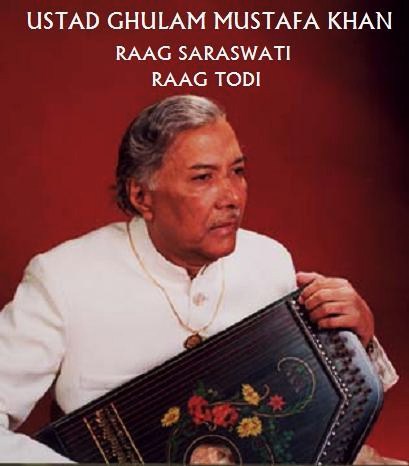
Ghulam Mustafa Khan - Saraswati, Bhupali Todi [HMV] 1975


01. Saraswati
  • Vilambit Ektal: More man bhaye
  • Drut Trital: Sagan aaye
02. Bhupali Todi [Zakir Hussain tabla]
  • Vilambit Khyal: Nisdin tumharo dhyan [ektal]
  • Drut Khyal: Hamari Jaye Kahiye [tintal]


Endowed with an exceptionally melodious and sensitively adaptable voice, Ghulam Mustafa Khan‘s music gives witness to the rigorous traditional training that he received from his distinguished gurus. He hails from a family steeped in North Indian Classical vocal music culture, his forefathers being some of the most prized court musicians honoured and celebrated by the Kings and Maharajas in a musical lineage that goes back to more than 150 years.

Ghulam Mustafa Khan has brought these traditions into the present with great effect, and added his own personal traits. Born over seven decades ago, on March 3, 1931, in the Badayun city of Uttar Pradesh, Ghulam Mustafa Khan was initiated into music by his father, Ustad Waris Hussain Khan. Later he was groomed under Ustad Fida Hussain Khan, and then later his son Nissar Hussain Khan.

Ghulam Mustafa Khan belongs to an illustrious school of music known as ‘Sahaswan Rampur Gharana‘. This Gharana has produced an abundance of khayal singers since the time of its founder Ustad Inayat Hussain Khan (1849-1919).

Khayal, in Urdu meaning imagination, is the most popular genre of North Indian classical vocal music, designed to give the singer optimum scope for improvisation. Originating in the courts of the Moghul emperors as a less rigid alternative to the Dhrupad style, it has evolved into a remarkably flexible form that allows an artist’s individuality considerable rein. Even within the past five decades the form has undergone many changes, and the tradition of innovation continues through pioneers like Ghulam Mustafa Khan.

Khayal has several schools following different style traditions. Most of these Gharanas have been built around certain families or specific locations like Gwalior and Rampur. Gharanas traditionally followed the Guru-Shishya system of instruction in which direct, one-on-one teaching and personal supervision meant a clearer and therefore deeper understanding, of both the traditions of that Gharana, of the raga, and of the role of a particular style in exploring and presenting that raga. As Inayat Hussain, the founder of the gharana, hailed from Sahaswan and was trained and lived in Rampur, this gharana came to be called Rampur Sahaswan.

It’s always been a struggle for khayal singers to establish themselves on the world music scene, because of the barrier of language. In fact, the lyrical content of the khayal while certainly enhancing the beauty of the presentation is regarded as secondary to the ability of the performer to improvise within the framework of the specific raga. The emphasis on lyrical content varies from artist to artist, many of the texts of khayal are written in an ancient form of Hindi known as Brij Bhasha. Khayal has also had a profound influence on instrumental music. Many instrumentalists point out that Indian music IS vocal music, and that the instrument should sing in the style of khayal.

Ghulam Mustafa Khan’s contribution goes beyond his own performance. He has trained and moulded some of India’s finest film singers including Manna Dey, Sonu Nigam and Hariharan. He was awarded the Padma Shree in 1991 by the Indian Government in recognition of his service to Indian music heritage.
i had some other posts in mind before we touched upon Ghulam Mustafa Khan & these two encroyably head-swirling renditions from 1975, but because they're so near & dear to my heart at the moment, i share them now. this musique has been my food for the past several weeks & i been utterly losing myself in these transcendental sounds a couple o' thymes each day. if you've enjoyed any of the hindustani vocal musique posted in the past or were innearested but didn't quite know where to sink your feet, i simply insist that you hear this. likely my favorite recordings in this domain at the moment & after all the disorienting weirdness from various locales, this is what centers me most. able to hold mood-altering notes for an eternity & unfurl superlectric taans, the virtuosity he displays here glistens like the iridescent plumes of some spectral space peacock whilst spatially enhancing the room & expanding my meristem. both ragas are sung in praise of saraswati, the hindu goddess of musique & learning, who's depicted just above entrancing flora & fauna with her trusty gramophone. 320 hearts & hugs to Ambrose Bierce. yr aim is true

Pandit Dinkar Kaikini - Sagar [Legendary Legacy]


Dinkar Kaikini
Sagar
Legendary Legacy Promotions Pvt. Ltd.
2004

1 Rag: Darbari 47:26
2 Rag: Paraj 10:18
At the tender age of seven, Dinkar Kaikini attended a concert that was to change his life forever. In one evening, he had the rare opportunity of hearing three greats of a Golden Age in Hindustani Sangeet: Ustad Alladiya Khan, Ustad Faiyaz Khan and Ustad Abdul Karim Khan. Upon hearing Ustad Faiyaz Khan, the young boy knew that he must devote his life to this art form and to the particular style of Faiyaz Khan Saheb himself. And thus began a lifelong journey dedicated to the mastery, propagation and furthering of Hindustani Raagsangeet.

His first guru was Pandit Karekatte Nagesh Rao, a veteran exponent of the Patiala Gharana. He then trained under Pandit Omkarnath Thakur of the Gwalior Gharana for a couple of years. He was about eleven years old when he joined Marris College, Lucknow, where he received the heart of his taalim from his Guruji, Pandit S.N. Ratanjankar, disciple of Pandit Vishnu Narayan Bhatkhande and Ustad Faiyaz Khan. Along with other shishyas, like S.C.R. Bhatt, Chidanand Nagarkar and K G Ginde, Kaikini spent his formative years receiving the rigorous training that helped him develop a keen sense of aesthetics as well as a passion for teaching and imparting knowledge. As a grand finale to this, he received the prestigious Bhatkhande Gold Medal for Khayal singing in 1943, following his performance in the final Bachelor of Music examination.

Dinkar Kaikini`s career as a musician is a testament to his limitless creativity: it exhibits a profound versatility and commitment to the art. He devoted his life to performing, composing and teaching. His performing career started in 1946 and has flourished since. He has toured internationally, including the US, UK, Canada, Singapore, Malaysia and Europe. He has served as an ambassador for Hindustani music, not only as a performing musician, but also as an educator. In 1974, he was selected by the Government of India to represent the Hindustani classical music tradition in the Soviet Union, Yugoslavia, and East Germany, where he gave performances and lecture demonstrations at Universities and cultural centers. He gave a second similar tour in the US, performing extensively in the academic communities.

He also held prominent positions in the music field. He spent long years with All India Radio, starting in 1954, first as composer and then Producer. He was also Assistant Director for the Directorate, Ministry of Information and Broadcasting. This was followed by a long tenure as Principal at Bharatiya Vidya Bhavan`s Music and Dance School, Mumbai. As Principal, Kaikini furthered his longstanding belief in promoting music through education and awareness.

Throughout his life, Kaikini was a prolific composer, having composed hundreds of compositions in styles like khayal, dhrupad, dhamar, thumri and bhajan, as well as several new ragas. His compositions have also been pioneering: he has composed for large choruses and set music for films and the ballet production, `Discovery of India` with Pandit Ravi Shankar.

In recognition of his tremendous contribution to music, the honours that have come his way have been numerous. These include the Sangeet Natak Akademi Award, the Tansen Award, Sangeet Ratna (Swar Sadhana Samitee, Mumbai), Sharangdev Award (Sur Singar Samsad) and the ITC Award, to name just a few
Pt. Dinkar Kaikini left this world for the eternal land of song the morning of January 23, 2010. there are only a few recordings available of the musical legacy he left behind, so let us honour his memory when we listen to these brilliant renditions that make thyme evaporate before your very ears. rest in peace Pandit Dinkar Kaikini. thx & praise to hrempe