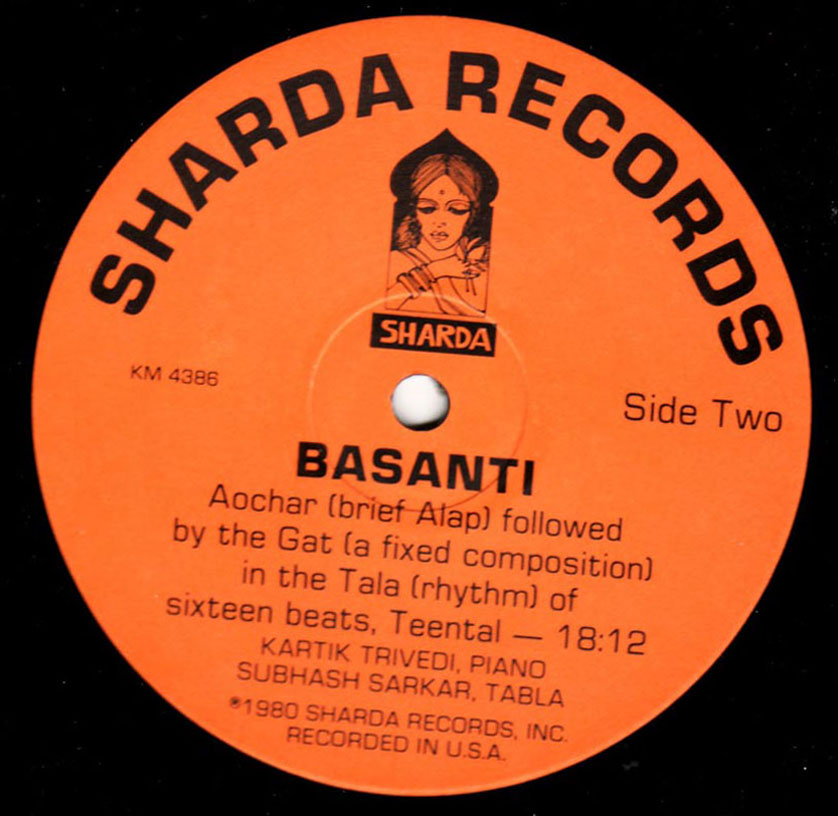
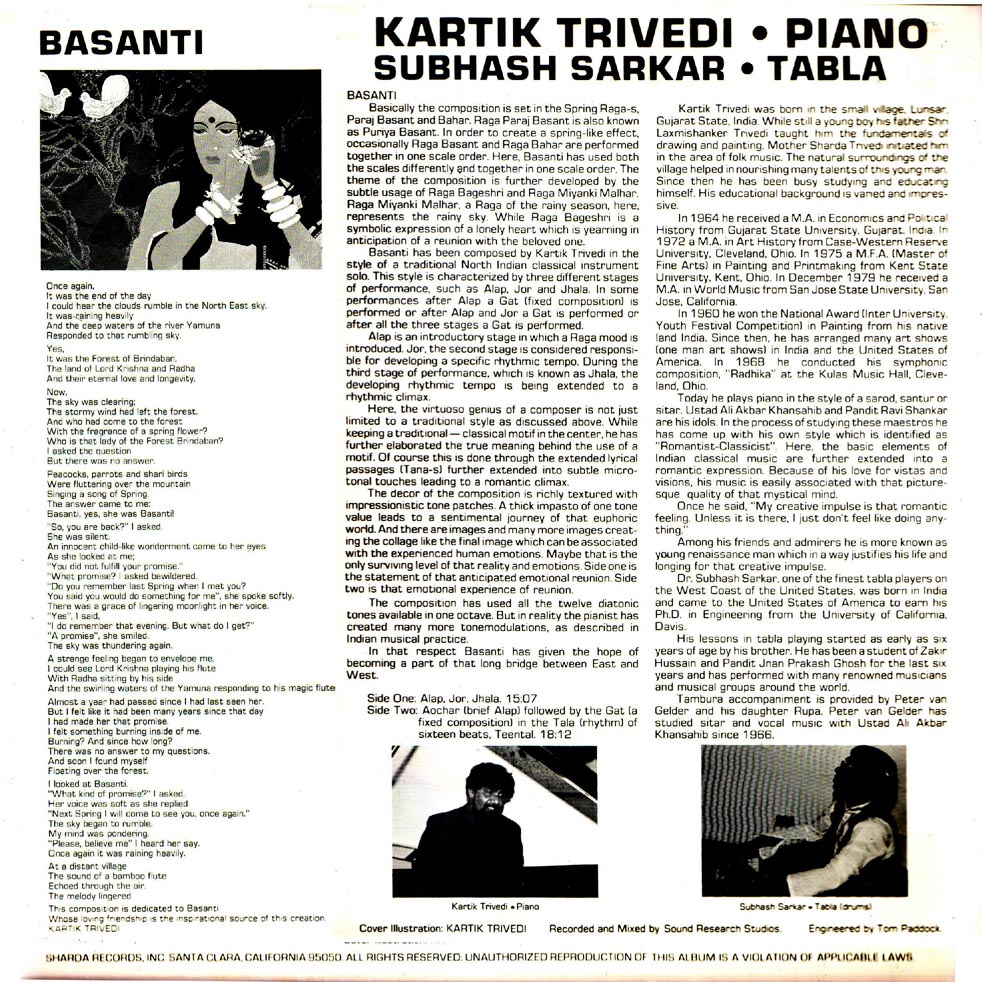
Kartik Trivedi ~ Piano, Cover Illustration Subhash Sarkar ~ Tabla
this precious recording was shamelessly swiped from raga blog, who tirelessly endeavor in furthering the evolution of our species. i love piano when it's applied to eastern scales. 320 rips courtesy of jc-l w/ my own scrounged imagery
01. Gujri Todi - Alap 02. Vilambit Gat - Teental 03. Behag - Madhyra Laya Gat Teental 04. Misra Bhairavi
Sukhvinder Singh on tabla
'Ram Narayan is noted as the Sarangi connoisseur in Hindustani classical music. Basically, it's a type of Indian lute that you play with a bow and was originally used as a backdrop in vocal music. Narayan, however, brought it to the forefront, and this collection of songs is a great example of the beautiful, swelling drones he managed to create with the instrument. The 40-minute track here, Gujr Todi Vilambit Gat in Teental, is the best illustration of his genius I have heard: deep sounds that resonate and powerfully accumulate more successfully than anything I've heard of doom metal or what have you [an odd comparison to make, though you might get what I mean after listening, maybe]. That said, Narayan's talent at the instrument, as he slides over the strings, is truly astounding. From his work alone, the sarangi has become possibly my favourite classical Indian instrument, and though there are conventional characteristics here rhythmically [plus the shorter track almost recalls Shankar's sitar playing, I think], this is true innovation.' ~ Killed In Cars
Arvind sez: 'The review above can be said for most of Ram Narayan's better recordings, so many of which we've been listening to over the last few days. His best work always shows pure genius and the capacity to dig deep into your being, like all good Indian classical music. That said, this Gujri Todi is really special. It was the first piece I heard by Ram Narayan in the 80s, and even after all these years, it never fails to raise a few hairs on my skin.'
now one featuring the legendary Ram Narayan in resplendently resonant sarangelic glory. i believe these recordings were originally compiled by Oriental for polycarb coaster in 1997 [& here again in 2003] & while the packaging might appear slightly cut-rate compared to the flavourful Indian LP sleeves of the 60's, the renditions are nothing short of magical & most definitely send me where i need to go. 320 thanks to wildstrings fer the transcendental tones. further
Born in 1917 in Kagwad [near Belgaum], Bijapure was initiated into harmonium playing by Vidwan Annigeri Mallayya. He also took singing lessons for several years which is thought to have helped him develop his fluid harmonium playing style. Pt. Rambhau has been running his musique school, Shri Ram Sangeet Mahavidyalaya, in Belgaum since 1938 & has sinced received numerous honours & titles from the Karnataka government. this is the first ever solo album of Pandit Rambhau K Bihapure, whose lightning fingers are the schtuff of legends. His students tried several thymes to persuade him to go to Bangalore for a recording sesh & finally in august 2002, the then 87 year olde maestro ascended the steps of a studio to record his first solo album. A list of musicians Bijapure has accompanied reads like a who's who of Indian musique: D.V. Paluskar, Utturkarbua, Amir Khan, Basvaraj Rajguru, Malikarjun Mansur, Kumar Gandharva & Bhimsen Joshi, just to name a few. Now 95, the guru still performs regularly at recitals with adepts like Ravindra Katoti, one of his most accomplished Shishyas. the two numbers are quite lengthy, so a low quality sound samp hardly seems necessary or appropriate. yule just hafta trust me that it's worthy & it won't even cost you 30 rupees :) 320 thanks to sweet sister Rachelle
Side 1 1. Yaman Kalyan - Alap, Gat in Teental 2. Tabla Solo
Side 2 3. Bairavi - Alap, Gats in Vilambit Rupaktal, Drut Teental
The sarod and Sharan are almost synonymous. It was not the same, however, way back in her childhood. Hailing from a family of famed scholars and successful businessmen of Delhi, music was sidelined to the level of a hobby for its members. Her in-laws were also no nearer to the musical muse. In both these families, however, music had remained of paramount interest. During festival times, like Holi and Basant, it was customary for the entire joint family household in old Delhi, especially the women folk, to assemble and sing while the culinary preparations for the festival were in progress. Even professional troupes were invited to perform on the occasion.
Strangely enough, Sharan’s introduction to sarod was almost an accident. She just chanced upon this new musical instrument in her brother Brij Narayan’s cupboard, and it caught her fancy. She took it down and struck the strings of this instrument. The sound struck such a chord in her heart that in that decisive moment she knew that this was her instrument for life and that she must master it and become a great ustad in it. But the journey from there to being an ustad was not all that easy. When she announced her resolve to pursue the sarod she was discouraged to do so, not just by her family but also by her guru, Baba Allauddin Khan himself. Sarod in those days was considered as predominantly a male instrument that required a lot of stamina in its user. But her tenacity paid off and Baba consented to be her guru. He put his heart and soul into teaching her this instrument.
Defying social and traditional norms, Sharan became a residential disciple of Baba. Shorn off all external distractions, she worked hard at her art, and practised for 10 hours a day. She developed a strong sense of layakari (rhythm) and the technique of sarod playing. Her guru instilled in her a command of raga that exuded his personality rather than the mere mechanics of sound and pattern.
Ultimately, Sharan’s determination and devotion paid off. As the demand for burgeoning musical talent rose, Sharan took her place on public platforms as a musician and performer. She has not only held music lovers enthralled for half a century, her devotion and passion for the sarod have also opened up a new avenue in the field of music, a new genre for women.
Together with fame and money, a flood of awards has also come her way. In 1968, Sharan made history by being the first woman musician in India to receive the Padmashri award. The Sangeet Natak Akademi award came her way in 1986. The Delhi State honour was given to her in 1974. Universities in India and abroad have showered her with justifiable acclaim. She has received doctorates of music from universities in the USA. The Delhi University, on its platinum jubilee celebrations, conferred on her the Alumnus Award.
The future will remember Sharan Rani not only as a great musician who is going to leave behind a great legacy for womankind but also for her gift of 300 musical instruments that are now a national treasure. Housed in the Instruments Gallery of the National Museum, her contributions are a rare collection of rare musical instruments. Intrigued by the origins of her instrument, Sharan has also delved deep into its research and recorded her findings in a book, The Divine Sarod, published in 1992. In this book she traces the instrument back to a second century sculpture.
The sarod is not just a musical tool for her. It is her source of inner strength and sustenance. No surprise then that she is known as ‘Sarod Rani’.
with owl the talk of Baba Allauddin Khan lately, i thought it timely to drop some slow burners from another sarod virtuoso & one of his most talented disciples, sweet Sharan Rani. this fine offering, another LP on the mysterious Disques Vogue imprint out of France, also features a tabla solo by Faiyaz Khan, himself an exceedingly accomplished & distinguished artist who has accompanied some of the finest stalwarts of Hindustani musique thru the ages. thanks again to Arvind for illumination