Veena ~ Ch. V. Kameswara Sharma Gotuvadayam ~ D. Kittapa Flute ~ K. Sanjeevi Tabla tharang ~ N.V. Moorthy Tape ~ J. Dass Conch [senku] ~ Kuppuswamy Ghatam ~ S. Narayana Iyer Mridangam ~ C.P.S. Bhaskar Chandai & sudha madhalam ~ N.C. Narayanan Tabla ~ P.S. Lakshmanan Jalra ~ P. Rajiah Buyl bul Thara ~ Abubaker
[Western Instruments]
Bass clarinet ~ Varadharajan & Ganesan Saxophone ~ Erric & Willy Horn Piano ~ S. Ramalingam alias Babu Guitar ~ Sadanadan Double bass ~ P.I. Johnson Trmpet ~ Newzealand Drums ~ Tony D'Costa Bongo ~ P.S. Lakshmanan
'Sly, syncretic combination of Carnatic raga & bachelor-pad lounge. Gossamer background blends worthy of any Esquivel record, snazzy licks on unique instruments, and a lilting, almost blushing sense of swing. Ramamoorthy is a violin player from Tamil Nadu. Like many large cities, Chennai has it's own film industry: Kollywood- named after the neighborhood where the studios are, Kodambakkam. Traditionally, it's known as a center for regional language movies (Telugu, Malayalam, etc), and by far the most famous composer from the area is Ilaiyaraaja. From 1952-65, Ramamoorthy was the elder songwriting partner of the more famous harmonium player and 'King of Light Music' MS Viswanathan (who seems to've played a fast Mort Shuman to his salt-of-the-earth Doc Pomus). Ramamoothy is still around, and recently gave expert singing advice (while wearing a kurta & missing half his teeth) on the Tamil answer to American Idol.' ~ weirdo
likely me fav reish this year, which sez a lot i fink. this slab achieves errything you might hope to hear from such a promising title & remains uniquely true to carnatic melodies. one of john zorn's personal faves too, apparently. 320 snakey rips later
A1. Boxing Song [Taloong] เพลงมวย [Pleng Muay] A2. Su Ki Ya Ki [Sloopy] สุกียากี้ [Sukiyaki] A3. Klong Yoaw [Merenge] เถิดเทิง [Thoet Thoeng] A4. Fountian [Sloopy] ฟ้อนเทียน [Fon Thian] or 'Candle Dance' A5. Cho Cho Chan [Twist] โจโจ้ซัง [Cho Cho Sang] or 'Cho Cho San' A6. Rose Rose I Love You [A-Go-Go] ฉันรักกุหลาบ [Chan Rak Kulap]
B1. Your Cheatin Heart [Cha-Cha-Chai] ยัวร์ชิตดิ้นฮารต์ [Yuar Chit Din Hart] B2. Flower Moon [Quickstep] บุปผาเพ็ญจันทร์ [Buppha Phenchan] B3. Kraw Taloong [Graw กราวตลุง [Krao Talung] B4. Arabian Song [Guaracha] เพลงอาหรับ (Pleng Arab] B5. Asava Leela [Guaracha] อัศวลีลา [Atsawalila] B6. Jean Ram Pad [A-Go-Go] จีนรำพัด [Chin Ram Phat] or 'Chinese Fan Dance'
'progressive classical music' [shadow prayuk] international album, new & special this year... a melodious sampling of the most excellent songs, packed in together on this record.'
another 'glassic' document of farfisa-laden thai shadow toons [including a hank williams cover] with transliterations by the inimitable peter doolan of มนต์รักเพลงไทย fame. where the english is 'broken', i left it as such, in the interest of historical accuracy & good humour, but more astute meanings might live there to the right of the tracklist, following the anglicized thai phoenetics. this rip was harvested piece-meal from the recently established archive of southeast asian music, who definitely deserve yer rapt attention. 320 ความกตัญญู to 'em. evenfurtherstill
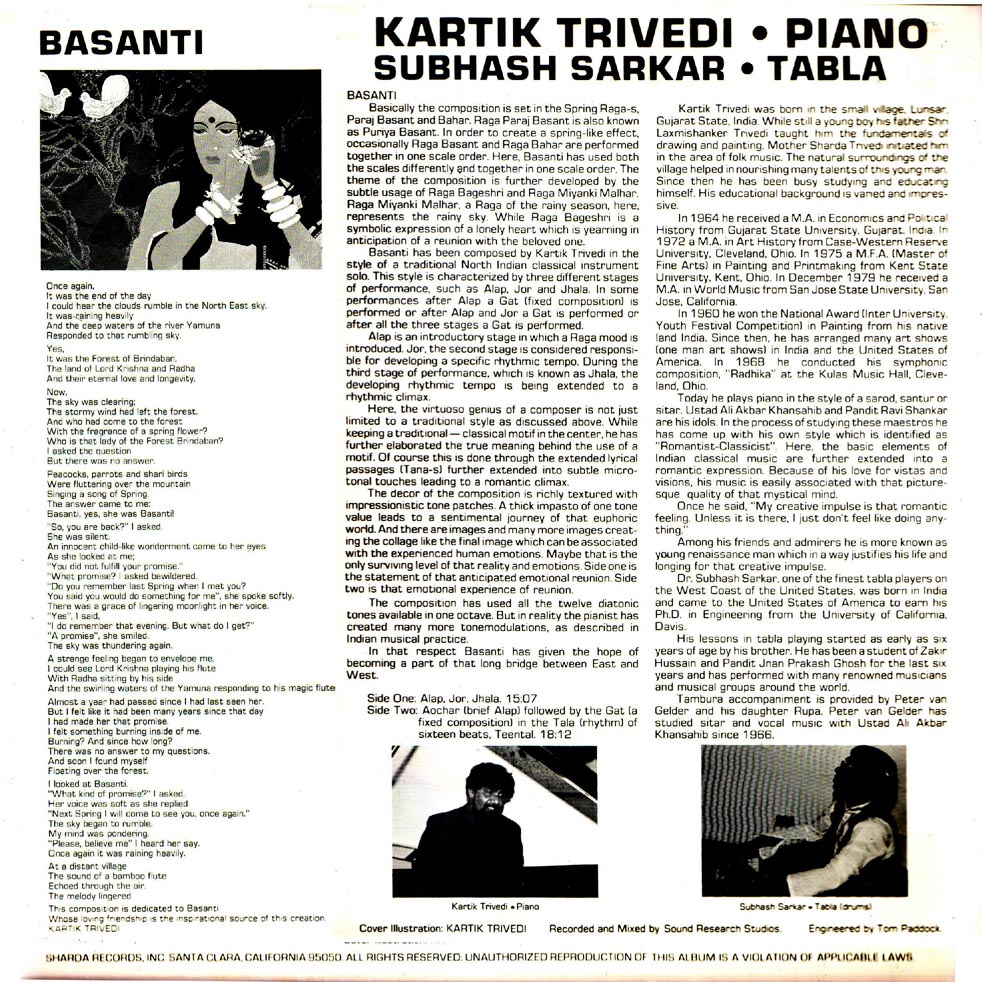
Kartik Trivedi ~ Piano, Cover Illustration Subhash Sarkar ~ Tabla
this precious recording was shamelessly swiped from raga blog, who tirelessly endeavor in furthering the evolution of our species. i love piano when it's applied to eastern scales. 320 rips courtesy of jc-l w/ my own scrounged imagery
A1. Manohraluifai [Talung] A2. Hey Klong Yao [Klong Yao] A3. Ra Cha Khlong Jhao [Klong Yao] A4. Horse Step Dance [Guaracha] A5. Monkla [Ram Wong] A6. Graw Taloong [Krao Talung] (Krao) A7. Sad Chatree [Talung]
B1. Kaektoimor [Talung] B2. Long Drum Song [Merenge] B3. Phoo Yai Lee [A Go-Go] B4. Talung Nang Yak [Talung] B5. Thorance Kan Saeng [Talung] B6. Chinese Fan Dance [A Go-Go] B7. King Of Drums [A Go-Go]
P.M. Pocket Music [A1, A7, B1], Son Of P.M., The [A2 - A6, B2 - B7] A collections of tracks from various singles and albums
'The groove is very much rooted in frenetic and rhythmic rock ‘n’ roll with discernible elements of pop, surf and exotica. It’s hard to pin down tracks like “The Horse Step Dance [Guaracha]” which has moments of Velvets like organ drone coupled with hypnotic latin bass and Ventures twang. “Sad Chatree [Talung]” is both intangible and otherworldly, coupling a relentless trance-inducing rhythm with an archaic Thai melody, which hovers and shimmers like an insect caught in hazy and perfumed smoke. There is much to be intoxicated here as this is music which defies rigid categorisation and easy interpretation. At times, the results are downright weird, “King Of Drums” sounds like the ghost of Lux Interior throwing primitive goo goo muck in a Thai temple. Odd and exotic indeed.' ~ asa
01. Kuen Kuen Lueng Lueng - Sroeng Santi mp3 02. Ruk Kun Samong - Plearn Promdan mp3 03. Pai Joi - Rung Petchburi 04. Ying Ting - Plearn Promdan mp3 05. Pu Yai Lee Santana - Rung Fah Puping 06. Kor Hua Jai Bee Kuen - Petch Burapa mp3 07. Nam Mun Pang - Sroeng Santi 08. Kanong Krung - Teungjai Bunpraruksa 09. Kosok Tee Det - Plearn Promdan 10. Baa Baa Buam Buam - Sroeng Santi 11. Jai Ten - Riem Daranoi 12. Ngun Pad Baht - Teungjai Bunpraruksa 13. Dub Fai Kui Gun - Sroeng Santi 14. Klug Tum La - Jalwal, Annie & Geerasak
'Hot on the heels of Soundway Records consummate selection of Luk Thung, Jazz and Molam forms from Thailand comes this killer compo of similar, heavier styles from the Finders Keepers crew. The fuzz bleeds through the garage-rock, the xylophones twinkle inside the pop and the distortion bends the psych into bold, never-before-heard new shapes... Wild, unbridled exotica from another time and place to the one you are currently sitting in. Probably...
It's possibly a misnomer to label music recorded outside of the USA or Europe with terms such as `psyche' or `surf' as it is often just a stylistic innovation based on exposure to foreign records via the radio or music stores. It doesn't necessarily chime in with any of the social shifts or changes that accompanied the music's development in the West. Even in America, the concept of teen culture was relatively new during the height of these genres popularity. People who could afford to take advantage of these new freedoms often had the financial cushioning to do so. This factor was amplified in South East Asia, and the music shouldn't be considered nationally representative - it's a more scaled down phenomenon, relevant to a small cross-section of society.
By the same token, this wasn't just bland copycat music to widen a band's audience, or to entertain expat patrons in bars or clubs. This was a sincere desire to experiment and repackage local sounds without necessarily needing to make a statement. The musical information was processed and partially recast amidst a blend of local music and arrangements, transposed onto drums, electric bass, guitar and keyboards.
Although in the mid-70s there was a wider protest movement in Thailand that found it's musical outlet in the `songs for life' of Caravan and Carabao, the music collected here was not part of the same aesthetic, although it's possible there was some musical overspill.
The styles featured on this compilation fall somewhere between Luk Thung (`song of the countryside') and Luk Krung (`song of the city'). Bangkok was a particular melting pot for the evolution of these two genres, the former alluding to musical themes and lyrics aimed at the wider national population, the latter looking westwards with a more urban `sophisticated' audience in mind. The tracks here were experimentations or dice rolling by both little known groups, as well as established figures like Plearn Promdan. Some tracks might represent a specific artist's only foray into this musical area.
Even within Thailand the majority of these tunes remain unissued, so it's with great pleasure that we present this glimpse of the strange underbelly of Thai Luk Thung in all its unique, original and outlandish glory - a small snapshot of an otherwise forgotten era.' ~ press
if ya dug the sroeng santi iron man 7" from last summer, this inspiring new collection from irrepressible, globetrotting 45 digger extraordinaire Chris Menist eclipses that release completely, as it features both of those fine tracks in addition to several more madcap burners. total life affirming fire, 320 rips later
01. Radio Morocco 02. Sev Acher 03. Helwa Shak 04. Kal el Lazi Kad Ham 05. Nights of Malta 06. Esoterica of Abyssynia 07. Space Prophet Dogon 08. Theme from “Wild World of Animals” 09. Cruel and Thin 10. Gum Arabic 11. Lies Up the Niger
'The Bishop brothers continue to dig into the Girls' archives from before Charles Gocher's tragic disappearance in 2007. In this new offering they revisit North African songs from Morocco to the Mid-East and beyond, interpreting them with their own distinctive style. All tracks on this CD are cover songs from Sun City Girl's repertoire, several frequently performed by the group live for more than 20 years. Several cuts were inspired by found unmarked cassettes and radio recordings made in Egypt and Morocco by Alan Bishop in the early 1980's. The original song titles and composers of the radio-inspired arrangements are unknown. SCG created their own song titles and rearranged the music, at times radically, to fit their vision. The rest of the tracks are by various artists from the Middle East and North Africa. One track, "Wild World of Animals" is an African piece written for the theme of an American television show by the same name from the 1970s.'
only just heard about this 'covers' album today & found it available here fer download in various formats. talk about piractical. jeez. opted to shine a light on their appropriation of Lili Twil [aka Cruel & Thin] by Les Frères Megri
01. The Blue Bird 02. Crépuscule hawïen 03. Manuska 04. Hawaï nous appelle 05. Sérénade bleue 06. Retour d'Hawaï 07. J'écoute la guitare 08. En écoutant l'ukulélé 09. Addio Signora! 10. Hawaiian berceuse 11. Je n'ai plus personne 12. Reflet viennois 13. Viens dans ce joli pavillon 14. Hé hop la hé 15. C'est une valse qui chante 16. Waikiki en fête 17. One kiss 18. La destinée du marin 19. Le jeune pêcheur 20. L'ile aux rêves d'or 21. Chant d'amour de Tahiti 22. Ay, ay, ay 23. De tout mon caeur 24. Dans la nuit 25. Avant de mourir
Gino Bordin [1899-1977] was born on 4th February 1899 in Vicenza, in the north east Italy. His eldest brother led an orchestra in which Gino played the musical saw and sometimes harp-guitar acquired from Luigi Mozzani, at Cesta. There he struck up a friendship with the prodigy Mario Maccaferri.
His name first appeared beside that of Michel Péguri, an accordionist, on a Perfectaphone disc where the record label showed “ banjo : Gino Bordin”. Although he later abandoned this banjo for guitar and Hawaiian guitar, he continued to play with musette accordionists until the end of his career.
In the 20s Gino supported other accordionists on his guitar and chanteurs and chanteuses also began to call on his talents as accompanist and writer. All doors opened for him, and, significantly, those to the recording studios. When the record companies realised the sudden taste for Hawaiian guitar, the slenderness of their catalogue licensed from America in this genre and the need to add a repertoire more to French public taste, they turned naturally to Gino Bordin, already a virtuoso on the instrument.
Perfectaphone recorded Dreamland and Beautiful Hawaï by Gino Bordin, Hawaiian guitar. Then Pathé issued in early 1928 four other covers of standards interpreted by a Hawaiian Trio, Bordin, Kamenetsky and de Lignori. From then Gino Bordin went on to record hundreds of titles for at least 15 labels, in his own name and also under various pseudonyms. We can count at least 120 sides for Parlophone, over 60 for Polydor and Pagode, at least 20 for Pathé. The Odéon label issued over 30 to which we should add English pressings on Decca and Ariel, those on Columbia and Polydor in Japan, Parlophone in Australia and Brazil. There were yet more titles on Salabert, Omnia, Grammophon, Supraphon, Disc Art, Gladiator, Colisée, MP, Clarus, Discum, Unifix and, after WW2, Pacific, Vogue, Mode, Mondo Music, Nixa, Saturne and Charmilles... that’s without counting the many discs he played on where the record label credit simply read: Hawaiian trio or Hawaiian Guitar
Gino Bordin adapted the guitar from Honolulu to every musical style. There were only a handful of Hawaiian standards or hapa haole tunes, but there were many originals including classical, in all sorts of orchestrations, from guitar duo to large string formations, in instrumental versions or with refrain. SACEM (the music copyright agency) handles a catalogue of about forty works written by Gino Bordin either alone or with co-writers Gardoni, Ferrari, Viseur and Saarbecoff. That short list doesn’t tell the full story because published sheet music and record labels show that he was the prolific writer of dozens more instrumental pieces and songs.
French radio stations broadcast Gino Bordin’s records widely and also invited him to play live in their studios. Then Radio Lausanne and stations from Hilversum in Holland spread his fame throughout Europe.
Now a star on records and radio, Gino increased the number of his concerts and tours. Since 1926 he had sported the white Hawaiian outfit and red silk sash, slipped the lei around his neck, posed with guitar flat on his lap and livened up the dance-halls of the casinos, at Dinard, Saint Jean-de-Luz and Monte-Carlo. In 1931 his orchestra consisted of three dancers in exotic dress, Alex Manara on second Hawaiian guitar, Vincent Kamenetsky on guitar and Joseph Puni, the authentic Hawaiian, on ukulele. Later Le Trio Havaïen saw Gino flanked by Jean Stéfani and André Thomas, Tino Rossi’s guitarists. As for the Bordin-Manara duo ...that was seen at every possible opportunity, and notably opened for Édith Piaf at the ABC in 1937. Gino Bordin played on all the great Paris stages, Paramount, Gaumont, Rex, Alhambra, Bobino, Européen, Vel’ d’Hiv, at the Carlton in Cannes, at Monte Carlo’s Palm Beach, at Maxim’s in Athens. He criss-crossed North Africa, went as far as Alexandria and Cairo, and went through Lausanne, Zurich, The Hague, Amsterdam and Rotterdam. During the war a lengthy tour took him to the Wintergardens in Vienna and Berlin and all across Germany to Prague and Warsaw
In France the guitar from Hawaii owes its popularity to Gino Bordin. At first he used a pear shaped acoustic Hawaiian guitar then being made in the Vosges. In 1932 Mario Maccaferri produced for Selmer his jazz guitar with resonator chamber which Django made famous and he designed at the same time a 7 string Hawaiian model without cutaway, an idea conceived with his friend Gino. In early 1936 it was Maccaferri who again brought him right up to date when he returned from a USA visit carrying under his arms a National lap steel electric 7 string, immediately christened the “Magic Guitar” by Gino and plugged in at the studio in May that same year. Gino, pioneer of the electric guitar, had already contributed to the instrument’s evolution by adding a low seventh string in 1931 and using a seventh tuning, then later a 6th tuning. His Nouvelle Méthode de Guitare Hawaïenne à Sept Cordes (New Hawaiian Guitar Method for 7 strings) published in 1935 by Max Eschig contained a “Transposer”, a cardboard device with holes which denote on the frets the location of notes for each chord. Based on a similar principle he also produced a set of 16 cards “500 guitar chords by the perforated strip system”. He published collections of arrangements for the instrument and up until the mid 1960s gave lessons at his home on or in the posh colleges of the southern suburbs. During this period Gino was still appearing in cabaret and still playing on stage with Fredo Gardoni. His career had lasted all through the 40s and 50s. He accompanied Patrice and Mario, then Tino Rossi once more ...and Lucienne Delyle too, while his records for Pacific and Vogue had wide distribution and the younger generation of players, Harry Hougassian and Marcel Bianchi considered him a master. From 1965 however Dupuytren’s Contracture reduced the movement in his left hand and forced him gradually to rein in his musical activity. In 1969 he retired to l’Isle-sur-la-Sorgue. And that’s where he has been at rest since 14 July 1977 - liners
superb hawaiian gypsy jazz. darker & more doleful than the typical fare & perhaps more timeless as a result, but then i do dig the somber schtuff. would certainly love to find this in more prestigious bits, but til then this'll hafta do :)
A1. Moshi 17:00 A2. Guilde's Song To Binkirri 2:55
B1. Gardenia Devil 6:00 B2. 14 Temps 4:50 B3. Bamako Koulikaro 3:50 B4. Afrika Freak Out 6:20
C1. Zombizar 7:20 C2. El Hadji 0:24 C3. Chechaoun 12:00
D1. Tindi Abalessa 10:25 D2. El Hadji 1:00 D3. Balandji In Bobo 3:06 D4. Sannu Ne Gheinyo 5:20 D5. El Hadji 0:20
Barney Wilen - tenor sax Michel Graillier - electric piano Pierre Chaze - guitar Simon Christian Tritsch - electric bass Micheline Pelzer - drums Didier Leon - takamba - oud Caroline de Bendern, Marva Broome, Babeth Lamy, Laurence - vox Composer - Barney Wilen [trx: B1, B4, C1, D4], Caroline De Bendern [trx: B1, C1, D4] Producer - Pierre Barouh Recorded By - Daniel Vallancien
Gatefold cover. Recorded in Studio Saravah. "Gardenia Devil" is taken from a poem of the chinese people. All other uncredited composed by tracks based on traditional folk songs.
'In 1970 Barney Wilen assembled a team of filmmakers, technicians and musicians to travel to Africa for the purpose of recording the music of the native pygmy tribes. Upon returning to Paris two years later, he created Moshi, a dark, eccentric effort fusing avant jazz sensibilities with African rhythms, ambient sound effects and melodies rooted in American blues traditions. Cut with French & African players including guitarist Pierre Chaze, pianist Michel Graillier and percussionist Didier Leon, this is music with few precedents or followers, spanning from extraterrestrial dissonance to earthbound, streetlegal funk.Wilen pays little heed to conventional structure, assembling tracks like 'Afrika Freak Out' & 'Zombizar' from spare parts of indeterminate origins' ~ amg
'A wild and groundbreaking record recorded by the great French tenor player Barney Wilen! Although he got his start as a bebopper in the 50's, Wilen sort of dropped out of sight by the end of the 60's and only emerged from time to time to cut strangely experimental sides. This record is unlike anything he ever made, and features a wild mix of African rhythms, ambient sound, and Wilen's deep deep tenor. By this point, Wilen had been absorbing a lot of different influences, from Coltrane, to Pharoah Sanders, to some of the European free players, and his sound is a weird mish mash of styles that weaves in and out of all the stuff on the record. It's a haunting bit of afro jazz & funky noise, with some cuts that are spacey, and others that are nice and funky.' ~ dusty
lately when i make a new jazz discovery, assimilate the sounds & decide i might wanna spread the gospel to you good peeps, a quick search in the engine reveals many a classique joint was owlready ushered into interwebular consciousness by one of several seminal jazz blawgs, whose illuminating arkhives will spread yer awareness like a fan. unfortunately, i seem to be about 3 years too late on some of the links when i trawl thru the backpages, but occasionally stumble upon a few rips in a roundabout way. thus, i am excited to bring you yet another pearl from the essential orgy in rhythm dustbin, on the groundbreaking saravah imprint. bacoso sez: 'Completely bonkers mash up of afro to free jazz with field recordings and vocal harmonies - out there and all the better for it. Recommended.' & eyed hafta humbly concur with that assessment. dear professor leary from a few years earlier comes highly recommended as well. 320remerciements à la révélateur d'origine. further
A1. Hugo Spellman A2. The Song of the Wanering Aengus A3. De Debil Take De Blue Tail Fly A4. The River Song
B1. London Blues B2. Her Hair Was Long B3. Young Lust B4. Love
Bonus 1. Dream Bonus 2. Where is My Wild Rose
'Hailing from New Zealand, Chris Thompson arrived on the folk guitar scene in the United Kingdom in 1971 and hung out and gigged with Wizz Jones, Davy Graham, Bert Jansch, John Martyn, Derroll Adams and others. A window into time gone by, evoking both a spatial and temporal quality that contemporary music oft seeks to emulate or revive, but will not come our way again.
Herein lies the complete self-titled 1973 Village Thing label album [recorded 1971 – 73]. Shimmering, hypnotic, flowing, psych-tinged, original acoustic folk guitar and vocal. Backed by various friends include Magic Carpet members Keshav Sathe and Clem Alford (providing and Eastern influence), and one cut with Ed Deane, guitarist from the Woods Band.
Only 101 copies were sold and the other 899 destroyed. The original LP was not promoted by the distributor [Transatlantic Records], but was dumped into a river as part of an insurance scam when Transatlantic’s big album of 1972, Pentangle’s 'Reflection', failed to sell.' ~ mythology
by request, some pirty schweet folky schtuff fer a munday eve. incruded are the only two bonus cuts from the Scenesof re-ish worth sharing. a heavy bert jansch influence is evident throughout but the tanpura drones make it quite listenable. nothing mindblowing, but certainly worth a few spins. he has a pleasant enuff singing voice too. 320 drippy hips
Vocals, Percussion - Joey Dee, Ray King Guitar - Patrick Patterson Bass - Steve Scipio Congas - Pablo Gonsales Drums - Sam Kelly Saxophone [Alto, Soprano] - Derek Gibbs Saxophone [Alto], Flute, Bongos - Mike Rose Saxophone [Tenor] - Peter Serreo
'Cymande' - originally released 1972, JANUS JLS 3044 'Second Time Round' - originally released 1973, JANUS JLS 3054 'Promised Heights' - originally released 1974, JANUS JXS 7004
Remastered 2-cd set with their 3 albums for Janus, plus 3 previously unreleased trx
Cymande were an eclectic band who released a few albums in the early 1970's. Arriving in London, England from Guyana & Jamaica, they developed a subtle, deep funk style heavily influenced by calypso rhythms, jazz, African music, and American soul. The name Cymande is derived from a Calypso word for Dove, which symbolizes peace and love. By the mid '70s the band members were going their separate ways. It wasn't until 20 years later that they reaped any financial rewards, as their music became a popular source for samplers. Perhaps the band's best known recording is the soulful dancefloor groove 'Bra', later sampled by the American hip-hop group De La Soul in their song 'Change In Speak' [from '3 Feet High & Rising'], by Def Jef on 'Give It Here', & by DJ Kool on 'Let Me Clear My Throat'. The Fugees sampled "Dove" for the title track of their second album, 'The Score' in 1996. The list goes on and on, and it's obvious why: Cymande was da chit & tuffa den allah dem other bands combined :) surprisingly stellar sound fer a remaster from 99. 320 rips!
Salah Ragab - Conducting, Piano, Drums, Congas Zaky Osman - Trumpet, Flute Mohammad Abdou - Trumpet Ibrahim Wagdy - Trumpet Khalifa El Samman - Trumpet Mahmoud Ayoub - Trombone Sadeek Basyouny - Trombone El Sayeed Dahroug - Trombone Abdel Atey Farag - Bass Trombone Mohammad Abdel Rahman - Bass Tuba El Saied El Aydy - Alto Sax Farouk El Sayed - Alto Sax Saied Salama - Tenor Sax & Baritone Sax Fathy Abdel Salam - Tenor Sax Abdel Hakim El Zamel - Baritone Sax Khmis El Khouly - Piano Moohy El Din Osman - Bass Abdel Hamid Abdel Ghaffar - [Toto], Nay, Bamboo Flute Sayed Ramadan - Bongos & Baza [Ramadan Drum] Sayed Sharkawy - Drums
'Drummer and multi-instrumentalist Salah Ragab was a central figure in the history of jazz in Egypt. A sometime collaborator with Sun Ra, Ragab founded the Cairo Jazz Band in 1968, the same year that he became the head of the Egyptian Military Music Department. The Cairo Jazz Band was Egypt's first big band, mixing American jazz with North African music, combining jazz instrumentation and musical style with indigenous melodies and instruments, like the nay (bamboo flute) and the baza (ramadan drum). Such musical cross-fertilization was not unusual in itself; American musicians from Sun Ra to Yusef Lateef had long been fascinated by the music of Islam and North Africa, incorporating both the instruments and musical forms of the Fertile Crescent into their work. But Salah Ragab’s music presents a topsy-turvied perspective, a view from the other side of the musical equation of West meets Middle East.
More importantly, however, The Cairo Jazz Band seriously swings. While there have been some tantalizing tidbits from Ragab available in the past, such Sun Ra Arkestra Meets Salah Ragab in Egypt. this reissue is the first time such a wide variety of Salah Ragab and the Cairo Jazz Band's music has been made available outside Egypt. Collecting material from 1968-73, Egyptian Jazz is published by the UK imprint Art Yard, who have hitherto exclusively released an outstanding series of vinyl-only Sun Ra recordings. It's no surprise, then, that there's much here to appeal to Sun Ra aficionados, but with songs like the swaggeringly cocksure 'Egyptian Strut' and blow-outs like the scorching “Ramadan in Space Time” and the ultra-groovy “Neveen,” this record more than stands on its own. As head of the Egyptian Military Music Department, Ragab had access to some of Egypt's finest instrumentalists, and he drew deep from this pool of musical talent. The ensemble playing is top-notch throughout and there are stand-out solos on flute, sax, and keyboards, notably on the percussion-heavy Neveen.' ~ dusted
'These recordings present Salah Ragab and The Cairo Jazz Band's definitive work, recorded in Heliopolis, Egypt between 1968 and 1973. Western Jazz musicians have been fascinated with the world of Islam for many years, for religious - spiritual, musical and sociological reasons. It was therefore inevitable that musicians of the Arabian North African area would play a part in the interaction of these two Musical Cultures. The compositions correspond to the cross over of musical styles at the time of the recording, 5000 miles away across the Mediterranean and Atlantic in New York with releases on Moodsville by Yusef Lateef and RCA by Ahmud Abdul-Malik.
This record represents The Cairo Jazz Band responding to the American Jazz scene of the 60's and 70's with influences from Mongo Santamaria to Randy Weston and Sun Ra. These tracks were first presented by The Ministry Of Culture in Cairo as a Prism Music Production and released with an additional disk by the composer Soliman Gamil "Musical Images". This release marks the first time Salah Ragab and The Cairo Jazz Band's definitive works are presented to the west.' press hype
a quick search reveals this woefully out of print collection was previously dropped by the peerless orgy in rhythm bloggy, but has since expired. i didn't acquire this folder from there as i only discovered that spot a few months ago & therefore have no way to verify whether it's their rip, but i have my suspicions & ya know how the good chit gets passed around. big shout out to dem kids regardless. at one point i had no interest in jazz & mostly agreed with hazrat inayat khan's assertion that it overwhelms & ultimately farkles the senses. he & i were likely just hearing the wrong chit cuz this schtuff smokes. i have long since been converted & redeemed. 320 salaams to the original illuminator
'This is the definitive anthology of pioneering ethno-musicologist, mystical adventurer & real life jazz guru Dr Lloyd Miller. This album tells the fascinating life story of one man & his journey through Europe and the Middle East, living off nothing but his wits, talent & an open-minded attitude towards musique and jazz. Master of dozens of languages and hundreds of instruments, Miller has spent fifty years immersed in the music of Europe, Asia & the Middle East. Featuring recordings taken from incredibly rare privately pressed albums, live sessions in Europe, and previously unreleased material, A Lifetime in Oriental Jazz tells the story of his extraordinary personal journey from the West Coast to the Far East. Played on a plethora of exotic instruments from around the world, Miller's music is a unique blend of jazz with the modal and spiritual sounds of traditional Asian and Middle Eastern music. Spiritual jazz, Eastern jazz - direct from the source.' ~ further
by request, this one features some seriously dope santur, in addition to oud, persian piano, sarod, clarinet & tabla. Dr. Miller, a California native, is also fluent in Persian, Dari, & French. He received his doctorate degree in ethno-musicology from the University of Utah, wrote his thesis on 'Music & Song in Persia' & also lived 7 years in Tehran, Iran. Miller was trained under Iranian jazz masters Dr. Daryush Safvat and Mahmoud Karimi. He even had his own prime time network jazz show in Tehran. i initially heard the good doctor, along with Ndikho Xaba and the Natives on the seemingly forgotten but eminently listenable spiritual jazz compiltion from a few years bach. a real thing of beauty. highest imaginable recomendation. 320 thanks to the original illuminator[s]