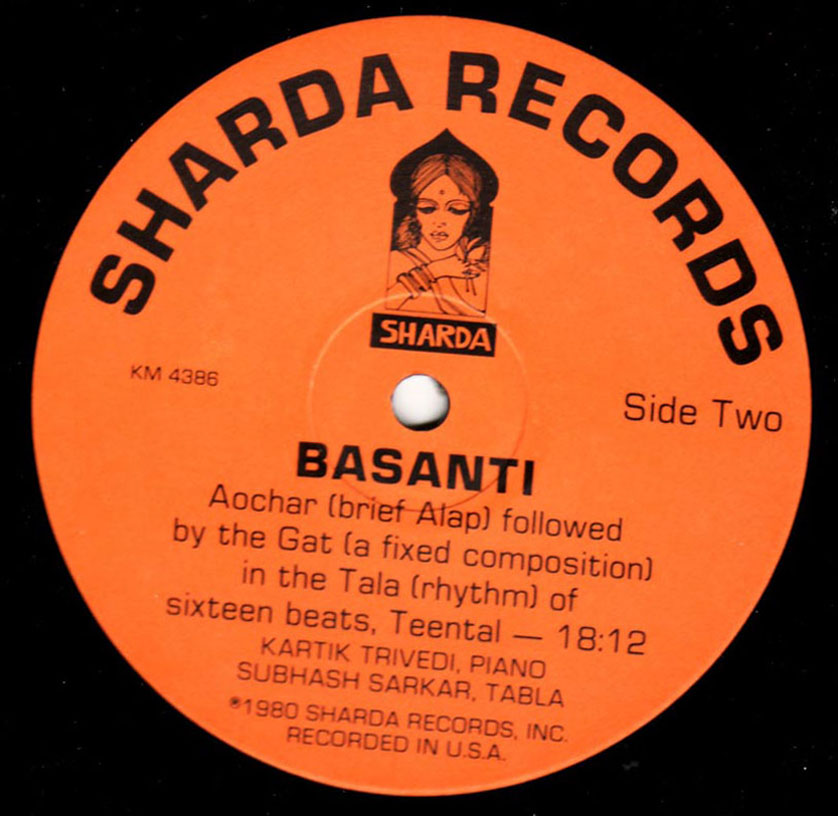
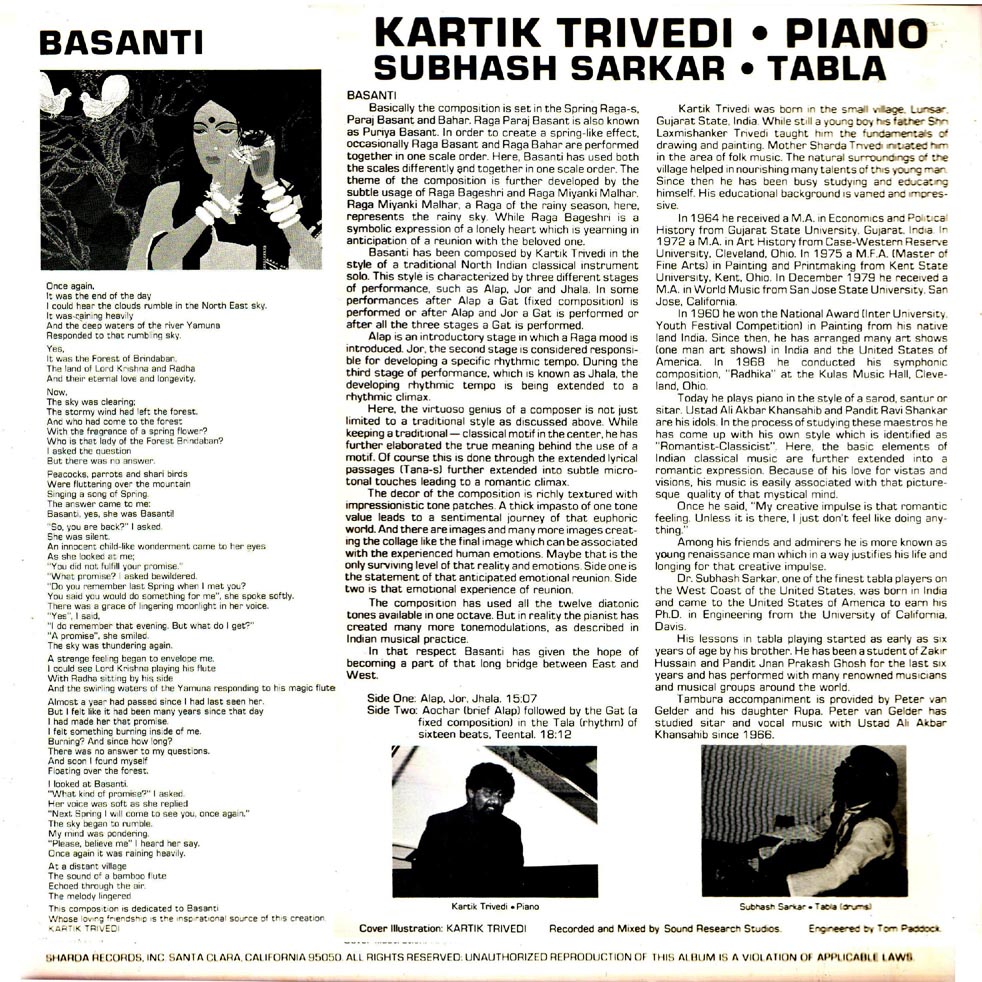
Kartik Trivedi ~ Piano, Cover Illustration Subhash Sarkar ~ Tabla
this precious recording was shamelessly swiped from raga blog, who tirelessly endeavor in furthering the evolution of our species. i love piano when it's applied to eastern scales. 320 rips courtesy of jc-l w/ my own scrounged imagery
01 Anonymous Lights 3:03 02 Arcane Notation 1:48 03 Almost [Prelude] 1:59 04 Fugitive Moonlight [Prelude] 2:59 05 Latitude 1 1:25 06 Berlin Kino 2:11 07 Along The Riverrun 1:35 08 Moon Blue Crooks 2:51 09 Music Noir [Prelude] 2:39 10 Cold Season [Prelude] 2:07 11 Latitude 2 1:36 12 And Then They Go 2:34 13 Rautendelein 2:15 14 Book Of Fixed Stars 11:11
Design - Faraway Press Written, Produced, Artwork By - Robert Haigh
Limited edition of 500 copies Packaged in a hand-made, heavy cardboard, mini LP style sleeve
'As enjoyable as Robert Haigh's albums have been, they never seemed to capture that same aching beauty of his classic albums from the '80s (both under his own name and as Sema). This latest album changes all that. The delicate touch and fragile melodies, which defined his best work, are both present. Sombre without being dour, reflective without being depressing, this represents Haigh's finest work in years.
The album begins sombrely with the title track; slow and nocturnal it sets the pace and the mood for the album. Like most of Anonymous Lights, this initial piece is short (only this and one other piece last longer than three minutes). Each tune is a vignette full of moonlight and dead calm. The influence of Erik Satie and Claude Debussy is obvious throughout but Haigh's unmistakable compositions could not be confused with scores from either composer. The likes of "Fugitive Moonlight" gently dances like light rain, as hypnotic as the natural sound but full of a supernatural magic and evoking the melodic powers of Satie and Debussy without aping their respective styles.
Elsewhere, "Berlin Kino" shows Haigh's superb ear for melody as he crafts a stunning constellation of notes over the pitch black of a repeating rhythm on the lower keys. The album's title and the starry quality of the notes both here and on pretty much every other piece on Anonymous Lights give the impression of being an observer, either a traveller gazing at a distant city or an astronomer casting their sight down the body of a telescope into the infinite heavens. This idea comes through strongest during "Moon Blue Crooks" which also incorporates the sound of a wind gusting through the music giving the feeling of in an old house, ear against the wall listening to a haunting (or haunted) piano as the weather beats the outside of the building.
At the end of Anonymous Lights is a lengthy piece, "Book of Fixed Stars," which evokes the same ghostly feelings as were present in the grooves of those old Sema records. Over the course of the piece, Haigh takes simple building blocks of melodic clusters and puts them together in cryptic, beautiful ways. The already slow pace of the album freezes and almost reaches a stop as Haigh lets each note form fully and ring; the reverberation blurring into the next note and creating a transfixing audio painting.'
To call this music beautiful is an understatement. Blixa Bargeld once said that "arms would not be able to stretch as far as necessary to form an adequate gesture for beauty." I like to think that Haigh has managed to form that gesture through his playing, stretching his arms along an infinite piano keyboard to create a true artistic representation of beauty at its purest' ~ brainwashed
by request. not exactly a bright sunshiney sunday afternoon record, but wotevs, eat's handy :) if it turns out ya dig this, don't miss Janas' previous drop of Three Seasons Only. a triumphant return to form fer Bobby H
A1 No Threat A2 The Shadows Of Mde. Velo's Story A3 Illuminated Bay, Illuminated Buoy A4 Row Boat A5 Into The Arc A6 Dance Of The Trout A7 Copper Hats
B1 Mesh B2 Lovers Of Observatory Time B3 The Barbers, The Barbers B4 Zebra Crossing
Peter Richardson [piano, keyboards] Greg Addison [guitar] Steve Couri [bass, guitar, synth] Tim Schultz [bongos, saxophone] Shane Fahey [synthesizer]
Recorded at M Squared Studios
'One of the best kept secrets in rock n' roll is the renaissance in Australian music in the first half of the 80s. Almost every capital city in the nation produced at least one or two really good bands, and Sydney and Melbourne a stack. Makers Of the Dead Travel Fast were likely the most obscure of the lot.
I simply must tell you this story, because it illustrates the band perfectly. The Makers gig we attended in Sydney in 1981 was the most laid-back rock n' roll show I've ever seen. The entire audience was sitting cross-legged on the floor. The band came on, six or seven people. They never introduced themselves, they just played. Throughout the entire show no one in the band said a word. Not a single person clapped, cheered, booed or even talked during the songs. We couldn't even figure out if it was them or not, because no one had ever seen a photograph of them, and they didn't play anything off the album. Then they played "Zebra Crossing". The song finished and we cheered like maniacs - all five of us! The band walked offstage. That was it.
The Vessels is post-punk instrumental music. The album is bookended by probably the two weirdest pop songs I've ever heard. It is pop - melodic, concise - but it's just out there. Electronic, robotic..? But catchy! And lyrics to boot: "Two of my former idols have now gone to the pack/ I pitted them against each other while we were countin' back to back.'
Between these bookends is the mood music. The mood is of being adrift on a still dark ocean in the middle of the night. It is curious, it is creaking. Just when things seem to be sinking right down into ambience, the pace lifts a tad again, piano-playing respectful and measured. And then.. "Copper Hats"!! One of the classic weird rock n' roll songs, 'Copper Hats' is the sound of a bunch of retards banging pots and pans and muttering - yet still the ever-lingering pop catchiness!
Side 2 sees the band clearly transcending the ambient tag with the addition of some free-form brass which reflects the milieu of jazz-punk contemporaries Laughing Clowns and others. This side is less essential, with repetitive, hypnotic pounding beginning to drag by the middle of the side. A strong finish though, with 'Zebra Crossing'. The Vessels, another minor classic; the sort of obscure rock n' roll grail you could - if you were that way inclined - spend the rest of your life searching for.' ~ source
one of the dreamiest albums from Oz's answer to Tuxedomoon, who retain a haunting vibe throughout without resorting to too much saxophone silliness. simply stunning piano musique, 320 enchanting evocations later
01 Patafisiskal Polska 02 Cafe, Copa, Puro 03 Neo-Realismo Del'Habanera 04 Midnight To Six Hands 05 A Glass Of Gaz 06 Return Of Johnny Guitar 07 4 Rroses Pour Marie 08 Valse De L'Aiguille Creuse 09 La Plaza D'Orient As Locus Solus 10 Waiting For Mister Motch On Beyrouth 66 11 Ava, In A Palindromic Garden 12 Patafisiskal Re-Polska
the arrangements & instrumentation on this album are more fleshed out than the compartively sparse Haïkus, but retain his singular style of repetitive melancholique simplicity in the most sublime way. nuff said. 320 remerciements à l'uploader d'origine. s'il vous plaît soutenir l'artiste
01. Tango del Rosselló 02. Smoke on the Water 03. Egyptian Reggae 04. Let me try 05. Alifib 06. Rue des soeurs noires 07. Your labios as tulips 08. Put a straw under baby 09. C'era una volta il West 10. Love theme from Ben Hur 11. Mexican theme frome Rio Bravo 12. Nocturn, a Joan Salvat-Papasseit 13. Souvenir de Vernet-Les-Bains 14. The sad skinhead 15. Good-bye pork-pie hat 16. Greenlands 17. Abril 74 18. Valse de l'aiguille creuse 19. 4 Roses pour Marie 20. Marcha mora 21. Amarcord 22. I surrender 23. Besame mucho 24. 96 tears 25. Les humeurs
Pascal Paul Vincent Comelade [born June 30, 1955], is a French Catalan musician. Comelade born was in Montpellier, France. After living for several years in Barcelona, he made his first album, Fluence, influenced by electronic music and by the group Heldon. Subsequently, his music has become more acoustic and is characterised by the sounds of toy instruments, used as solo-instruments and as an integral part of the sound of his group, the Bel Canto Orquestra.
Each new album by Pascal Comelade is in itself a bit of an event. The man makes himself rare in France and is much more prolific in Catalonia, where he is considered to be an essential musician. In France, he is seldom mentioned in the media, and, in record shops, his music is often to be found in the film score section, with experimental music or even with world music. The last time he really got the attention of the critics was for his musical show Psicotic Music-Hall in 2002, a tribute to La Bodega Bohemia, a historical cabaret in Barcelona.
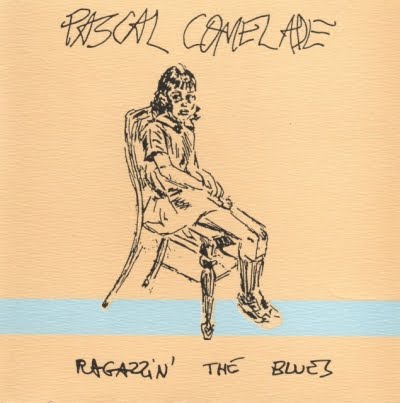
"I did a series of concerts in Tokyo in 1991 and played at the French-Japanese Institute. In the sixties, Yves Klein was there, giving French lessons in order to pay for his own judo lessons. My first record for DSA, 'Détail Monochrome' [1984] was - with its title and its cover [a monochrome blue one] - an involuntary tribute to Yves Klein. A second luck was that I found in Tokyo a toy piano from the same manufacturer of the piano which is in the CCAM Studio. With both pianos, I recorded 'Haïkus de pianos' as a special thank you to all the nice Japanese people I met in Tokyo." ~ pc
one of the most innovative french composers unfurls a sublimely short but super sweet set of unlikely covers & strong originals for grand & toy piano :) thoughtful sequencing & continuity demand repeated listening, with only about half the tunes featuring the prominent ticklin of toy ivories. 320 remerciements à l'uploader d'origine
01. Hook & Sling - (Extended Unedited Mix, previously unreleased) 02. Sissy Walk - (previously unreleased) 03. If It's Good to You It's Good for You - (Extended Unedited Mix, previously unreleased) 04. Check Your Bucket 05. How Sweet It Is - (previously unreleased) 06. Thang, Pt. 1, The 07. Funky Jam 08. Hey Mama Here Comes the Preacher 09. Funky Yeah 10. Eddie's Rubber Band 11. Love Has Been Good - (previously unreleased) 12. Just Wonder - (previously unreleased) 13. Thang, Pt. 2, The 14. That Certain Someone 15. Come to Me - (previously unreleased)
Edwin Joseph Bocage ['Eddie Bo'] was an American singer and New Orleans-style pianist. Schooled in jazz, he was known for his blues, soul & funk recordings, compositions, productions & arrangements. He debuted on Ace Records in 1955 and released more single records than anyone else in New Orleans other than Fats Domino. these are 15 of his classic sides from the 60's. r.i.p. Eddie Bo 1930 – 2009
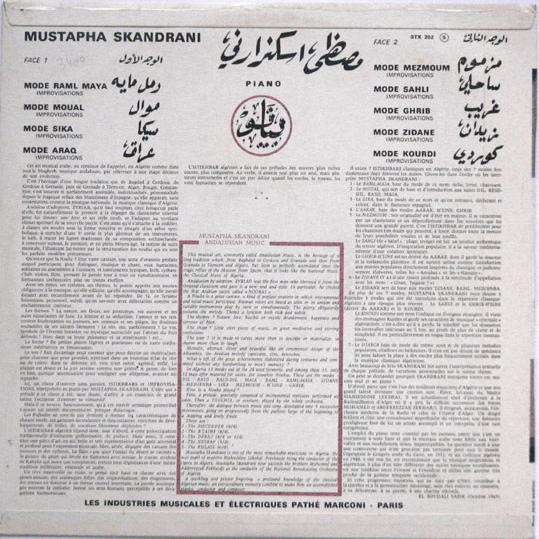
Mustapha Skandrani [November 17, 1920 - October, 2005] was a musician, composer, conductor & teacher of Algerian chaâbi of Algiers. Monument to the genre & Andalusian musique, the history of Algerian musique is intimately linked to his personality. It retains its virtuosity of Cheiikh Pianoriental and his compositions are highly appreciated by fans of this music.
Cheikh Mustapha Skandrani was born in the Lower Casbah in Algiers of a family from Cherchell (Tipasa). According to him, his origins are Iskander, a town in Turkey. He grew up and attended school in the ancient Casbah and its winding roads that take us back in Algiers and mysterious magic of another time. The lower part of the Casbah is where he was born near the sea and the port of Algiers & was at the time of the splendor of the city, a major commercial district. There remains today little trace except for a flea market in a bustling shopping ancient streets.
At an early age, Mustapha's uncle Habib Skandrani, noticing his nephew's interest in the piano - an instrument still disregarded by both chaâbi and art music ensembles - took it upon himself to teach him the rudiments. Mustapha has also his uncle to thank for getting interested in such instruments as the mandoline, guitar and kuweitra often heard in the ensembles of that time. He mastered playing them as well as his beloved piano, in no time. Sid-Ali, his father was also a passionate Andalusian music & it was in this atmosphere conducive to music that Mustapha began his musical career in 1938. First with Ahmed Sebti, a master of Andalusian music & then with Hadj M'Rizek, grand master of the song Hawzi who mastered all sorts of musical instruments, such as derbouka, piano, violin, mandolin & was not afraid of promoting the piano as a way to modernize the chaâbi and hawzi genres.
His radio debut was made with the composer and his partner Rasheed Ksentini Marie Soussan. Mahieddine Bachtarzi singer nicknamed "The Caruso of the desert by the French press discovered and hired him to replace the Jewish pianists. This resultedin a major tour of Algeria in 1940 with Oum Kalthoum, Mahieddine Bachtarzi , Driscar, Mustapha Kateb and others. Upon his return from tour, he accompanied all the stars who took part in concerts including Dahmane Ben Achour , El Hadj Menouar and dean of the Chaabi Mohammed El Anka.
In 1939, Mohammed Salah Arzour who was in charge of the musical programmes on the radio, had the first of a series of art music concerts broadcasted. As soon as Mustapha Skandrani had come back to Algiers, he was engaged to accompany, on the piano, such famous singers as: Dahmane Ben Achour, Hadj M'Rizek, Hadj Mahfoud, Hadj Menouar, Bachtarzi Mahieddine and Hadj M'Hamed Elanka.
Then the "Orchestre des sociétés réunies" came into existence with such masters as Ahmed Sebti, Mahieddine Lak'hal, Mohammed Benteffahi, the brothers Fakhardji and their most brilliant pupils; Mustapha Skandrani, at the piano, gave that orchestra the specific 'colour' still found in the way Andalusian music is played today, and thus founded the Andalusian School of Algiers.
In the years 1941 to 1945, he participated in the tours arranged by Mahieddine, entertained the guests of sport clubs, played for audiences at the "Padovani" - the music hall of Algiers - during the month of Ramadan and, on the radio, accompanied such great masters of art music and chaâbi as Elanka, Hadj M'Rizek, Hadj Mahfoud and Dahmane Ben Achour.
In 1945 he accompanied Salim Halali at the great gala performance given at the 'Forum', a public square in central Algiers, and also Lili Boniche at her gala performances in Algiers, Oran and Casablanca.
Besides, Mustapha Skandrani conducted the orchestra of the Algiers opera house every time a new play in Arabic was put on the stage, forty-six in all until 1956.
In 1956 Boudali Safir created the several ensembles of 'Radio Alger'. Mustapha Skandrani was to be in charge of the urban ensemble, conduct the folk music ensemble in the place of M. Elanka, and be the piano soloist of the art music ensemble conducted by M. Fakhardji. This prevailing position on the radio he kept until Algeria was independent. In independent Algeria he can boast of being the greatest Algerian pianist alive despite the fact there are many pianists nowadays. He also goes on conducting both the chaâbi and Andalusian ensembles.
From 1966 -1981, he devoted himself to teaching, taking a class at the Conservatoire d'Algiers. In 1981, Mustapha Skandrani directed the conservatory. Mustapha Skandrani was a master veteran who encouraged his students to the originality and development of their personality & often required them to submit to examinations & competitions with other works than those of the late Mohamed El Anka. Since 1938, Mustapha Skandrani has composed over 300 songs or modern chaabi and 187 compositions and Qasidah songs including 'Youm El Djemaa,' 'El Haraz', 'kifechhilti', 'Qahoua or Latey', 'A bouya Hnin'' filaati wool. He died in October 2005 at his home in Algiers after a long and painful illness. He was 85 & a one of a kind talent. There will never be another brother like him. May his eternal soul rest in peace.
marvelously unique recordings of a singular talent, generously bestowed upon us by an autodidactique musicologue extraordinaire who wishes to remain anonymous. a thousand thanks for this glorious gift. tis indeed a rare & wondrous treasure