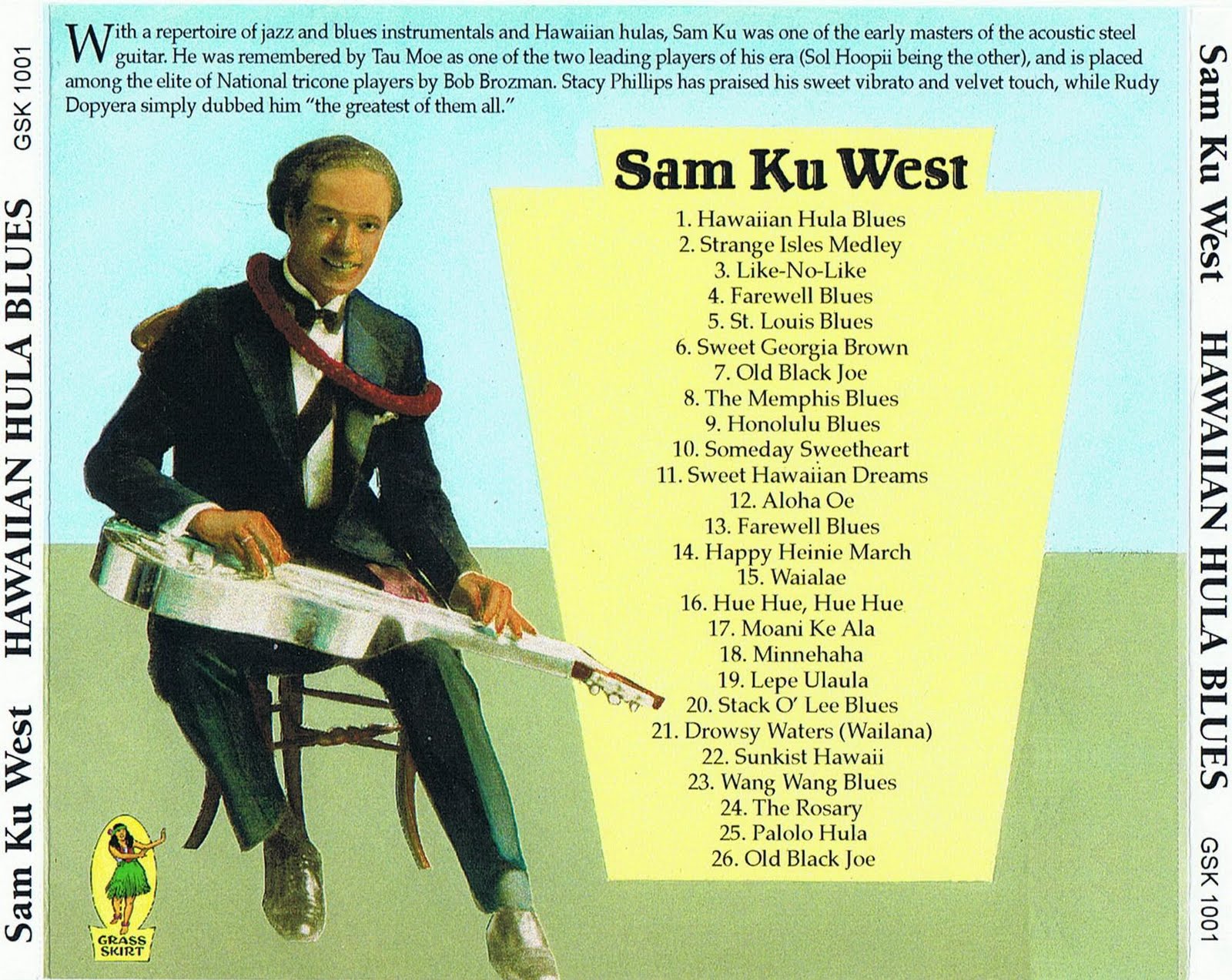
'Sam Ku was born in Honolulu, Hawaii in 1907, becoming a professional musician when he joined Irene West's troupe of touring musicians and dancers in 1926. Initially he was known as Sam Ku, Jr. but soon adopted the professional name of Sam Ku West. Often he would be billed as the 'Kreisler of the steel guitar' [referring to the famous violinist]. This title was given to him by Prince George of England who saw him play in Singapore in 1926.
His recorded legacy was 27 sides - mainly instrumental pieces - recorded for Banner, Gennett, Vocalion and Victor in a 15 month period starting in June of 1927. There were plans for him to record for Odeon in Germany, but illness prevented that .
He was encouraged by his manager to learn to play the concert harp and quickly added solos on this instrument to his live act, though he never recorded with it.
In his short career he toured extensively, making two visits to the Far East. He spent six months on the vaudeville circuits of New York, Boston and Chicago. The final year of his life were spent in Europe. He died in Paris in 1930.
Sam was remembered by Tau Moe, who for a short time was one of his backing band, as one of the two best steel players at the time... the other being Sol Hoopii.' ~ Brad
another tragic figure who left this world for the land of song at a mere 23 years young. dunno why i been diggin so much hawaiian musique lately, but i do find it rather soothing on these 100 degree evenings, ack! i'm likely just gettin long in the talon. anyhu, Sam miraculously recorded these 26 sides in the span of 9 months whilst extensively touring europe & asia with his ensemble. a 320 rip w/ illuminating booklet included
01. Hawaiian Capers - King Nawahi's Hawaiians 02. Singin' In The Bathtub - Four Hawaiian Guitars 03. Ukulele Benny - Georgia Jumpers 04. May Day Is Lei Day In Hawaii - King Nawahi's Hawaiians 05. Dinah - Red Devils 06. Mauna Kea - King Nawahi's Hawaiians 07. Honolulu Bound - Hawaiian Beach Combers 08. My Little A-1 Brownie - Charles B. Smith 09. Big Feet Rag - Georgia Jumpers 10. My Girl From The South Sea Isles - Hawaiian Beach Combers 11. Ticklin' The Strings - King Nawahi's Hawaiians 12. Black Boy Blues - Four Hawaiian Guitars 13. California Blues - Georgia Jumpers 14. I've Seen My Baby - Q R S Boys 15. Waikiki Blues - Hawaiian Beach Combers 16. I Went To Hilo - King Nawahi's Hawaiians 17. Guitar Rhythm - Georgia Jumpers 18. Hawaiian Melody - Hawaiian Beach Combers 19. Aloha Means I Love You - King Nawahi's Hawaiians 20. Wiggle Yo Toes - Q R S Boys 21. Otto Wood, The Bandit - Slim Smith 22. Maui No La Ka Oi - King Nawahi's Hawaiians 23. I'm A Dreamer Aren't We All - Hawaiian Beach Combers
One of the few Hawaiian guitarists during the 1920's and 1930's who could be considered a legitimate contender to the title of 'King of the Hawaiian Guitar' was Benjamin Keakahiawa Nawahi. 'King' Bennie Nawahi was born on July 3, 1899 in Honolulu to a large family. He taught himself to play slack key guitar, and by the age of 15 was playing Hawaiian guitar in Honolulu parks for sailors and tourists.
In 1919 Bennie got a job playing steel guitar with his brother Joe's group, the Hawaiian Novelty Five, on the passenger liner Matsonia. The group worked between San Francisco and Honolulu, eventually touring North America on the Orpheum vaudeville circuit. Before long, Bennie left the group and became an established singer and ukulele virtuoso. He was crowned 'King of the Ukulele' by impresario Sid Grauman of Grauman's Chinese Theater fame. His stunts included playing the song "Turkey in the Straw" on Hawaiian guitar with his feet.
By 1928 Bennie Nawahi had started his recording career, recording on many different labels, including Columbia, Victor, Q.R.S. and Grey Gull. He settled in Los Angeles in the early 1930s and formed a group called King Nawahi and the International Cowboys [which also featured a very young Roy Rogers]. Nawahi was one of the few Hawaiian musicians to consistently black jazz or blues numbers, some with black groups such as the Georgia Jumpers. He was also unusual among Hawaiian steel guitarists of his day in that he used a single cone Triolian rather than the National tricone guitars preferred by others.
In 1935, tragedy struck Nawahi, as he suddenly lost his eyesight while returning home from a performance. Doctors were unable to explain why he became blind. After a short time, he returned to the stage, working with various Hawaiian groups in the Polynesian restaurants and clubs that were popular in Southern California. After World War II, he again joined his brother in the Nawahi trio, recorded a few additional tunes, and continued to perform in clubs.
In addition to his musical abilities, Nawahi was also famed as a long distance swimmer. In 1946 he swam from San Pedro to Catalina Island in just over 22 hours. He is still the only blind man to have completed this swim. Remaining musically active through the years, Bennie Nawahi suffered a stroke in the late 1970s that left his body partially paralyzed. He died 'in the city they call Long Beach', California after a long illness on January 29, 1985.' ~ Brad
Bennie Nawahi was one of the true masters of the Hawaiian steel guitar, ukulele and just about any instrument with strings on it. Not only does his work rank as some of the greatest Hawaiian musique ever recorded, the imaginative, accomplished phrasing in his solos make him one of the unheralded giants 1920s string jazz. This overview covers Bennie's singing and instrumental work on native Hawaiian melodies, the blues, jazz, pop and rural music he heard on the mainland, and some of his own dazzling instrumental compositions. 23 toe tappin titillaters. a 320 rip
01. Bei Mir Bist du Schön ~ Waikiki Serenaders 02. Hootchy Kootchy Henry ~ Daphne Walker, Bill Wolfgramm & His Hawaiians 03. Murray Moon, The ~ Johnny Wade 04. Bell Bird Serenade ~ Jimmy Carter's Hawaiians, Pixie Williams 05. Magic and Moonlight ~ Keith Branch & His South Sea Islanders 06. Ryoshu ~ Buckie Shirakata & His Aloha Hawaiians 07. Gitaar Berboenji ~ Ninja Dan Ismail/Sweet Java Islanders/Miss Ninja Dan Ismail 08. Kota Ambon ~ Bintang Sinar 09. Cupid ~ Aloha Boys 10. Hawaiian Paradise ~ Miss Lucy Shoolbred & The Hawaiian Syncopaters 11. Hawaiiese Oe [Hawaiian Eyes] ~ Hendrik Jansen Se Hawaiiese Orkes 12. Yaka Hula ~ Kanui & Lula 13. Aloha Beloved ~ Kanui & Lula 14. Jubileumspotpurri 2: Drömmarnas Ö Tahiti ~ Yngve Stoor Med Sin Hawaiiorkester 15. Moonlight and Shadows ~ Malihini Hawaiians 16. On the Field ~ Hawaiian Quartett 17. Die Hula Mädchen Von Hawaii ~ Golgowsky Quartet & Tau Moe's Original Hawaiians 18. Die Weissen Blüten Von Tahni ~ Lys Assia Mit Hawaiian-Ensemble Aloha Islanders 19. Hawaii-Marche ~ Gino Hawaiian Orchestra Bordin 20. Ukulele Lady ~ A.P. Sharpe & His Honolulu Hawaiians 21. Ta Aspra Poulia Sta Vouna [The White Birds in the Mountains] ~ Kostas Bezos 22. Maui No la Ka Oi ~ Instrumentalni Soubor Karla Slavika 23. O Casuta Mica [In a Little Hula Heaven] ~ Ansamblul Mihail Daia 24. Kahanamoku [Bright] ~ Puka-Pakas 25. Mijn Iona ~ Kilima Hawaiians 26. Hawaiian War Chant ~ Kealoha Life
Regions of recordings[1922-195?]: Amsterdam, The Netherlands; Athens, Greece; Auckland, New Zealand; Berlin, Germany; Bucharest, Romania; Calcutta, India; Copenhagen, Denmark; Hilversum, The Netherlands; India; Japan; Johannesburg, South Africa; Paris, France; Prague, Czech Republic; Stockholm, Sweden; Sydney, New South Wales, Australia; The Netherlands; Tokyo, Japan; Wellington, New Zealand; Zurich, Switzerland
clever pun; steeling/stealing, get it? back in the day, the world had Hawaii fever. presented here are several thoroughly fascinating & enjoyable ethnological forgeries of this unprecedented phenomenon from the 78rpm era. virtually every continent throws down except for Hawaii itself & i strongly doubted any artists included actually hailed from the islands, but it seems i was mistaken. digger dug over at wfmu spotted these folks :) good lookin. 320 mahalos to twicezonked fer de hook-up