01. Jimmie Rodgers - Gamblin' Bar Room Blues 2 (1932) 02. Ethel Waters - Frankie and Johnny (1938) 03. Sonny Boy Williamson - Your Funeral My Trial (1958) 04. Lord Executor - Seven Skeletons Found in the Yard (1938) 05. Billy Boy Arnold - Prisoner's Plea (1957) 06. Wilmoth Houdini and His Humming Birds - Bandsman Shooting Case (1934) 07. Roosevelt Sykes "The Honey Dripper" - 44 Blues (1939) 08. Memphis Minnie - Biting Bug Blues (1935) 09. Bessie Smith & Her Blue Boys - Send Me to the 'lectric Chair (1937) 10. Wade Mainer & Zeke Morris - Down in the Willow Garden(1937) 11. Blind Boy Fuller - Pistol Slapper Blues (1938) 12. A'nt Idy Harper & the Coon Creek Girls - Poor Naomi Wise (1938) 13. Honeyboy - Bloodstains on the Wall (1953) 14. Little Walter and His Jukes - Boom Boom, Out Goes the Light (1955) 15. Louis Armstrong with Louis Jordan and His Tympany Five - You Rascal, You (1950) 16. Champion Jack Dupree - I'm Going Down with You (1945) 17. The Stanley Brothers - Pretty Polly (1950) 18. Archibald - Stack-A-Lee Parts 1 & 2 (1950) 19. Henry Thomas "Ragtime Texas" - Bob McKinney (1927) 20. G B Grayson & Henry Whitter - Rose Conley (1927) 21. Billie Holiday - Strange Fruit (1938) 22. Lonnie Johnson - Got the Blues for Murder Only (1930) 23. The Delmore Brothers - The Fugitive's Lament (1935)
'Ever since the days of Cain and Abel, many a fine murder story has gripped people's imagination. Jealousy is not the only root cause of man's murderous impulse. Greed, lust, guilt, power - any one of these, it seems, is sufficient to justify taking a human life. Every day we read of brutal murders being committed. These stories were ripped from newspaper headlines and recast into verse and recorded, often within weeks of the actual event. They became part of the repertoire of hillbilly bands, blues guitarists, jugbands, r&b and tin pan alley entertainers, bluegrass artists and calypso singers.'
one of the most successful thematic compilations of haunted olde tunes from the trikont imprint, featuring a few familiar staples & several more stunners that don't seem to get repeatedly regurgitated on every new old-timey comp from some of the younger upstarts. 320 er FLACK + bi-lingual skannage
01. Eddie South - Two Guitars 1929 02. Danai - Misirlou, 1947 03. Georges Boulanger et son Orchestre - Sombre Dimanche, 1934 04. Oscar Alemán - Bésame Mucho, 1943 05. Abe Ellstein Orchestra - Second Avenue square dance, 1950 06. Shorty Godwin - Jimbo Jambo Land, 1929 07. Harry Choates - Devil in the Bayou, 1946 08. Dick Reinhart - Always Marry Your Lover, 1929 09. Efisio Melis - Fiuda Bagadia, 1943 10. Wasyl Emetz - Ukranian Bandura, 1930 11. Amelita Galli-Curci - Sadko: Song of India, 1922 12. The Gilt Edged Four - Yiddisher Charleston, 1927 13. Damia - Sombre Dimanche, 1936 14. William Moore - Old Country Rock, 1928 15. Emmet Miller - Sam & Bill At The Graveyard, 1930
Wile Side
16. Mohd Rafi - Jinhe Naaz Hai Hind Par [Pyaasa], 1957 17. Samuel Malavsky - V'Shomru, 1929 18. Syl Johnson - Teardrops, 1959 19. Kookie Cook - Revenge, 1966 20. Grayson & Whitter - Rose Conley, 1927 21. Lata Mangeshkar - Kahin Deep Jale Kahin Dil [Bees Saal Baad], 1962 22. Malvina Reynolds - From Way Up Here, 1971 23. Freshly Wrapped Candies - Green Grass, 1987 24. Graham Davies - The Road Is Hard, 1976 25. Wiley Walker & Gene Sullivan - When My Blue Moon Turns to Gold Again, 1941 26. Stan Hubbs - Golden Rose, 1982 27. Spooky Dance Band - Nightmare Fantasy, y2k 28. Ben Douglas - Foxhunt, 1960
started making a mix of a buncha haunting 78's just to see if i could & once i had, i began to realize i been listening to pretty much the same tunes fer the last decade & disproportionately representing america & turkey. so i attempted to switch it up a bit & this is the result. too sad fer the public? kitty lovingly donated by murky
01. Fado em Lá Maior 2:39 02. Fado Peniche 2:11 03. Fado Alexandrino 2:32 04. Fado Armandinho 2:59 05. Fado Estoril 2:48 06. Fado en Mi Menor 2:39 07. Fado Magioli 2:30 08. Fado Conde de Anadia 2:37 09. Fado Bacalhau 2:51 10. Marcha em Ré Maior 2:22 11. Marcha em Ré Menor 3:14 12. Fado Fernandinha 2:33 13. Variações en Lá Menor 2:50 14. Variações en Mi Menor 3:02 15. Fado de Sintra 2:39 16. Variações em Lá Maior 2:31 17. Variações em Ré Maior 3:04 18. Fado das Berlangas 3:10 19. Fado Fontalvo 2:53 20. Olhos Bonitos 2:37
'At a time when the Portuguese guitar was not as technically developed as it is nowadays, there appeared a man who was responsible for introducing important innovations in playing style and technique, thereby bringing the instrument into modernity. A true pioneer, Armando Augusto Freire, nicknamed Armandinho, will always be remembered as one of the best Portuguese guitar performers in fado history. His style is very lyrical and inventive, and his uncanny ability to improvise amazed audiences wherever he performed.
Born in Lisbon in 1891, Armandinho was drawn to the Portuguese guitar from an early age due to the possibilities that it offered him in his longing for expressing his characteristic sentimentality. A self-taught musician, Armandinho was deeply influenced by his admired Petrolino, an obscure and extravagant guitarist that is said to have performed as far afield as Czarist Russia. His first public appearance took place when he was fourteen at the Teatro das Trinas, and even back then, his style was already becoming very polished, setting him apart from most of his contemporaries. Armandinho soon became one of the most sought-after accompanists in Lisbon, and he was an integral part of many overseas tours that took him to Brazil, Argentina, and Uruguay. In the early 1930s, he toured Madeira and the Azores Islands with Martinho d’Assunção, João da Mata, and singer Ercília Costa, and he also performed in Angola and Mozambique with singers Berta Cardoso and Madalena de Melo. Throughout his career, he accompanied many great fadistas, including Amália Rodrigues in her early years as a singer.
Armandinho was not only an extraordinarily gifted musician, but he was also a very accomplished composer. Some of the tunes that he wrote, such as “Fado Armandinho,” “Ciganita,” “Fado São Miguel,” and “Fado Mayer,” have acquired the status of standards and are still widely performed today. Although his recording career was not very prolific, he did cut some sides for HMV that are now collector’s items and that allow us to appreciate his unparalleled artistry and the magic sounds that he could produce with a Portuguese guitar in his hands.
Armandinho was a man who devoted his whole life to fado and to the Portuguese guitar. After his passing in December of 1946, when he was only 55, he became a legend, a classic, a performer to whom virtually every Portuguese guitarist is indebted. Some of his many followers include such magnificent musicians as Jaime Santos, Raúl Nery, and José Nunes. In his very nostalgic, autobiographic fado “Belos Tempos” (“Good Times”), Fernando Farinha remembers Armandinho as 'that great commander,' ranking him as one of the most versatile Portuguese guitarists in the history of fado. There is no doubt that the innovations introduced by Armandinho during the first half of the twentieth century changed the Portuguese guitar forever and played a decisive role in shaping the sound of fado as we know it now. Hence, his incomparable talent and his extraordinary legacy will always live on.' ~ Anton Garcia-Fernandez
surprising to find zero recordings from this conjurer available in blawgland, apart from what we previously dropped here. with a bell-like tone, armandinho was grand wizard of the fado, his runs occasionally reminiscent of a sped-up music box or washington phillip's dolceola maybe? i dunno, but what i love about his evocative sound is indeed the sentimentality it provokes, making me misty fer some ineffable quality i can't quite place or a distant dream i can't consciously remember. i get similar goosebumps from several 1920s recordings, many of which are indeed lamentations & certainly there's a sorrow & longing embedded in the melodies, but perhaps the loss that resonates most when i listen to these timeless tunes is a sense of nostalgia fer an age where mastery on this level was even possible
01. I'll Go With Her 02. Rollin' Stone (Part 1) 03. Get Away Blues 04. Alabama Blues 05. I Do Blues 06. Long Train Blues 07. That's No Way To Get Along 08. Fallin' Down Blues 09. Jailhouse Blues 10. Losin' Out Blues 11. Rollin' Stone (Part 2) 12. Old Jim Canan's 13. Nashville Stonewall 14. Police Sergeant Blues
'There are perhpas only a handful of blues musicians with as much to offer as Robert Wilkins. His breadth of material is practically unmatched among his peers and he is one of the few artists who puts a premium on the individuality of his songs. His effortless command of different styles and captivating vocals are masterful. Classic performances abound.' ~ press
likely my fave blues bra & still as haunting & evocative as the day is long. the shellac transfers & mastering by richard nevins are top notch too, as is customary with yazoo. how i envy you, uninitiated. 320 rips lata
01. The Blue Bird 02. Crépuscule hawïen 03. Manuska 04. Hawaï nous appelle 05. Sérénade bleue 06. Retour d'Hawaï 07. J'écoute la guitare 08. En écoutant l'ukulélé 09. Addio Signora! 10. Hawaiian berceuse 11. Je n'ai plus personne 12. Reflet viennois 13. Viens dans ce joli pavillon 14. Hé hop la hé 15. C'est une valse qui chante 16. Waikiki en fête 17. One kiss 18. La destinée du marin 19. Le jeune pêcheur 20. L'ile aux rêves d'or 21. Chant d'amour de Tahiti 22. Ay, ay, ay 23. De tout mon caeur 24. Dans la nuit 25. Avant de mourir
Gino Bordin [1899-1977] was born on 4th February 1899 in Vicenza, in the north east Italy. His eldest brother led an orchestra in which Gino played the musical saw and sometimes harp-guitar acquired from Luigi Mozzani, at Cesta. There he struck up a friendship with the prodigy Mario Maccaferri.
His name first appeared beside that of Michel Péguri, an accordionist, on a Perfectaphone disc where the record label showed “ banjo : Gino Bordin”. Although he later abandoned this banjo for guitar and Hawaiian guitar, he continued to play with musette accordionists until the end of his career.
In the 20s Gino supported other accordionists on his guitar and chanteurs and chanteuses also began to call on his talents as accompanist and writer. All doors opened for him, and, significantly, those to the recording studios. When the record companies realised the sudden taste for Hawaiian guitar, the slenderness of their catalogue licensed from America in this genre and the need to add a repertoire more to French public taste, they turned naturally to Gino Bordin, already a virtuoso on the instrument.
Perfectaphone recorded Dreamland and Beautiful Hawaï by Gino Bordin, Hawaiian guitar. Then Pathé issued in early 1928 four other covers of standards interpreted by a Hawaiian Trio, Bordin, Kamenetsky and de Lignori. From then Gino Bordin went on to record hundreds of titles for at least 15 labels, in his own name and also under various pseudonyms. We can count at least 120 sides for Parlophone, over 60 for Polydor and Pagode, at least 20 for Pathé. The Odéon label issued over 30 to which we should add English pressings on Decca and Ariel, those on Columbia and Polydor in Japan, Parlophone in Australia and Brazil. There were yet more titles on Salabert, Omnia, Grammophon, Supraphon, Disc Art, Gladiator, Colisée, MP, Clarus, Discum, Unifix and, after WW2, Pacific, Vogue, Mode, Mondo Music, Nixa, Saturne and Charmilles... that’s without counting the many discs he played on where the record label credit simply read: Hawaiian trio or Hawaiian Guitar
Gino Bordin adapted the guitar from Honolulu to every musical style. There were only a handful of Hawaiian standards or hapa haole tunes, but there were many originals including classical, in all sorts of orchestrations, from guitar duo to large string formations, in instrumental versions or with refrain. SACEM (the music copyright agency) handles a catalogue of about forty works written by Gino Bordin either alone or with co-writers Gardoni, Ferrari, Viseur and Saarbecoff. That short list doesn’t tell the full story because published sheet music and record labels show that he was the prolific writer of dozens more instrumental pieces and songs.
French radio stations broadcast Gino Bordin’s records widely and also invited him to play live in their studios. Then Radio Lausanne and stations from Hilversum in Holland spread his fame throughout Europe.
Now a star on records and radio, Gino increased the number of his concerts and tours. Since 1926 he had sported the white Hawaiian outfit and red silk sash, slipped the lei around his neck, posed with guitar flat on his lap and livened up the dance-halls of the casinos, at Dinard, Saint Jean-de-Luz and Monte-Carlo. In 1931 his orchestra consisted of three dancers in exotic dress, Alex Manara on second Hawaiian guitar, Vincent Kamenetsky on guitar and Joseph Puni, the authentic Hawaiian, on ukulele. Later Le Trio Havaïen saw Gino flanked by Jean Stéfani and André Thomas, Tino Rossi’s guitarists. As for the Bordin-Manara duo ...that was seen at every possible opportunity, and notably opened for Édith Piaf at the ABC in 1937. Gino Bordin played on all the great Paris stages, Paramount, Gaumont, Rex, Alhambra, Bobino, Européen, Vel’ d’Hiv, at the Carlton in Cannes, at Monte Carlo’s Palm Beach, at Maxim’s in Athens. He criss-crossed North Africa, went as far as Alexandria and Cairo, and went through Lausanne, Zurich, The Hague, Amsterdam and Rotterdam. During the war a lengthy tour took him to the Wintergardens in Vienna and Berlin and all across Germany to Prague and Warsaw
In France the guitar from Hawaii owes its popularity to Gino Bordin. At first he used a pear shaped acoustic Hawaiian guitar then being made in the Vosges. In 1932 Mario Maccaferri produced for Selmer his jazz guitar with resonator chamber which Django made famous and he designed at the same time a 7 string Hawaiian model without cutaway, an idea conceived with his friend Gino. In early 1936 it was Maccaferri who again brought him right up to date when he returned from a USA visit carrying under his arms a National lap steel electric 7 string, immediately christened the “Magic Guitar” by Gino and plugged in at the studio in May that same year. Gino, pioneer of the electric guitar, had already contributed to the instrument’s evolution by adding a low seventh string in 1931 and using a seventh tuning, then later a 6th tuning. His Nouvelle Méthode de Guitare Hawaïenne à Sept Cordes (New Hawaiian Guitar Method for 7 strings) published in 1935 by Max Eschig contained a “Transposer”, a cardboard device with holes which denote on the frets the location of notes for each chord. Based on a similar principle he also produced a set of 16 cards “500 guitar chords by the perforated strip system”. He published collections of arrangements for the instrument and up until the mid 1960s gave lessons at his home on or in the posh colleges of the southern suburbs. During this period Gino was still appearing in cabaret and still playing on stage with Fredo Gardoni. His career had lasted all through the 40s and 50s. He accompanied Patrice and Mario, then Tino Rossi once more ...and Lucienne Delyle too, while his records for Pacific and Vogue had wide distribution and the younger generation of players, Harry Hougassian and Marcel Bianchi considered him a master. From 1965 however Dupuytren’s Contracture reduced the movement in his left hand and forced him gradually to rein in his musical activity. In 1969 he retired to l’Isle-sur-la-Sorgue. And that’s where he has been at rest since 14 July 1977 - liners
superb hawaiian gypsy jazz. darker & more doleful than the typical fare & perhaps more timeless as a result, but then i do dig the somber schtuff. would certainly love to find this in more prestigious bits, but til then this'll hafta do :)
01. Rocky Porter - The World Is A Monster 02. Johnny Bond and His Red River Valley Boys - All I Can Do Is Cry 03. Andy Reynolds & His 101 Ranch Boys - Beer Bottle Mama 04. Neal Jones - I’m Playing It Cool 05. Johnny Hicks - Pick Up Blues 06. Freddie Hart - Blue 07. Billy Walker - The Record 08. Johnny Hicks - Rainy Night Blues 09. Bobby Lord - I’m The Devil Who Made Her That Way 10. Jimmy Johnson - Throwing My Life Away 11. Paul Howard & His Cotton Pickers - Drinking All My Troubles Away 12. Carl Story - What A Line 13. Little Jimmy Dickens - Me And My Big Loud Mouth 14. The Maddox Brothers - Ugly And Slouchy 15. Billy Walker - I Can’t Keep The Girls Away 16. George Morgan - A Shot In The Dark 17. Jimmy Littlejohn - No Parking Here 18. Jimmy Murphy - Here Kitty Kitty 19. Smiley Maxedon - Red Hot Mama And An Ice Cold Beer 20. The Tunesmiths - Oh Stop! 21. Frankie Miller - Hey! Where Ya Goin? 22. Charlie Adams - I’m A Railroad Daddy 23. Polly Possum & Joe Wolverton with The Dog Patch Boys - Don’t Talk To Me About Men 24. Charlie Adams - Pistol Packin’ Mama Laid Her Pistol Down 25. Ray Price - Much Too Young To Die 26. Carl Smith - There’s A Bottle Where She Used To Be 27. Chuck Wells - The Barroom Girl 28. Jimmy Johnson - I’ve Lived A Lot In My Time 29. The Country Boys - Bud’s Bounce 30. Jack Rhodes & His Lone Star Buddies - Eternity 31. Freddie Hart - The Wall 32. Rose Maddox - When The Sun Goes Down
'Out of the ashes of World War II, post-war Corporate U.S.A would sully its hands with anything in search of a buck. Heck, even Hillbilly music... Here, for the first time, are 32 of the grimiest, most delicious slabs of Hillbilly misery and mayhem to grace the Columbia Records imprint. From the Rhinestone Noir of Rocky Porter’s “The World Is A Monster” and Johnny Bond’s “All I Can Do Is Cry” to the proto-feminist declaration of Polly Possum’s “Don’t Talk To Me About Men” and the proto-punk loser’s lament of The Maddox Brothers “Ugly And Slouchy”. More tears in your beer than you can count, more kick in your heels than a regiment of cavalry.' - press
01. Twelfth Street Rag 3:28 02. I Ain't Got Nobody 3:09 03. Hula Blues 3:12 04. Chimes 3:00 05. Sweet Lei Lehua 2:57 06. Most Of All I Want Your Love 07. Feelin' No Pain 3:23 08. Kilohana 3:21 09. Stack O'Lee Blues 3:01 10. St. Louis Blues 3:06 11. Patches 3:12 12. Alekoki 2:38 13. Farewell Blues 2:52 14. Singing The Blues 2:56 15. Hilo 3:04 16. Tin Roof Blues 3:16
dear frenz, aint got no thyme fer sound samps & that mess bein on de road like eye is, but rest assured if you dug any of the other hawaiian ish we dropped previously, do not hesitate. hoopii was gawdhed & deez peerless recordings are over 80 years olde. this one requested at the resplendent record fiend grog, 320 luaus later
01. Louis Dumaine's Jazzola Eight - To-Wa-Bac-A-Wa 02. Roy Johnson's Happy Pals - Happy Pal Stomp 03. Mamie Smith - Goin' Crazy With The Blues 04. Sam Morgan's Jazz Band - Over In The Gloryland 05. Pickett-Parham Apollo Syncopators - Mojo Strut 06. Paul Tremaine And His Aristocrats - Four Four Rythm 07. Charlie Johnson And His Paradise Band - The Boy In The Boat 08. Bennie Moten's Kansas City Orchestra - She's Sweeter Than Sugar 09. Ross De Luxe Syncopaters - Florida Rhythm 10. Frenchy's String Band - Texas And Pacific Blues 11. Taylor's Dixie Serenaders - Everybody Loves My Baby 12. Jelly Roll Morton's Red Hot Peppers - Kansas City Stomps 13. Ben Tobier And His California Cyclones - Hot And Heavy 14. Fowler's Favorites - Percolatin' Blues 15. Oliver Naylor's Orchestra - Slowin' Down Blues 16. George McClennon's Jazz Devils - While You're Sneaking Out (Somebody E 17. Floyd Mills And His Marylanders - Hard Luck 18. Maynard Baird And His Orchestra - Postage Stomp 19. King Oliver's Jazz Band - Mabel's Dream 20. Gowan's Rhapsody Makers - I'll Fly To Hawaii 21. Sammie Lewis With His Bamville Syncopators - Arkansas Shout 22. The Hotentots - Lot's O' Mama 23. Frankie Franko And His Louisianians - Somebody Stole My Gal
'This groundbreaking series brings together some of the greatest performances of early jazz, illustrating that before jazz became a listener's music of improvised solos it was the rhythm-driven dance music of America, the rock and roll of its day. This album shows the incredible variety of the 1920s jazz by bringing together diverse, often obscure masterpieces by legendary small groups and large bands from both city and country. Highlighted is the rich regional flavor of early American jazz with showpieces by territory bands such as Ross De Luxe Syncopaters, Taylor's Dixie Serenaders, and Roy Johnson's Happy Pals along with classics by the pioneer New Orleans band of Louis Dumaine, Sam Morgan and much more. This is an entertaining and illuminating exploration of early jazz which traces its roots back to marching bands, ragtime and vaudeville.' ~ press
i should be headin to bed, but for the sake of levity, hear goes another 78 toe-tapper to counterbalance the austerity of those mournful bosnians, in case cumbias somehow aint yer bag [seriously?]. take this allah killa zero filla vintage jazz joint from our fine friends at yazoo & wash it bach with a rotgut shot o' bathtub gin :) 320 fanx to pomegranate for this piece, booklet lovingly included. lest we forget the roots & branches
01. Fatima - Alexander Maloof & the Maloof Oriental Orchestra 2:39 02. Il-Bulbul Nagha - Constantine Souse 6:40 03. Hawwil Ya Ghannam - Amer Khadaj, Jalil Azzouz 6:04 04. Lamma Ya Albi - Sana Khadaj, Jalil Azzouz 6:13 05. Raks 'Arabi - Na'im Karakand 3:08 06. Wakef 'Ala - Hanan, Joe Bedway, Yacoub Ghannim, Hakki Obadia, Na'im Karakand 7:14 07. La'uli Bayt - Anton "Tony Abdel Ahad, Philip Solomon, Ronny Kirby 5:51 08. Arabic Folk Songs - Danny Thomas, Toufiq Barham 7:39 09. Flute Imitation - Na'im Karakand 4:00 10. Li'b Al Khayl - Russell Bunai, Joe Bedway, Muhammad al-Akkad 5:24 11. Only You - Kahraman 3:07 12. Taqasim 'Ala al-'Ud - Jalil Azouz 6:25 13. Hall Tadree - Russel Bunai, Joe Bedway, Philip Solomon, Muhammad al-Akkad 6:09 14. Al-Jazayir - Tony Abdel Ahad, Philip Solomon 2:24
'This collection represents a vibrant, dynamic but little-known aspect of American music, predating the era of the album, cassette and CD. The 14 performances collected here, originally recorded on 78 r.p.m. records by Arab American musicians, are but a sample of the music that sustained people of Arab heritage in America during roughly the first half of the twentieth century. Independent Arab-American labels such as Alamphon, Abdel Ahad, Star of the East and Cleopatra were among those who recorded for the people of Arab heritage who had settled in America. That so many independent companies flourished [the original 78 rpm recordings here date from 1916 to the early 1950s] reflects the enthusiasm of the Arab-American community for this music.' ~ back cover
evocative sonic nectar of the shellac era is my musical raison d'être more than any other, so i'm ecstatic to unfurl one of the most potent collections of arabic songs & dances ever assembled. in the mid 90s when i began digging 78 rpm compilations of 'ethnic', blues, jazz & gospel pirty heavily, this joint was amongst the first inspirational wave of releases responsible for making that period of discovery so exciting. the physical document itself was lost in the whirlwind that is life & it's only by virtue of a dear friend that these achingly beautiful melodies have recently made their way back into my consciousness, booklet & owl :))) شكرا مرة أخرى صديقي العزيز. هذا هو أعظم هدية يمكن تخيلها
01. Train 45 - Grayson & Whitter 02. Nine Pound Hammer - Frank Blevins & His Tar Heel Rattlers 03. Last Gold Dollar ~ Ephraim Woodie & The Henpecked Husbands 04. Ground Hog - Jack Reedy & His Walker Mountain String Band 05. My Name Is Ticklish Reuben - Smyth County Ramblers 06. Fly Around My Pretty Little Miss - Frank Blevins & His Tar Heel Rattlers 07. Nobody's Darling - North Carolina Ridge Runners 08. Short Life Of Trouble - Grayson & Whitter 09. Don't Get Trouble In Your Mind - Frank Blevins & His Tar Heel Rattlers 10. Cluck Old Hen - The Hill Billies 11. Likes Likker Better Than Me ~ Woodie Brothers 12. Way Down in Alabama ~ Smyth County Ramblers 13. The Fatal Courtship ~ Ephraim Woodie & The Henpecked Husbands 14. I've Always Been A Rambler - Grayson & Whitter 15. I've Got No Honey Babe Now - Frank Blevins & His Tar Heel Rattlers 16. Governor Al Smith For President - Carolina Night Hawks 17. Chinese Breakdown - Jack Reedy & His Walker Mountain String Band 18. Be Kind To A Man When He's Down - North Carolina Ridge Runners 19. Old Aunt Betsy - Frank Blevins & His Tar Heel Rattlers 20. Chased Old Satan Through The Door - Woodie Brothers 21. Handsome Molly - Grayson & Whitter 22. Sally Ann - Frank Blevins & His Tar Heel Rattlers
'An outstanding collection of 22 songs and tunes first recorded between 1927-1931 by string bands from Ashe County, North Carolina, a mountainous area in the northwest corner of the state once known as “The Lost Provinces” because of its extreme isolation. The music includes traditional fiddle tunes, folk songs, Anglo-Irish ballads, comic songs, topical numbers and original compositions, all from the time period often called the “golden era” of old-time string music. The anthology brings together for the first time the complete recordings of Frank Blevins & His Tar Heel Rattlers, the Carolina Night Hawks, the North Carolina Ridge Runners, and many more.'
the first comp we ever picked up from this superb label sometime last century & still a stunner, due in no small part to the presence of the venerable Grayson & Whitter on several cuts. do yer homework. these are just the kinda jams that make me wanna live waaaaaaay out in the country & a dam fine way to enjoy yer stay on this planet. 320 hillbilly hollers
01. Rukus Juice And Chittlin' - Memphis Jug Band 02. The Jazz Fiddler - Walter Jacobs And Lonnie Carter 03. Moanin' And Groanin' Blues - "Peg Leg" Howell And His Gang 04. Dance Hall Shuffle - Clifford Hayes' Louisville Stompers 05. My Four Reasons - Banjo Ikey Robinson And His Bull Fiddle Band 06. Wild Cow Blues - Joe Williams' Washboard Blues Singers 07. Knox County Stomp - Tennessee Chocolate Drops 08. Rustlin' Man - State Street Boys 09. Sister Maud Mule - Alec Johnson 10. G Rag - Georgia Yellow Hammers 11. Throw Me In The Alley - Peetie Wheatstraw And His Blue Blowers 12. If You Can't Make It Easy, Sweet Mama - Dixieland Jug Blowers 13. Bunker Hill Blues - Frank Stokes 14. I Got A Gal - James Cole's String Band 15. Sweet To Mama - State Street Boys 16. Doctor Medicine - South Memphis Jug Band 17. Cabo Verdranos Peca Nove - Abrew's Portuguese Instrumental Trio 18. Worried Man Blues - Joe Williams' Washboard Blues Singers 19. Georgia Crawl - Henry Williams And Eddie Anthony 20. Good Old Turnip Greens - Bo Chatman 21. Memphis Stomp - The Blue Boys 22. Get Up Off That Jazzophone - The Bubbling-Over Five 23. Rukus Juice Shuffle - Alabama Rascals 24. Lazy Lazy River - Mississippi Sheiks
'24 tracks of rare fiddle music from the early years of recorded sound, covering a wide range of artists and styles. Playing ragtime tunes, country breakdowns, hardcore blues and hot jazz, these fiddlers cut loose on the instrument known as 'The Devil's Box.' Blues fans recognize Lonnie Johnson, Bo Carter, and Big Bill Broonzy as masters of the guitar, but these men were also talented fiddlers, and they’re all included on this disc. You’ll hear jazz from Chicago’s South Side, string band music from Mississippi, and blues from Beale Street. The State Street Boys play uptown blues, while groups like the Alabama Rascals and the Dixieland Jug Blowers provide good-time dance music.'
we loves old hat. the amazing musical selections & illustrious accompanying booklet [not included here] make this collection a mandatory perchase. 320 quintessential scrapes
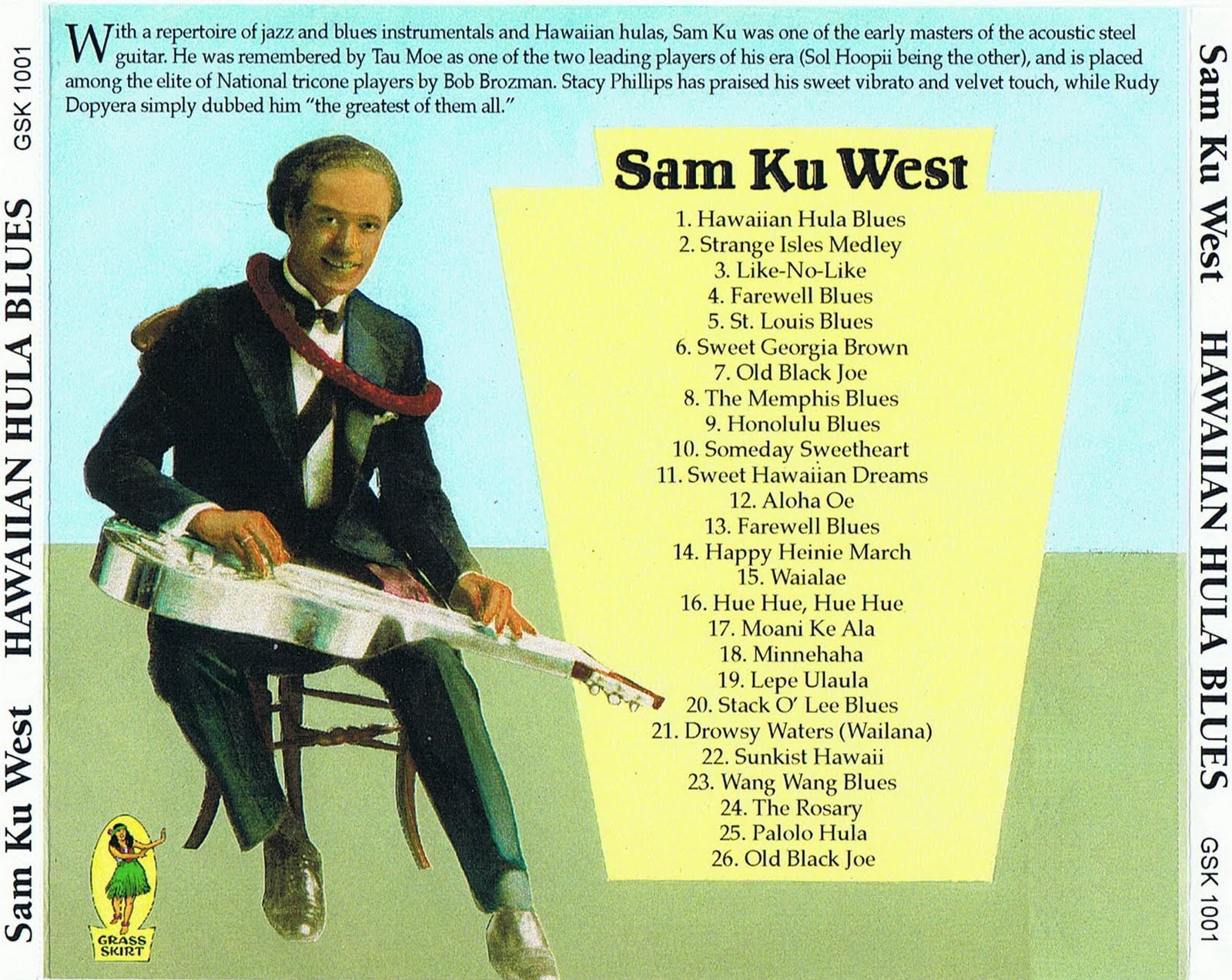
'Sam Ku was born in Honolulu, Hawaii in 1907, becoming a professional musician when he joined Irene West's troupe of touring musicians and dancers in 1926. Initially he was known as Sam Ku, Jr. but soon adopted the professional name of Sam Ku West. Often he would be billed as the 'Kreisler of the steel guitar' [referring to the famous violinist]. This title was given to him by Prince George of England who saw him play in Singapore in 1926.
His recorded legacy was 27 sides - mainly instrumental pieces - recorded for Banner, Gennett, Vocalion and Victor in a 15 month period starting in June of 1927. There were plans for him to record for Odeon in Germany, but illness prevented that .
He was encouraged by his manager to learn to play the concert harp and quickly added solos on this instrument to his live act, though he never recorded with it.
In his short career he toured extensively, making two visits to the Far East. He spent six months on the vaudeville circuits of New York, Boston and Chicago. The final year of his life were spent in Europe. He died in Paris in 1930.
Sam was remembered by Tau Moe, who for a short time was one of his backing band, as one of the two best steel players at the time... the other being Sol Hoopii.' ~ Brad
another tragic figure who left this world for the land of song at a mere 23 years young. dunno why i been diggin so much hawaiian musique lately, but i do find it rather soothing on these 100 degree evenings, ack! i'm likely just gettin long in the talon. anyhu, Sam miraculously recorded these 26 sides in the span of 9 months whilst extensively touring europe & asia with his ensemble. a 320 rip w/ illuminating booklet included
01. Hawaiian Capers - King Nawahi's Hawaiians 02. Singin' In The Bathtub - Four Hawaiian Guitars 03. Ukulele Benny - Georgia Jumpers 04. May Day Is Lei Day In Hawaii - King Nawahi's Hawaiians 05. Dinah - Red Devils 06. Mauna Kea - King Nawahi's Hawaiians 07. Honolulu Bound - Hawaiian Beach Combers 08. My Little A-1 Brownie - Charles B. Smith 09. Big Feet Rag - Georgia Jumpers 10. My Girl From The South Sea Isles - Hawaiian Beach Combers 11. Ticklin' The Strings - King Nawahi's Hawaiians 12. Black Boy Blues - Four Hawaiian Guitars 13. California Blues - Georgia Jumpers 14. I've Seen My Baby - Q R S Boys 15. Waikiki Blues - Hawaiian Beach Combers 16. I Went To Hilo - King Nawahi's Hawaiians 17. Guitar Rhythm - Georgia Jumpers 18. Hawaiian Melody - Hawaiian Beach Combers 19. Aloha Means I Love You - King Nawahi's Hawaiians 20. Wiggle Yo Toes - Q R S Boys 21. Otto Wood, The Bandit - Slim Smith 22. Maui No La Ka Oi - King Nawahi's Hawaiians 23. I'm A Dreamer Aren't We All - Hawaiian Beach Combers
One of the few Hawaiian guitarists during the 1920's and 1930's who could be considered a legitimate contender to the title of 'King of the Hawaiian Guitar' was Benjamin Keakahiawa Nawahi. 'King' Bennie Nawahi was born on July 3, 1899 in Honolulu to a large family. He taught himself to play slack key guitar, and by the age of 15 was playing Hawaiian guitar in Honolulu parks for sailors and tourists.
In 1919 Bennie got a job playing steel guitar with his brother Joe's group, the Hawaiian Novelty Five, on the passenger liner Matsonia. The group worked between San Francisco and Honolulu, eventually touring North America on the Orpheum vaudeville circuit. Before long, Bennie left the group and became an established singer and ukulele virtuoso. He was crowned 'King of the Ukulele' by impresario Sid Grauman of Grauman's Chinese Theater fame. His stunts included playing the song "Turkey in the Straw" on Hawaiian guitar with his feet.
By 1928 Bennie Nawahi had started his recording career, recording on many different labels, including Columbia, Victor, Q.R.S. and Grey Gull. He settled in Los Angeles in the early 1930s and formed a group called King Nawahi and the International Cowboys [which also featured a very young Roy Rogers]. Nawahi was one of the few Hawaiian musicians to consistently black jazz or blues numbers, some with black groups such as the Georgia Jumpers. He was also unusual among Hawaiian steel guitarists of his day in that he used a single cone Triolian rather than the National tricone guitars preferred by others.
In 1935, tragedy struck Nawahi, as he suddenly lost his eyesight while returning home from a performance. Doctors were unable to explain why he became blind. After a short time, he returned to the stage, working with various Hawaiian groups in the Polynesian restaurants and clubs that were popular in Southern California. After World War II, he again joined his brother in the Nawahi trio, recorded a few additional tunes, and continued to perform in clubs.
In addition to his musical abilities, Nawahi was also famed as a long distance swimmer. In 1946 he swam from San Pedro to Catalina Island in just over 22 hours. He is still the only blind man to have completed this swim. Remaining musically active through the years, Bennie Nawahi suffered a stroke in the late 1970s that left his body partially paralyzed. He died 'in the city they call Long Beach', California after a long illness on January 29, 1985.' ~ Brad
Bennie Nawahi was one of the true masters of the Hawaiian steel guitar, ukulele and just about any instrument with strings on it. Not only does his work rank as some of the greatest Hawaiian musique ever recorded, the imaginative, accomplished phrasing in his solos make him one of the unheralded giants 1920s string jazz. This overview covers Bennie's singing and instrumental work on native Hawaiian melodies, the blues, jazz, pop and rural music he heard on the mainland, and some of his own dazzling instrumental compositions. 23 toe tappin titillaters. a 320 rip
A1 - Attila the Hun - History of carnival A2 - Wilmoth Houdini - Way down sobo A3 - King Radio and the Tiger - Millington A4 - Attila the Hun - Archie boulay A5 - the Lion - Hojoe A6 - the Attila - Zingue talala A7 - John Buddy Williams & his Blue Rhythm Orchestra - Barre-a-oh A8 - Lord Invader - Demasbar
B1 - King Radio - Matilda B2 - the Lion - Buddy Abraham B3 - the Caresser - Madame khan B4 - Al Philip iere Syncopators - Play mass don't do me that B5 - Lionel Belasco & his Orchestra - Juliane B6 - the Executor - Christmas is a joyful day B7 - the Lion - Netty netty B8 - Lord Beginner - Christmas morning the rum had me yawning
'The holiday melodies of distant Trinidad in the rhythms of calypso are almost narrower than their age-long remoteness… Very Rare and beautiful plate' ~ Iraklis
ack! the work schedule is gettin kinda hectic, so one more drop this afterlunch. i was gonna save this one for xmas but who knows where owl be christma$$ day? mañana never comes so we gotta do what we can whilst we can, eh? another winner cobbled together from the bountiful 78 collection of Dick Spottswood & pressed onto crickly vinyl two decades ago. daps to the og illuminator
01. Over The Road I'm Bound To Go 02. Blackwater Blues 03. Sail Away Ladies 04. Walking In The Sunshine 05. Don't Get Weary Children 06. Greay Cat on the Tennessee Farm 07. Deliverance Will Come 08. Go Along Mule 09. Carve That Possum 10. Keep My Skillet Good And Greasy 11. Ain't It A Shame To Keep Your Honey Out Of The Rain 12. I'm A-Goin' Away To Morn 13. Jordan Is A Hard Road To Travel 14. Way Down The Old Plank Road 15. Shall We Gather At The River 16. Tom And Jerry 17. Uncle Dave's Beloved Solo 18. Bile Them Cabbage Down 19. The Crossed Butcher & the Cackling Hen 20. Rise When The Rooster Crows 21. Rock About My Sara Jane 22. Worthy Of Estimation 23. The Bible's True 24. Rabbit In The Pea Patch 25. Hold That Wood-Pile Down 26. Run, Nigga, Run
'Uncle Dave Macon, beginning his professional musical career after the age of 50, brought musical and performance traditions of the 19th-century South to the recording catalogues & radio shows of the early country music industry. In 1925, he became one of two charter members of the Grand Ole Opry, then called the WSM Barn Dance. A consummate showman on the banjo and a one-man repository of countless old songs and comic routines, Macon remained a well-loved icon of country music until & well beyond his death in 1952.
Born David Harrison Macon in Smartt Station in middle Tennessee's Warren County, he was the son of a Confederate officer who owned a large farm. Macon heard the folk music of the area when he was young, but he was also a product of the urban South: after the family moved to Nashville and began operating a hotel, Macon hobnobbed with traveling vaudeville musicians who performed there. After his father was stabbed near the hotel, Macon left Nashville with the rest of his family. He worked on a farm and later operated a wagon freight line, performing music only at local parties and dances.
Macon's turn toward a musical second career was due partly to the advent of motorized trucks, for his wagon line fell on hard times in the early '20s after a competitor invested in the horseless novelties. In 1923, he struck up a few tunes in a Nashville barbershop with fiddler Sid Harkreader, and an agent from the Loew's theater chain happened to stop in. Soon Macon and Harkreader were touring as far a field as New England, and when George D. Hay began bringing together performers two years later for what would become the Opry, Macon was a natural choice. The tour also brought Macon the first of his many recording dates, held in New York for the Vocalion label in 1924. Macon would record prolifically through the 1930s (and occasionally up to 1950) for various labels, accompanied at different times by Harkreader, the brother duo of Sam & Kirk McGee, the Delmore Brothers, the young Roy Acuff, and other string players including a then-unknown Bill Monroe. For secular material, his backing band took the name of the Fruit Jar Drinkers.
Macon's recordings are richly enjoyable in themselves and are priceless historical documents, both for the large variety of banjo styles they preserve and for the window they afford on American song of the late 19th century. Macon performed musical-comic routines such as the 'Uncle Dave's Travels' series, topical songs, often of his own composition ("Governor Al Smith"), playful folk songs ("I'll Tickle Nancy"), gospel with his Dixie Sacred Singers, blackface minstrel songs, unique proto-blues pieces that Macon learned from African-American freight workers ['Keep My Skillet Good and Greasy'], and songs of other types. Yet 'the Dixie Dewdrop' was loved most of all for his presence as a live musician, captured not only on the weekly Opry broadcasts [which were broadcast nationally for a time in the 1930s] but also in the 1940 film Grand Ole Opry. Macon delivered what an 1880s southern vaudeville audience would have demanded for its hard-earned dollar: showmanship [he handled the banjo with Harlem Globetrotters-like trick dexterity], humor, political commentary [often of the incorrect variety by modern standards], and unflagging energy.
Macon continued to appear on the Opry almost until his death, gradually taking on the status of a great-hearted living link to country music's origins. He became the tenth member of the Country Music Hall of Fame in 1966, and the revival of old time music that flourished as part of the folk movement focused the attention of younger listeners on his music. Yet Macon remains less well understood, and less present in the musical minds of country listeners, than Jimmie Rodgers or the Carter Family, even though he was nearly as well-known in his own day. Perhaps that's because he represents an older layer of American music-making than almost any other performer known to country audiences: modern hearers can easily connect with Rodgers' blues or the Carters' homespun sentiment, but Macon may require greater effort. Such effort, in any case, is well repaid by an acquaintance with his musical legacy.' ~ James Manheim
by request, an all killer no filler compilation of Uncle Dave's finest 78 rpm shellac sides. mostly these are ensemble pieces with his crew the Fruit Jar Drinkers, but there are a few solo stabs as well, including a couple extremely beautiful & uplifting gospel numbers. seriously some of the most surreal, damaged & arkane krunk tunes ever recorded. highest imaginable recommendation but a brief word o' warning to ye of a sensitive constitution: like you read, Unc was raised on a farm in Tennessee by a Confederate officer & while he seems to retain a progressively thoughtful & compassionate disposition throughout, he does indeed drop some racial slurs hither & thither, as was typical of the genre in the south. nonetheless, this is among the finest early examples of brilliant, high energy banjo pickin insanity you're likely to hear. Uncle Dave was a tireless force of nature & a consumate entertainer. they don't make em like this anymore. obviously a direct influence on the Holy Modal Rounders. roots! a 320 rip
01. Sporting House Rag 2:18 02. Original Rags 2:48 03. The Crave 3:04 04. The Naked Dance 2:49 05. Mister Joe 2:49 06. King Porter Stomp 2:50 07. Winin' Boy Blues 2:55 08. Animule Dance 2:47 09. Thought I Heard Buddy Bolden Say 2:46 10. The Naked Dance 2:50 11. Don't You Leave Me Here 2:51 12. Mamie's Blues 2:44 13. Michigan Water Blues 3:01 14. Sweet Subsitute 2:52 15. Panama 2:29 16. Good Old New York 2:44 17. Big Lip Blues 3:10 18. Why? 2:48 19. Get the Bucket 2:51 20. If You Knew 2:50 21. Shake It 2:49 22. Dirty, Dirty, Dirty 2:50 23. Swinging the Elks 2:50 24. Mama's Got a Baby 2:39 25. My Home Is in a Southern Town 2:45
'These 25 tracks were originally made for the General label in 1939-40. They were his last commercial recordings and among the thirteen piano solos that begin the program are some of his best. This disque contains Jelly Roll Morton's final studio recordings (the only existing later performances by Morton are a couple of tunes from a radio broadcast) and supercedes an earlier two-LP Atlantic set. The main reason to acquire this 1997 CD is Morton's 13 classic piano solos, which include five vocals, his first on record other than the much earlier "Dr. Jazz" and the Library of Congress sides. Only ten of the solos were originally released, so this is a very complete reissue. Morton, despite ailing health, was in very good form for the sessions, and his versions of 'The Crave,' 'King Porter Stomp,' 'Winin' Boy Blues,' 'Buddy Bolden Blues' & 'Don't You Leave Me Here' are quite memorable. In addition, he is heard heading three band dates that, despite the presence of trumpeter Henry 'Red' Allen and clarinetist Albert Nicholas, do not quite live up to their potential. They did introduce Jelly Roll's 'Sweet Substitute' [a future standard] and include a hot rendition of 'Panama,' but such songs as 'Get the Bucket' and 'Mama's Got a Baby' have not been revived since. Still, this set is highly recommended for the solo performances, Jelly Roll Morton's final contribution to the music he claimed to have founded.' ~ Scott Yanow
the first half of this coaster is totally fab & so highly recommended, but we owlso git to hear his last group sides for those interested. i heard karen dalton's cover of sweet substitute long before i ever heard the original. 320/FLAC + booklet
01. Leather Britches ~ W.A. Hinton 02. Baptist Shout ~ Frank Jenkins 03. Oh Molly Dear ~ B.F. Shelton 04. Don't Let Your Deal Go Down Medley ~ Charlie Poole & Lucy Terry 05. Far In The Mountain ~ Red Headed Fiddlers 06. Don't Get Weary Children ~ Uncle Dave MacOn 07. Coo Coo Bird ~ Clarence Ashley 08. Italy ~ Bascom Lamar Lunsford 09. Shuffle Feet Shuffle ~ Whitter-Hendley-Small 10. Charming Betsy ~ Land Norris 11. Coal Creek March ~ Marion Underwood 12. Going Back To Jericho ~ Dock Walsh 13. Pretty Polly ~ B.F. Shelton 14. Home Sweet Home ~ Frank Jenkins 15. Orphan Girl ~ Buell Kazee 16. American & Spanish Fandango ~ Smith & Allgood 17. Little Birdie ~ John Hammond 18. Banjo Pickin' Girl ~ Coon Creek Girls
'Originally released by County Records in 1969, "Mountain Banjo Songs & Tunes" was the first collection of pre-war banjo performances ever issued. The underlying theme of the original collection was that there was no single "old-time banjo style" but rather an astounding variety of approaches to playing the five-string banjo. This re-issue of the LP carries the point further with additional tracks and greatly improved sound. An essential comp for the fan of old-time ballads, songs, and instrumentals; the set contains fine examples of the clawhammer, three-finger, classical, and minstrel styles of five-string banjo.' ~ press hype
'When this album originally came out, it was one of the first collections of its kind, a deep exploration of pre-WWII banjo music that included some of the finest plunkers of the 1920s and '30s. Buell Kazee, Dave Macon, Charlie Poole and the Coon Creek Girls are among the more well-known artists on here, although it's the more idiosyncratic choices that make this such a charming set. There's plenty of the weirdness, spookiness, the authenticity and immediacy that makes these type of vintage recordings so fascinating... This is a great collection, the kind of music I could leave playing on the stereo for days on end, and be both satisfied and surprised anew each and every time I hear it. Great job on the sound remastering, too, by the way! Highly recommended, especially if you enjoyed the Harry Smith collections.' ~ some bra
a stellar slice & although it features some wee overlap with yazoo compilations of old school kentucky tunes, this one came forst & remains a fine testimony to the genre, featuring some of the biggest names & a few obscuros from bach in the day of pre-war 78s. the predominant theme here seems to be birds: pirty polly/coo coo/little birdie/molly dear, in their various appropriations. the B.F. Shelton sides are especially spooky dookers & well dam, owl the artists featured here are among me very favourites & eminently worthy of yer kind attention & further investimigation. a 320 rip
01. Rocky Pallet 02. Rock That Cradle Lucy 03. Soldier's Joy 04. Sal's Gone to the Cider Mill 05. Ride Old Buck to Water 06. Molly Put the Kettle On 07. Hell Broke Loose in Georgia 08. Fly Around My Pretty Little Miss 09. Liberty 10. Devilish Mary 11. Cackling Hen and Rooster Too 12. Miss McLeod's Reel 13. Pretty Little Widow 14. Dixie 15. Broken Down Gambler 16. Leather Breeches
'Decades before rock & roll, the Skillet Lickers blasted through raucous old-time romps that still sound as fresh and edgy as they must've sounded back in the 1920s, when they emerged as hillbilly music's leading artist. Fiddles endlessly blaze and soar over dance calls and raw, down-home hollers while Riley Puckett's guitar work keeps it all anchored. Puckett was probably the first star guitarist of old-time music and his unique, single-string style of rhythm guitar [harmonically fluid but rhythmically adventurous] proved essential to the development of bluegrass, not only for early rhythm guitarists, but later on for lead flat-pickers like Doc Watson, who enhanced it and moved it to the foreground. The songs, from 'Soldier's Joy' to 'Cackling Hen' to 'Dixie' to 'Leather Breeches,' fiddlers' standards even then, remain so today thanks in large part to these historic recordings.
The original members were Gid Tanner, Riley Puckett, Clayton McMichen and Fate Norris. The members had been performing in various combinations around Atlanta before 1924, but it was in that year that Tanner [a fiddle-playing chicken farmer] & the blind guitarist Puckett recorded to become Columbia Records' first hillbilly talent. In 1926 with McMichen and Norris, they recorded for the first time as Gid Tanner And The Skillet Lickers. Over the years there were significant line-up variations & other important members included Lowe Stokes, Bert Layne [both outstanding fiddlers], Hoke Rice [guitar], Gid's brother Arthur [banjo, guitar] & teenage son Gordon [fiddle]. By 1931, in some combination or other, they had cut 88 sides for Columbia - all but six being released. Their material included fiddle tunes, traditional ballads and pop songs, plus little comedy skits such as their noted 'A Corn Licker Still In Georgia'. Quite possibly the greatest stringband of all time.
The compilation contains 16 tracks that the hillbilly musical comedy group recorded between 1926 and 1931. The Skillet Lickers were one of the most popular groups of their time, and although their music and humor has dated considerably in the decades since, the musical talents of fiddler Gid Tanner remain impressive, and this compilation is the best way to hear him and his group.' ~ Marc Greilsamer
cracked-out madness from these insane visionaries. they recorded so many sides it's dizzying, but this comp remains a worthy distillation of their scope. another goodun lives hear. without the skillet lickers, there would be no holy modal rounders. gid tanner & riley puckett are the forefathers of this swirling brand of methylated mayhem & these whoops & warbles are as authentique as it gets. sounds like home
01. Sweet Like A Honey Bee 02. Song No. 99 03. Uncle Jo' Gimme Mo' 04. Trifling Men 05. No Mo' Bench And Board 06. Sweet Papa Willie 07. Honey I'm Bound To Go 08. The Cooks In Trinidad 09. Arima Tonight, Sangre Grande Tomorrow Night 10. Black But Sweet 11. I Need A Man 12. Stop Coming And Come 13. Tiger Tom Kill Tiger Cat 14. That Big Black Woman 15. West Indian Sugar Crop 16. Unfortunate Milley 17. Teacher Nose Gay The Shouter 18. Mickey Cipriani's Career 19. Glorius Centenary 20. Cipriani's And Bradshaw's Death 21. Bandsman Shooting Case 22. African Love Call 23. The Devil Behind Me 24. Poor But Ambitious
'Wilmoth Houdini was the most recorded calypsonian of his generation. His songs covered a variety of styles and topics including prostitution, murder, satire, Carnival, social equality, and male-female relationships. Historic Calypsos from 1928 - 1940.'
possibly me favourite calypsonian after growling tiger. houdini has superb flow & keeps it 100% real. the red hot orchestra who bachs him up on many of these sides are called gerald clarke's night owls. nuff said. lionel belasco is in the mix too. a few more of the finest early calypso collections live hither & thither & whither. everybody happy. a 320 rip. get some!
Harry Choates - fiddle & vocals Johnnie Mae Smirle [Manuel] - piano Joe Manuel - banjo B.D. Williams - bass Eddie Pursley - guitar Ron Ray 'Pee Wee' Lyons or Julius “Papa Cairo” Lamperez - steel guitar
'Harry Choates was an American Cajun music fiddler. Choates's place of birth is disputed. He moved to Port Arthur, Texas in the 1930s, and received little schooling, instead spending time in local bars listening to music on the jukebox. By age 12 he started playing fiddle for spare change in barbershops. He gained early professional experience playing in the bands of Leo Soileau and Leroy LeBlanc, then split off to form his own group called the Melody Boys in 1946. His 1946 song 'Jole Blond', a top 10 hit for Choates, was recorded by country singer Moon Mullican and became a major hit.
Harry Choates was not only one of the most influential musicians in the history of Cajun music, but one of its most tragic figures. A wild and imaginative fiddler, Choates wrote such classic tunes as the Cajun national anthem 'Jole Blon,' & popularized such songs as 'Allons à Lafayette.' Recording for Gold Star, DeLuxe, D.O.T., Allied, Cajun Classics, Macy's, and Humming Bird, Choates introduced Western swing, blues, jazz & country music to the two-steps and waltzes of southwest Louisiana's bayous, influencing nearly every Cajun musician who followed in his footsteps.
Like Hank Williams, Choates balanced his musical talents with painful struggle in his real life. An acute alcoholic, he sold the rights to 'Jole Blon' for $100 and a bottle of whiskey. His habit of missing concerts led him to be blacklisted by the musicians union in San Antonio and resulted in his band breaking up. His death was equally tragic. Failing to make support payments of $20 a week for his son and daughter following his divorce, he was jailed by a judge who found him in contempt of court. After three days of forced withdrawal, he began beating his head against the cell bars and fell into a coma. He died a few days later on July 17, 1951, 6 months before his 30th birthday :(
a tragically short life of trouble for a boy with a broken heart. here go Harry's finest shellac sides for the Gold Star label, recorded betwixt 1946 - 49. included as a bonus is the aforementioned 'Jole Blond'. 320 tanx to brother Ambrose Bierce of We Love Music fame for the blistering bits & booklet. r.i.p. Harry Choates