01. The Blue Bird 02. Crépuscule hawïen 03. Manuska 04. Hawaï nous appelle 05. Sérénade bleue 06. Retour d'Hawaï 07. J'écoute la guitare 08. En écoutant l'ukulélé 09. Addio Signora! 10. Hawaiian berceuse 11. Je n'ai plus personne 12. Reflet viennois 13. Viens dans ce joli pavillon 14. Hé hop la hé 15. C'est une valse qui chante 16. Waikiki en fête 17. One kiss 18. La destinée du marin 19. Le jeune pêcheur 20. L'ile aux rêves d'or 21. Chant d'amour de Tahiti 22. Ay, ay, ay 23. De tout mon caeur 24. Dans la nuit 25. Avant de mourir
Gino Bordin [1899-1977] was born on 4th February 1899 in Vicenza, in the north east Italy. His eldest brother led an orchestra in which Gino played the musical saw and sometimes harp-guitar acquired from Luigi Mozzani, at Cesta. There he struck up a friendship with the prodigy Mario Maccaferri.
His name first appeared beside that of Michel Péguri, an accordionist, on a Perfectaphone disc where the record label showed “ banjo : Gino Bordin”. Although he later abandoned this banjo for guitar and Hawaiian guitar, he continued to play with musette accordionists until the end of his career.
In the 20s Gino supported other accordionists on his guitar and chanteurs and chanteuses also began to call on his talents as accompanist and writer. All doors opened for him, and, significantly, those to the recording studios. When the record companies realised the sudden taste for Hawaiian guitar, the slenderness of their catalogue licensed from America in this genre and the need to add a repertoire more to French public taste, they turned naturally to Gino Bordin, already a virtuoso on the instrument.
Perfectaphone recorded Dreamland and Beautiful Hawaï by Gino Bordin, Hawaiian guitar. Then Pathé issued in early 1928 four other covers of standards interpreted by a Hawaiian Trio, Bordin, Kamenetsky and de Lignori. From then Gino Bordin went on to record hundreds of titles for at least 15 labels, in his own name and also under various pseudonyms. We can count at least 120 sides for Parlophone, over 60 for Polydor and Pagode, at least 20 for Pathé. The Odéon label issued over 30 to which we should add English pressings on Decca and Ariel, those on Columbia and Polydor in Japan, Parlophone in Australia and Brazil. There were yet more titles on Salabert, Omnia, Grammophon, Supraphon, Disc Art, Gladiator, Colisée, MP, Clarus, Discum, Unifix and, after WW2, Pacific, Vogue, Mode, Mondo Music, Nixa, Saturne and Charmilles... that’s without counting the many discs he played on where the record label credit simply read: Hawaiian trio or Hawaiian Guitar
Gino Bordin adapted the guitar from Honolulu to every musical style. There were only a handful of Hawaiian standards or hapa haole tunes, but there were many originals including classical, in all sorts of orchestrations, from guitar duo to large string formations, in instrumental versions or with refrain. SACEM (the music copyright agency) handles a catalogue of about forty works written by Gino Bordin either alone or with co-writers Gardoni, Ferrari, Viseur and Saarbecoff. That short list doesn’t tell the full story because published sheet music and record labels show that he was the prolific writer of dozens more instrumental pieces and songs.
French radio stations broadcast Gino Bordin’s records widely and also invited him to play live in their studios. Then Radio Lausanne and stations from Hilversum in Holland spread his fame throughout Europe.
Now a star on records and radio, Gino increased the number of his concerts and tours. Since 1926 he had sported the white Hawaiian outfit and red silk sash, slipped the lei around his neck, posed with guitar flat on his lap and livened up the dance-halls of the casinos, at Dinard, Saint Jean-de-Luz and Monte-Carlo. In 1931 his orchestra consisted of three dancers in exotic dress, Alex Manara on second Hawaiian guitar, Vincent Kamenetsky on guitar and Joseph Puni, the authentic Hawaiian, on ukulele. Later Le Trio Havaïen saw Gino flanked by Jean Stéfani and André Thomas, Tino Rossi’s guitarists. As for the Bordin-Manara duo ...that was seen at every possible opportunity, and notably opened for Édith Piaf at the ABC in 1937. Gino Bordin played on all the great Paris stages, Paramount, Gaumont, Rex, Alhambra, Bobino, Européen, Vel’ d’Hiv, at the Carlton in Cannes, at Monte Carlo’s Palm Beach, at Maxim’s in Athens. He criss-crossed North Africa, went as far as Alexandria and Cairo, and went through Lausanne, Zurich, The Hague, Amsterdam and Rotterdam. During the war a lengthy tour took him to the Wintergardens in Vienna and Berlin and all across Germany to Prague and Warsaw
In France the guitar from Hawaii owes its popularity to Gino Bordin. At first he used a pear shaped acoustic Hawaiian guitar then being made in the Vosges. In 1932 Mario Maccaferri produced for Selmer his jazz guitar with resonator chamber which Django made famous and he designed at the same time a 7 string Hawaiian model without cutaway, an idea conceived with his friend Gino. In early 1936 it was Maccaferri who again brought him right up to date when he returned from a USA visit carrying under his arms a National lap steel electric 7 string, immediately christened the “Magic Guitar” by Gino and plugged in at the studio in May that same year. Gino, pioneer of the electric guitar, had already contributed to the instrument’s evolution by adding a low seventh string in 1931 and using a seventh tuning, then later a 6th tuning. His Nouvelle Méthode de Guitare Hawaïenne à Sept Cordes (New Hawaiian Guitar Method for 7 strings) published in 1935 by Max Eschig contained a “Transposer”, a cardboard device with holes which denote on the frets the location of notes for each chord. Based on a similar principle he also produced a set of 16 cards “500 guitar chords by the perforated strip system”. He published collections of arrangements for the instrument and up until the mid 1960s gave lessons at his home on or in the posh colleges of the southern suburbs. During this period Gino was still appearing in cabaret and still playing on stage with Fredo Gardoni. His career had lasted all through the 40s and 50s. He accompanied Patrice and Mario, then Tino Rossi once more ...and Lucienne Delyle too, while his records for Pacific and Vogue had wide distribution and the younger generation of players, Harry Hougassian and Marcel Bianchi considered him a master. From 1965 however Dupuytren’s Contracture reduced the movement in his left hand and forced him gradually to rein in his musical activity. In 1969 he retired to l’Isle-sur-la-Sorgue. And that’s where he has been at rest since 14 July 1977 - liners
superb hawaiian gypsy jazz. darker & more doleful than the typical fare & perhaps more timeless as a result, but then i do dig the somber schtuff. would certainly love to find this in more prestigious bits, but til then this'll hafta do :)
01. Twelfth Street Rag 3:28 02. I Ain't Got Nobody 3:09 03. Hula Blues 3:12 04. Chimes 3:00 05. Sweet Lei Lehua 2:57 06. Most Of All I Want Your Love 07. Feelin' No Pain 3:23 08. Kilohana 3:21 09. Stack O'Lee Blues 3:01 10. St. Louis Blues 3:06 11. Patches 3:12 12. Alekoki 2:38 13. Farewell Blues 2:52 14. Singing The Blues 2:56 15. Hilo 3:04 16. Tin Roof Blues 3:16
dear frenz, aint got no thyme fer sound samps & that mess bein on de road like eye is, but rest assured if you dug any of the other hawaiian ish we dropped previously, do not hesitate. hoopii was gawdhed & deez peerless recordings are over 80 years olde. this one requested at the resplendent record fiend grog, 320 luaus later
01. These Trails 1:24 02. Our House In Hanalei 1:51 03. Of Broken Links 1:40 04. El Rey Pescador 3:07 05. Psyche I & Share Your Water 5:22 06. Hello Lou 3:47 07. Rusty's House & Los In Space 5:49 08. Psyche II 2:30 09. Sowed A Seed 2:17 10. Rapt Attention 2:15 11. Waipoo 2:36 12. Garden Botanum 3:31
Guitar - Dric Kingsbury Synthesizer, Recorded By, Arranged By, Mixed By - Dave Choy Written-By, Dulcimer, Guitar, Vocals - Margaret Morgan Written-By, Guitar, Sitar, Vocals - Carlos Pardeiro Written-By, Guitar, Tabla, Vocals - Patrick Cockett
Originally released in 1973 Recorded at Sinergia, Inc. Honolulu
'These Trails was an Honolulu, Hawaii group that was privately pressed on Sinergia Records in 1973. Their eponymous debut is an album that skillfully combines a keen sense of melody with otherworldly vocals from the enigmatic, late 'Margaret Morgan' and innovative sonic experimentation that over 30 years later has stood the test of time. What's more, the band furnished each of its tracks with the colours, scents and atmospheres of the botanical treasure of the volcanic Pacific island paradise that birthed them.
These Trails incorporate the synthesizer and multiple vocal tracks into something rich, moody and magical - with warbling frequency modulation complimenting Morgan's amazing slow vibrato, fleshed out by graceful acoustic guitars. The songs are full of simple beauty and the power of the performances will never diminish over time.
Each track stands out: "Psyche I & Share Your Water" is a 5 minute track begins with a calm, soothing Folk feel highlighted by some fine acoustic guitar work. Eventually it descends into bad trip territory with ghastly vocals and spooky electronics – an outstanding track, very trippy and worth the price of admission alone. 'Garden Botanum' is another strong highlight that hits like a ray of Hawaiian sunshine, the arrangements are free and green with lots of interesting twists, the vocals are beautifully exotic. 'Rapt Attention' is short, perfect ditty with a twee, joyful feeling and an incredible vocal performance. This is an unbelievably wonderful piece of music and one of the greatest albums of the 70s.' ~ ???
i humbly concur. the sweetest hawaiian psychedelique folk record ever manifested & still a favourite around deez parts. the tremulous trills of maggie's warbling vibrato, coupled with the gloop n' gurgle of vintage synths amidst a beautiful bed of acoustic alchemy make for an enchanting listen. nice feet too. upgrades are go. 320 blessings upon the originilluminator
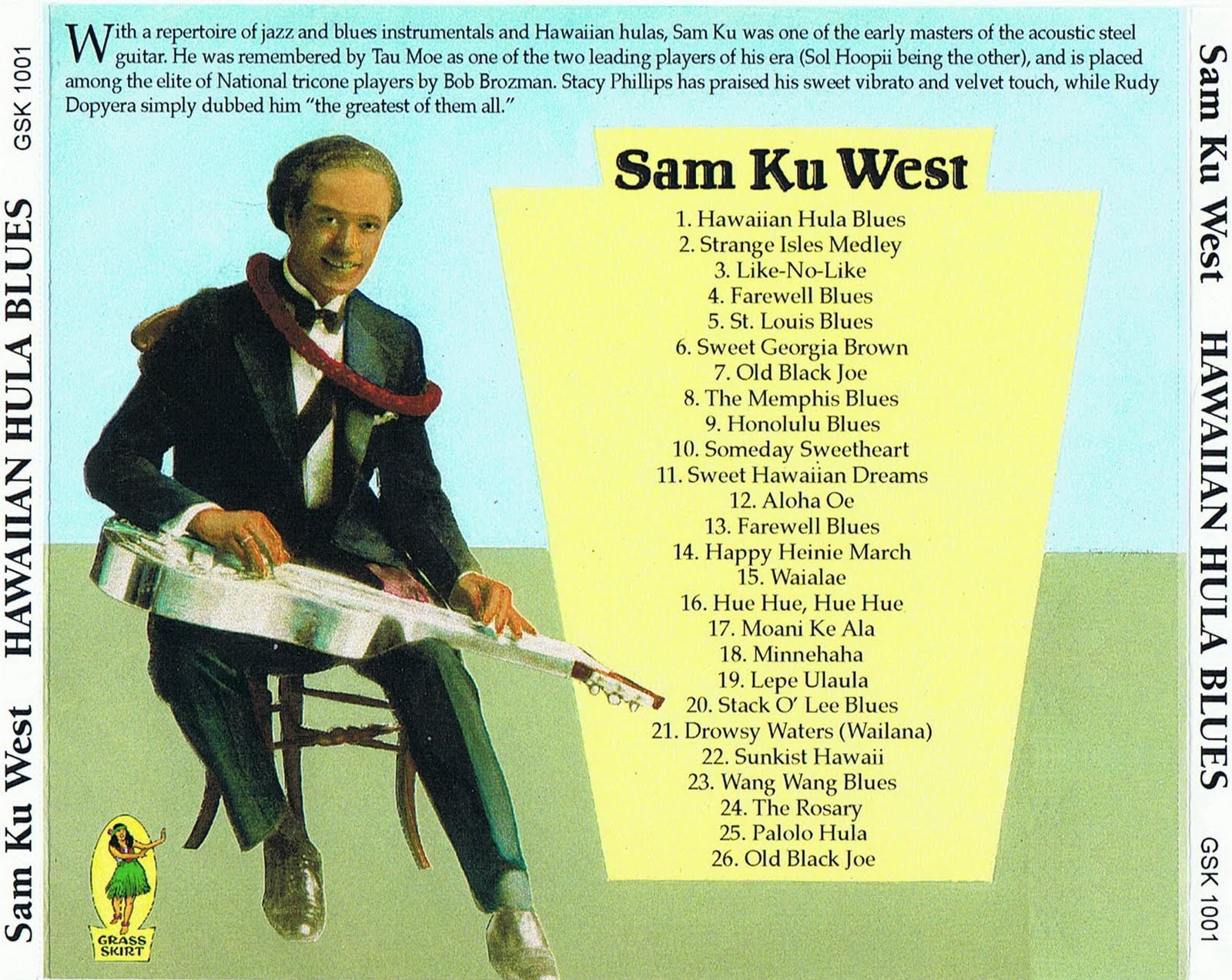
'Sam Ku was born in Honolulu, Hawaii in 1907, becoming a professional musician when he joined Irene West's troupe of touring musicians and dancers in 1926. Initially he was known as Sam Ku, Jr. but soon adopted the professional name of Sam Ku West. Often he would be billed as the 'Kreisler of the steel guitar' [referring to the famous violinist]. This title was given to him by Prince George of England who saw him play in Singapore in 1926.
His recorded legacy was 27 sides - mainly instrumental pieces - recorded for Banner, Gennett, Vocalion and Victor in a 15 month period starting in June of 1927. There were plans for him to record for Odeon in Germany, but illness prevented that .
He was encouraged by his manager to learn to play the concert harp and quickly added solos on this instrument to his live act, though he never recorded with it.
In his short career he toured extensively, making two visits to the Far East. He spent six months on the vaudeville circuits of New York, Boston and Chicago. The final year of his life were spent in Europe. He died in Paris in 1930.
Sam was remembered by Tau Moe, who for a short time was one of his backing band, as one of the two best steel players at the time... the other being Sol Hoopii.' ~ Brad
another tragic figure who left this world for the land of song at a mere 23 years young. dunno why i been diggin so much hawaiian musique lately, but i do find it rather soothing on these 100 degree evenings, ack! i'm likely just gettin long in the talon. anyhu, Sam miraculously recorded these 26 sides in the span of 9 months whilst extensively touring europe & asia with his ensemble. a 320 rip w/ illuminating booklet included
01. Hawaiian Capers - King Nawahi's Hawaiians 02. Singin' In The Bathtub - Four Hawaiian Guitars 03. Ukulele Benny - Georgia Jumpers 04. May Day Is Lei Day In Hawaii - King Nawahi's Hawaiians 05. Dinah - Red Devils 06. Mauna Kea - King Nawahi's Hawaiians 07. Honolulu Bound - Hawaiian Beach Combers 08. My Little A-1 Brownie - Charles B. Smith 09. Big Feet Rag - Georgia Jumpers 10. My Girl From The South Sea Isles - Hawaiian Beach Combers 11. Ticklin' The Strings - King Nawahi's Hawaiians 12. Black Boy Blues - Four Hawaiian Guitars 13. California Blues - Georgia Jumpers 14. I've Seen My Baby - Q R S Boys 15. Waikiki Blues - Hawaiian Beach Combers 16. I Went To Hilo - King Nawahi's Hawaiians 17. Guitar Rhythm - Georgia Jumpers 18. Hawaiian Melody - Hawaiian Beach Combers 19. Aloha Means I Love You - King Nawahi's Hawaiians 20. Wiggle Yo Toes - Q R S Boys 21. Otto Wood, The Bandit - Slim Smith 22. Maui No La Ka Oi - King Nawahi's Hawaiians 23. I'm A Dreamer Aren't We All - Hawaiian Beach Combers
One of the few Hawaiian guitarists during the 1920's and 1930's who could be considered a legitimate contender to the title of 'King of the Hawaiian Guitar' was Benjamin Keakahiawa Nawahi. 'King' Bennie Nawahi was born on July 3, 1899 in Honolulu to a large family. He taught himself to play slack key guitar, and by the age of 15 was playing Hawaiian guitar in Honolulu parks for sailors and tourists.
In 1919 Bennie got a job playing steel guitar with his brother Joe's group, the Hawaiian Novelty Five, on the passenger liner Matsonia. The group worked between San Francisco and Honolulu, eventually touring North America on the Orpheum vaudeville circuit. Before long, Bennie left the group and became an established singer and ukulele virtuoso. He was crowned 'King of the Ukulele' by impresario Sid Grauman of Grauman's Chinese Theater fame. His stunts included playing the song "Turkey in the Straw" on Hawaiian guitar with his feet.
By 1928 Bennie Nawahi had started his recording career, recording on many different labels, including Columbia, Victor, Q.R.S. and Grey Gull. He settled in Los Angeles in the early 1930s and formed a group called King Nawahi and the International Cowboys [which also featured a very young Roy Rogers]. Nawahi was one of the few Hawaiian musicians to consistently black jazz or blues numbers, some with black groups such as the Georgia Jumpers. He was also unusual among Hawaiian steel guitarists of his day in that he used a single cone Triolian rather than the National tricone guitars preferred by others.
In 1935, tragedy struck Nawahi, as he suddenly lost his eyesight while returning home from a performance. Doctors were unable to explain why he became blind. After a short time, he returned to the stage, working with various Hawaiian groups in the Polynesian restaurants and clubs that were popular in Southern California. After World War II, he again joined his brother in the Nawahi trio, recorded a few additional tunes, and continued to perform in clubs.
In addition to his musical abilities, Nawahi was also famed as a long distance swimmer. In 1946 he swam from San Pedro to Catalina Island in just over 22 hours. He is still the only blind man to have completed this swim. Remaining musically active through the years, Bennie Nawahi suffered a stroke in the late 1970s that left his body partially paralyzed. He died 'in the city they call Long Beach', California after a long illness on January 29, 1985.' ~ Brad
Bennie Nawahi was one of the true masters of the Hawaiian steel guitar, ukulele and just about any instrument with strings on it. Not only does his work rank as some of the greatest Hawaiian musique ever recorded, the imaginative, accomplished phrasing in his solos make him one of the unheralded giants 1920s string jazz. This overview covers Bennie's singing and instrumental work on native Hawaiian melodies, the blues, jazz, pop and rural music he heard on the mainland, and some of his own dazzling instrumental compositions. 23 toe tappin titillaters. a 320 rip
01. Bei Mir Bist du Schön ~ Waikiki Serenaders 02. Hootchy Kootchy Henry ~ Daphne Walker, Bill Wolfgramm & His Hawaiians 03. Murray Moon, The ~ Johnny Wade 04. Bell Bird Serenade ~ Jimmy Carter's Hawaiians, Pixie Williams 05. Magic and Moonlight ~ Keith Branch & His South Sea Islanders 06. Ryoshu ~ Buckie Shirakata & His Aloha Hawaiians 07. Gitaar Berboenji ~ Ninja Dan Ismail/Sweet Java Islanders/Miss Ninja Dan Ismail 08. Kota Ambon ~ Bintang Sinar 09. Cupid ~ Aloha Boys 10. Hawaiian Paradise ~ Miss Lucy Shoolbred & The Hawaiian Syncopaters 11. Hawaiiese Oe [Hawaiian Eyes] ~ Hendrik Jansen Se Hawaiiese Orkes 12. Yaka Hula ~ Kanui & Lula 13. Aloha Beloved ~ Kanui & Lula 14. Jubileumspotpurri 2: Drömmarnas Ö Tahiti ~ Yngve Stoor Med Sin Hawaiiorkester 15. Moonlight and Shadows ~ Malihini Hawaiians 16. On the Field ~ Hawaiian Quartett 17. Die Hula Mädchen Von Hawaii ~ Golgowsky Quartet & Tau Moe's Original Hawaiians 18. Die Weissen Blüten Von Tahni ~ Lys Assia Mit Hawaiian-Ensemble Aloha Islanders 19. Hawaii-Marche ~ Gino Hawaiian Orchestra Bordin 20. Ukulele Lady ~ A.P. Sharpe & His Honolulu Hawaiians 21. Ta Aspra Poulia Sta Vouna [The White Birds in the Mountains] ~ Kostas Bezos 22. Maui No la Ka Oi ~ Instrumentalni Soubor Karla Slavika 23. O Casuta Mica [In a Little Hula Heaven] ~ Ansamblul Mihail Daia 24. Kahanamoku [Bright] ~ Puka-Pakas 25. Mijn Iona ~ Kilima Hawaiians 26. Hawaiian War Chant ~ Kealoha Life
Regions of recordings[1922-195?]: Amsterdam, The Netherlands; Athens, Greece; Auckland, New Zealand; Berlin, Germany; Bucharest, Romania; Calcutta, India; Copenhagen, Denmark; Hilversum, The Netherlands; India; Japan; Johannesburg, South Africa; Paris, France; Prague, Czech Republic; Stockholm, Sweden; Sydney, New South Wales, Australia; The Netherlands; Tokyo, Japan; Wellington, New Zealand; Zurich, Switzerland
clever pun; steeling/stealing, get it? back in the day, the world had Hawaii fever. presented here are several thoroughly fascinating & enjoyable ethnological forgeries of this unprecedented phenomenon from the 78rpm era. virtually every continent throws down except for Hawaii itself & i strongly doubted any artists included actually hailed from the islands, but it seems i was mistaken. digger dug over at wfmu spotted these folks :) good lookin. 320 mahalos to twicezonked fer de hook-up
A1 Mme. Riviere's Hawaiians - Mai Kai No Kauai A2 Coral Islanders - Hui E A3 Waikiki Stonewall Boys - Hano Hano Hawaii A4 Sol K. Bright Hollywaiians - Tomi Tomi A5 Mme. Riviere's Hawaiians - Paahana A6 Kalama's Quartet - Lei E A7 Sol Hoopii Trio - Lehua A8 George Ku Trio - Kuu Lei
B1 Coral Islanders - Na Lei B2 Mme. Riviere's Hawaiians - La Lupe Ua Sola B3 Tamari Tahiti - Parari'i Pararara'i B4 Kalama's Quartet - Pehea Hoi Au B5 Sol Hoopii Trio - Uheuhene B6 Sam Alama - Ama Ama B7 Mme. Riviere's Hawaiians - E Mama Ea B8 Kalama's Quartet - Sassy
global warming is real & when it gets this hot my ears reach for the hawaiian musique. this may have lived somewhere in blogland before [el diablo tun tun anyone? + r.i.p. +] but i was unable to find it in the engine. one to add to the congolaise slows & kroncong rotation.