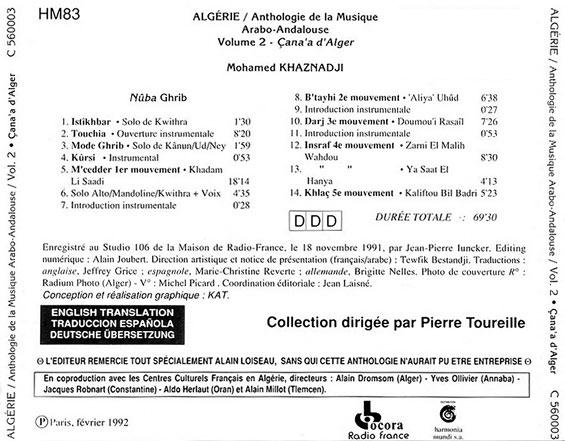
Algeria - Anthology of Arab-Andalusian Music Vol.2 [Algérie - Anthologie de la Musique Arabo-Andalouse Vol.2] La Nûba Ghrib - Mohamed Khaznadji Ocora C 560003, recorded 1991, CD released 1992
01. Istikhbar 02. Touchia 03. Mode Ghrib Solo de Kanun, Ud, Ney 04. Kursi 05. Mcedder 1er mouvement. Khadam Li Saadi 06. Solo Alto, Mandoline, Kwithra, Voix 07. Introduction instrumentale 08. Btayhi 2e mouvement. Aliya Uhud 09. Introduction instrumentale 10. Darj 3e mouvement. Doumoui Rasail 11. Introduction instrumentale 12. Insraf 4e mouvement. Zarni El Malih Wahdou 13. Insraf 4e mouvement. Ya Saat El Hanya 14. Khlac 5e mouvement. Kaliftou Bil Badri
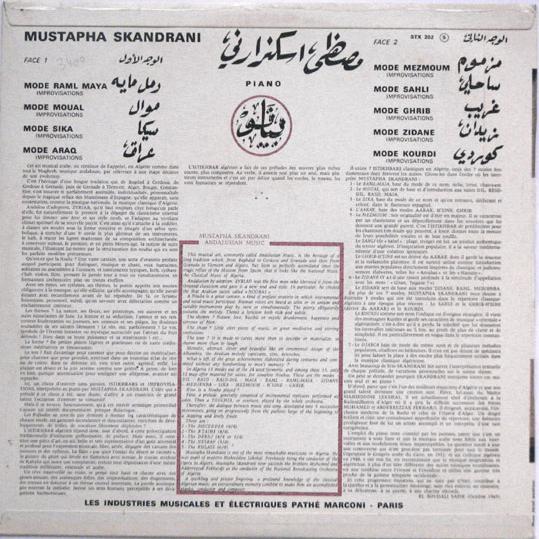
a bit of trivia anyone? okeh then, who's dat playing piano in this performance? the first soul to leave the correct response wins a gold star & an exclusive download or something
VA - Anthologie du raï vol. 1 - Les Racines - Les Chioukh
[El Dorado MED - 951001 - P. 1995]
01 Mabrouk 5:19 Cheikh Hamada 02 Civilisée 5:52 Mohamed El Mamachi´ 03 Salha Malha 3:34 Cheikha Djerba 04 El Mout El Ghadara 5:35 Cheika Rimitti 05 Latlomouni [Ma Tloucminich] 6:07 Cheikha Habiba el Abassia 06 Si Mohammed Ouine Daini? 5:23 Cheikha Rabla Tlemcania 07 Hada Rayek Antia 5:04 Boutaïba Saïdi 08 Moulat Dollar 4:33 Djillali Ain Tedles 09 Hadi S'Nin 4:56 Abdelmoula Elabassi 10 Rani N'Saaf 5:35 Cheikha Zahouania [l'Original] 11 Fatma Ain Ettir 5:33 Cheikha Oachma [la tatouée]
the premier raï collection in my world by far. not to get into labels or definitions but this is the real deal, pre-synth, proto-raï affair & the standards hear are stripped down to their traditionally minimalist campfire core roots, consisting of that unmistakably evokative north afrique berber flute, persistantly tribal drumming & entrancingly hypnotique vocals. most authentique & effective, bearing similar stylistique sensibilities to the stellar Cheikha Remitti collection posted previously. She's featured hear as well alongside some of the most obskure & amazing of the genre. eyed love to hear more from several of these artists if you know of any recordings; namely Djillali Ain Tedles, Cheikha Oachma & Cheikha Habiba el Abassia. a stunning representation of the true proto-raï nobility & their underground recordings. this one really does my head in. tanx& praisesto our generous benefactor ~ le autodidacte champignon musicologue anonyme avec le goût éclectique
VA - Le Stikhbar Chanté (En Algerie) Les Préludes dans la Musique Arabo-Andalou Club du Disque Arabe [AAA 093] 1994
01 Nabiyatou elhosni 4:24 Dahmane Ben Achour 02 Bohormat elahdi 3:56 Dahmane Ben Achour 03 Qateltani bighaïri char'ine 4:12 Mohamed Khaznadji 04 Ouine ana ouine hbabi 3:04 Cheika Tetma 05 Qalbi oula men alem bih 1:24 Abdelkrim Dali 06 Masaâb haml elfraq 3:02 H.Mahfoud 07 Elhob yaatik qahra 1:14 Dahmane Ben Achour 08 Fraq elhayat 2:52 Fadhila Dziriya 09 Baâd elhajr elassir 2:37 H.M. Elanka 10 Ana laou achtkit lesma 3:10 Guerouabi 11 Assalat ala ennabi 1:46 B. Elankis 12 Osnor assa tnal 4:31 A. Chaou 13 Aqbal fasl arrabi 2:12 Hsissen 14 Elli habkoum 1:29 D. El Harachi 15 Haj sbabi maa elli 2:29 H. Saïd 16 Elqalb chahik 3:10 Salim Halali 17 Ya froukh ammis nelhor 2:40 A. Zerrouki 18 Athine youren 4:04 Cherife Kheddam 19 Ya fares 4:43 Driassa 20 Mada teddi ya trab 4:49 Abdelhamid Ababsa
ALGERIAN PRELUDES IN ARABO-ANDALUSIAN MUSIC VOCAL ISTIKHBAR
All Algerian nawbahs begin with a piece called istikhbar [prelude]. Our CD AAA 007 gives an idea of the "instrumental istikhbar-s " as they are played on the various instruments traditionally used in classical Andalusian music. On this release you will get an opportunity to listen to 'vocal istikhbars', which are improvised vocal pieces.
In theory as well as in musical practice, Arab music is monodic but characterized by an untiring quest of all possible vocal abilities and all imaginable refinements in the area of modal diversity and basic intervals.
In performance everything is related to the refinement of the melodic line ornamented by fiorituras which may be compared to arabesques. The sophistication of the ornamentation tests the singer. Usually his interpretation of a poem is improvised in the mode of the next piece. Traditionally a vocal istikhbar is sung by the hed singer of the nawbah, enabling him to display all his vocal virtuosity from the start - we must not forget that personal achievements have always been considered of major importance in music.
Algerian istikhbars are known to be very rich musical pieces. Nowadays more and more istikhbar-s are compositions in spite of their seeming improvised. Here poetry and music blend into one and the refined sonorities of the various instruments respond to the human voice.
There are seven classical Algerian istikhbars, one for every basic mode, the others deriving from those seven ones. There are also istikhbar-s the origin of which is to be looked for in the East, not in Andalusian music. The interpretations by Mustapha Skandrani on his 'Stikhbar' LP from 1965 were recorded in the following order : "raml maya", "mawal", "sika", "iraq", "mezmûm", "ghrib" and "zidane" ; "dhil", "rasd-dhil" and "maya" derive from "mawal"; "hsine" and "ghrib" from Iraq and are usually found in folk music as far as it derives from classical music, which is the case with hawzi, arûbi and Chaâbi
The word "zidane" brings to mind the French words "Gitane" (Spanish Gipsy) and Tzigane (Hungarian Gipsy). Actually "zidane" is a mode characterized by sonorities reminding of genres that have but little to do with Arab music. From "zidane" two modes derive : "raml" and "mûjennaba". Three modes have but recently become part of classical Algerian music : "sahli" (from sahel i.e. beach, strand) - a genre close to "sika" -, the previously mentioned "hsine" and "kûrdi". From its name, it's easy to infer the third one originated in the Kurdish mountains. Hardly influenced by Algerian music, it has actually kept most of its Eastern charateristics. This list would not be exhaustive if we did not mention a very seldom used mode, of Eastern origin too, and not much influenced by Algerian music either : "djaharka"
Modern songs as well as folk songs use the same genres. Even songs considered as "folklore" and going back to the mists of time have nevertheless been somewhat influenced by classical music, for instance in their structure, their instrumental and non-metric vocal preludes, their refrains separating the verses etc.
On this collection we present you a number of istikhbars in the following order :
1- istikhbars as they are sung in classical nawbah-s either as preludes, or between two m'saddarat to achieve more diversity.
2- istikhbars in songs deriving from classical music ("hawzi", "arûbi", and "shaâbi".
3- istikhbars in modern songs that are quite similar in structure.
There are differences of course particularly in the type of accompaniment ; qanûn, kûweitra, lute and kamanja to accompany classical istikhbars; banjo, guitar and mandole to accompany folk songs. As to modern songs, they are often accompanied on the piano, organ or flute.
4- To illustrate an istikhbar of the folklore, we have chosen a Kabylian " ashwiq ". It reminds one of both a classical istikhbar and a Saharan "Aï !Aï ! " It could even be compared with the Spanish "Canto Flamenco" were it not for the rugged singing typical of the mountain dwellers' and that specific portamento which resounds from one mountain top to another as a heart-rending call for help - outstandingly modulated though! An "ashwiq" song does follow rules just as any istikhbar does but its rhythm is "free". Typical for such a song is that it always tells a tale of woe, laments over solitude, lorn lovers faithful to their love in spite of being forsaken... The words of these songs are unpretentious, they are not an experienced poet's verses, they are words sprung from the heart of a modest girl spinning wool or that of a shepherd, both being anonymous people but transitorily favoured by inspiration.
The example given here, "Athin yûren", is a vocal duet by Cherif Kheddam. It is a delicate, well-structured piece, rich in oriental sonorities and fiorituras . Here he sings it together with Nouara, all the while accompanying their duet on the lute. Of course, such a refined accompaniment brooks no comparison with the thin accompaniment provided by the flute, a regular instrument with the Kabyles.
5 - Our last istikhbar is a very odd one. It serves as an introduction to a song of the Saharan genre 'Aï ! Aï !', a genre the repertory of which consists of nothing else than istikhbars.
Some of the finest musique ever wax'd, but this collection of preludes leaves me starving to hear more, which is the only downside to this otherwise encroyable compilation of 'overtures' from renowned singers of the golden age of Algérie Arabo-Andalusian musique. In terms of broadening my scope regarding the very rich artistry, tradition & vocal virtuosity from this region, the depths of which was hitherto unknown to me, this compilation surely stands alone as the best i've personally ever had the good fortune to come across. If listening to this one leaves your ears as thirsty as it does mine, thankfully there is more just a few cliques away. Le Chargé d'affaires et Ministre de la Culture et des relations internationelles Luobanienne has recently posted another diamond, this thyme from Dahmane Ben Achour [featured on several traques hear] at the wildly inspirational & educational Anthems for the Nation of Luobaniya 罗巴尼亚国歌. spread the love around. sharon is karen! would also love to hear morefrom H. Mahfoud, A. Chaou & Abdelhamid Ababsa so kindly keep yr ears to the ground.
Lili Labassi - La Génie du Chààbi Vol.1 - 1932-39 Blue Silver - 50349 - P. 1995
01 Ma Fiha Bass [1934] 6:05 02 El Guelsa Di Fes [1939] 6:09 03 Ya Bechar [1934] 6:12 04 DJani Bechari DJa [1939] 5:45 05 Ya Sââd Dak Ennar [1933] 6:30 06 Cheftek Fel M'Name [1934] 5:54 07 Ââfou Ââfou Ya Lebnats [1932] 6:20 08 Ya Kelbi Testehal [1937] 5:57 09 Moulat El Messiassa [1937] 5:50 10 Malheubi [1937] 5:03 11 Ana Bellah Ou Bechââr [1933] 6:32
The day an unbiased musicologist worthy of his title & without any prejudice of race, religion or origin studies Algerian musique [Chààbi & Andaluz] the obvious will appear; that its paramount lord is undoubtedly Lili Labassi.
He was barely twenty when he was first called Cheikh [master]. As an instrumentalist, this viola virtuoso invented a style which has become legend & remains unequalled. As a vocalist he created a unique style of interpretation, combining tradition with his personal rendition. In regard to musical creation, there are about 300 masterpieces displaying his talent as a lyricist & composeur.
Such talent gathered in the same person make Lili Labassi the genius of Algerie Chààbi as well as Arab-Andalusian musique.
Twas his father Mààlem Youcef who taight him the basiques of classikal Andaluzian musique by the book. Lili Labassi mastered all the classikal nubas [suites] including Moroccan nubas still unknown to Algerian musicians at the thyme, which explains his pre-eminence.
His viola was his confidant, his advocate, his alter ego. The osmosis between him & his instrument was unique. Upon hearing him a good 200 meters away from where he was playing, one could actually say 'this is Lili Labassi playing', as people often did.
Although often imitated & heavily plagiarized, his style has remained unmatached. He re-invented all the stikhbars of all the various modes, each thyme creating new melodique lines without altering the original ones. Twas magique.
The viola was his favourite instrument, but on some 78s he plays lute or kointra with equal skillfullness & exceptional style.
He had a tenor tessitura. He would fully express himself in live performances ~ concerts, celebrations, baptisms, weddings, bar-mitvahs & galas were not limited to a few minutes as were the sides of a 78 rpm disque. He despised plagiarism [hehe] & he enjoyed enjoyed confusing & surprising his audience by switching to another mode of tonality whist he enriched his creations with improvisation & arabesques.
He was a total artist ~ altogether a writer, composer, singer & virtuoso instrumentalist. These characteristics make him exceptional. The singer of genius he was, he re-invented a style & masterfully expressed all the range of feelings in orientsal lyricism. He invented a violin style that has become legendary. No one will ever play the violin the way Labassi did. As a lyricist & composeur, he enriched the Algerian cultural heritage with massterpieces which now pertain to its classical repertoire.
marvelous, one of a kind recordings of a singular talent, generously bestowed upon us by the aforementioned autodidactique musicologue extraordinaire who still wishes to remain anonymous. a thousand thanks for this glorious gift. tiz indeed a rare & wondrous treasure. for another fabulous Labassi 78 side, kindly seeexcavated shellac
Cheikh H'sissen [or Hsissen] is one of the great masters of musique Chaâbi from Algeria. born December 8, 1929 in the Casbah of Algiers, he began training at the mandolin and percussion when he was quite young. Soon he managed to master these instruments & at 15 years old, Cheikh Missoum, meticulous in his choice of musicians, was captivated by the artistic qualities of this prodigy. After several years spent with Cheikh Missoum, H'sissen learned a lot about the secrets of music Chaâbi. Hsissen would later use all the advice dished out by his master. Equipped with a splendid voice & enjoying a prodigious memory, allowing it to retain a long poem after reading it once or twice, he sang to much acclaim throughout the casbah & quickly ranked among the great tenors of the day. In a relatively short time, H'sissen became one of the cheikhs synonymous with chaâbi musique.
In 1959, H'sissen fell seriously ill. He died at the age of 30 years, following a battle with lung disease. He was buried in el djelaz in the city of Tunis [Tunisia]. Thus, the voice of the nightingale was extinguished forever. However despite the brevity of his career, H'sissen is considered by music lovers as one of the greatest masters of Chaâbi ever known in Algeria. hommage et biographie en français ici
happy june! forgive me for pushing my agenda so early in the month, but i need help finding any albums from the amazing chanson chaâbi Hsissen who died young & left an all too brief recorded legacy. the Club du Disque Arabe imprint released a retrospective collection entitled H'sissen ~ Andalouse Soirees Vol.1 [AAA-150] believed to be blurrily depicted above & there seem to be a few other less legit releases as well. can i get a witness? thank you.
Mustapha Skandrani [November 17, 1920 - October, 2005] was a musician, composer, conductor & teacher of Algerian chaâbi of Algiers. Monument to the genre & Andalusian musique, the history of Algerian musique is intimately linked to his personality. It retains its virtuosity of Cheiikh Pianoriental and his compositions are highly appreciated by fans of this music.
Cheikh Mustapha Skandrani was born in the Lower Casbah in Algiers of a family from Cherchell (Tipasa). According to him, his origins are Iskander, a town in Turkey. He grew up and attended school in the ancient Casbah and its winding roads that take us back in Algiers and mysterious magic of another time. The lower part of the Casbah is where he was born near the sea and the port of Algiers & was at the time of the splendor of the city, a major commercial district. There remains today little trace except for a flea market in a bustling shopping ancient streets.
At an early age, Mustapha's uncle Habib Skandrani, noticing his nephew's interest in the piano - an instrument still disregarded by both chaâbi and art music ensembles - took it upon himself to teach him the rudiments. Mustapha has also his uncle to thank for getting interested in such instruments as the mandoline, guitar and kuweitra often heard in the ensembles of that time. He mastered playing them as well as his beloved piano, in no time. Sid-Ali, his father was also a passionate Andalusian music & it was in this atmosphere conducive to music that Mustapha began his musical career in 1938. First with Ahmed Sebti, a master of Andalusian music & then with Hadj M'Rizek, grand master of the song Hawzi who mastered all sorts of musical instruments, such as derbouka, piano, violin, mandolin & was not afraid of promoting the piano as a way to modernize the chaâbi and hawzi genres.
His radio debut was made with the composer and his partner Rasheed Ksentini Marie Soussan. Mahieddine Bachtarzi singer nicknamed "The Caruso of the desert by the French press discovered and hired him to replace the Jewish pianists. This resultedin a major tour of Algeria in 1940 with Oum Kalthoum, Mahieddine Bachtarzi , Driscar, Mustapha Kateb and others. Upon his return from tour, he accompanied all the stars who took part in concerts including Dahmane Ben Achour , El Hadj Menouar and dean of the Chaabi Mohammed El Anka.
In 1939, Mohammed Salah Arzour who was in charge of the musical programmes on the radio, had the first of a series of art music concerts broadcasted. As soon as Mustapha Skandrani had come back to Algiers, he was engaged to accompany, on the piano, such famous singers as: Dahmane Ben Achour, Hadj M'Rizek, Hadj Mahfoud, Hadj Menouar, Bachtarzi Mahieddine and Hadj M'Hamed Elanka.
Then the "Orchestre des sociétés réunies" came into existence with such masters as Ahmed Sebti, Mahieddine Lak'hal, Mohammed Benteffahi, the brothers Fakhardji and their most brilliant pupils; Mustapha Skandrani, at the piano, gave that orchestra the specific 'colour' still found in the way Andalusian music is played today, and thus founded the Andalusian School of Algiers.
In the years 1941 to 1945, he participated in the tours arranged by Mahieddine, entertained the guests of sport clubs, played for audiences at the "Padovani" - the music hall of Algiers - during the month of Ramadan and, on the radio, accompanied such great masters of art music and chaâbi as Elanka, Hadj M'Rizek, Hadj Mahfoud and Dahmane Ben Achour.
In 1945 he accompanied Salim Halali at the great gala performance given at the 'Forum', a public square in central Algiers, and also Lili Boniche at her gala performances in Algiers, Oran and Casablanca.
Besides, Mustapha Skandrani conducted the orchestra of the Algiers opera house every time a new play in Arabic was put on the stage, forty-six in all until 1956.
In 1956 Boudali Safir created the several ensembles of 'Radio Alger'. Mustapha Skandrani was to be in charge of the urban ensemble, conduct the folk music ensemble in the place of M. Elanka, and be the piano soloist of the art music ensemble conducted by M. Fakhardji. This prevailing position on the radio he kept until Algeria was independent. In independent Algeria he can boast of being the greatest Algerian pianist alive despite the fact there are many pianists nowadays. He also goes on conducting both the chaâbi and Andalusian ensembles.
From 1966 -1981, he devoted himself to teaching, taking a class at the Conservatoire d'Algiers. In 1981, Mustapha Skandrani directed the conservatory. Mustapha Skandrani was a master veteran who encouraged his students to the originality and development of their personality & often required them to submit to examinations & competitions with other works than those of the late Mohamed El Anka. Since 1938, Mustapha Skandrani has composed over 300 songs or modern chaabi and 187 compositions and Qasidah songs including 'Youm El Djemaa,' 'El Haraz', 'kifechhilti', 'Qahoua or Latey', 'A bouya Hnin'' filaati wool. He died in October 2005 at his home in Algiers after a long and painful illness. He was 85 & a one of a kind talent. There will never be another brother like him. May his eternal soul rest in peace.
marvelously unique recordings of a singular talent, generously bestowed upon us by an autodidactique musicologue extraordinaire who wishes to remain anonymous. a thousand thanks for this glorious gift. tis indeed a rare & wondrous treasure
Les Racines du Raï ~ Raï Roots Cheikha Remitti Collection 'LaVoix du Maghreb' Buda Musique [82874-2] 1994
01 - anta rabhi ou ras mali 02 - ana rabi sabni 03 - salmi farchi aangui 04 - ouchta dani naachak 05 - rabi radni lebladi 06 - mal galbi 07 - rani ghadya 08 - mal hbibi zaafan 09 - b'ni ou aali
Cheikha Remitti was one of the most famous singers of the Algerian folk musique style known as raï. She began performing in the raï style in the late-30s but her renown spread more rapidly after WWII when she began recording professionally and singing about a more hedonistic, sexually liberated lifestyle. This caused much controversy and led to her being criticized by both the country's Muslim leaders and the Algerian Nationalists fighting for independence against France. The former group denouncing her on moral grounds and the latter on nationalistic ones: they claimed her music expressed a distinctly French perspective.
At the origin of the raï movement, she sang of alcohol, night life, sex & love, but by the 70's & 80's her repertoire was being shameless looted by the rising generation of Algerian singers in France. Remitti remained popular with the Algerian people, despite being banned from the airwaves after the country gained independence. Appearing to have been born old & grown even older, Remitti was a formidable woman who exuded joy and bitterness in equal measure. Though in her later years she re-emerged, recording wild albums with the likes of Robert Fripp backing her up, Les Racines Du Rai features some of her most powerful and evocative singing. The craggy roughness of her voice is in & of itself a warning: live this sort of life, it says, & you might wind up like me, a gypsy, alone, at the mercy of men, fate, sex & wine. But it's said with a wink ~ there are far worse fates. She performed frequently at private events in the country and for Algerian ex-pats in France, where she lived and ultimately died of a heart attack at age 83, in May 2006. A lot of this music is really ecstatic and exciting to listen to.
i luv this schtuff. for the jaded , soundclips are thoughtfully included above