Showing posts with label pianoriental. Show all posts

Tuesday, June 15, 2010

پیانو نوازی نوازی ~ مرتضی محجوبی Mortezā Mahjubi ~ Art of Piano


1 dastgahe se gah دستگاه سه گاه
2 dastgahe homayoon دستگاه همایون
3 bayate tork بیات ترک
4 avaze dashti آواز دشتی
5 avaze aboo ata آواز ابو عطا
6 avaze afshari آواز افشاری


Mortezā Mahjoubi مرتضی محجوبی [Tehran, 1900 - 1965] was an innovative, largely self-educated composer & performer who was renowned for his masterful utilization of the piano in performing traditional Iranian musique. Mortezā came from a musical family; his father, Abbas Ali Mahjoubi, played the ney, the Persian wooden flute; his mother, Fakhressadat, could play a little piano & his brother, Reza Mahjoubi, became a great violinist. Morteza's family happened to own a piano, a rare possession among people of Tehran during that time.

This very suitable family atmosphere & his own natural genius helped Morteżā to get initiated into the world of musique in his early childhood. As a child, he often sat behind the piano & played this instrument in his own childish fashion, creating certain tunes. His parents, noticing his aptitude for musique, took him to Ḥosayn Hangāfarin, a famous musician & performer of violin & piano to teach him the basics of musique & performance of the piano. They later sent him to Maḥmud Mofaḵḵam, a pianist & outstanding student of master musician Āqā Ḥosaynqoli, to further familiarize him with the repertoire [radif] and melody sections [guša] of traditional Persian musique & to aid him in mastering the art of piano playing.

Maḥjubi’s genius in absorbing musique manifested itself from early childhood. By the time he was ten years old, he had become an expert pianist who played in the gatherings of the aristocracy. His fame as a child prodigy reached such proportions that he, at the age of ten, participated in a concert featuring ʿĀref Qazvini & accompanied ʿĀref’s singing on the piano. Since ʿĀref was extremely fastidious in regard to the performance of his band’s members, his acceptance of a young boy as his own back-up performer illustrates Maḥjubi’s masterful excellence as a youthful pianist. He had become a well-known musician by the age of twelve and was regarded, by many, as the leading piano performer of his thyme.

Maḥjubi was not familiar with the international system of musical notation, so he invented his own system of writing music by using symbols that were somewhat similar to the siāq script (a system of signs once used in accounting. Parviz Yāḥaqqi, the Persian composer and violinist, has related that he had once composed a song that was to be broadcast on the radio. When the musical note sheets were distributed to the members of the orchestra, Maḥjubi asked Yāḥaqqi to play the song on the violin. He then jotted the tune down in his own style of writing music on the back of his cigarette pack. When the rehearsal started, Maḥjubi’s performance was unexpectedly more accurate than the rest of the orchestra.

After the establishment of the Radio Tehran, Maḥjubi was one of the first musicians to join & take part in its musical programs. Later, in 1956, when radio program entitled Golhā was launched, Maḥjubi became one of the most outstanding figures of this musical program, which aimed at demonstrating the aesthetic relationship between poetry and music in Persian culture. According to those present, Maḥjubi would sometimes go to the Golhā studio at Radio Tehran without an appointment or an advanced notice and play the piano in solitude. On such occasions, the technical personnel of the Golhā program would, without Maḥjubi’s knowledge, record his performance on tape. These recordings are now considered among the treasures of traditional Persian musique.

The significance of Maḥjoubi’s work is partly in the fact that he performed Persian melodies on a completely Western instrument with such masterful excellence that one would think the piano was truly a Persian instrument. Maḥjubi’s melodies & style contain embellishments and accents that brilliantly manifest genuine characteristics of Persian musique.

Maḥjubi was one of the most prominent improvising music performers. He always began playing without advanced planning and his works always took form under the influence of his feelings and his sentimental impressions at the time of playing the piano. For this reason, if he played in the Dašti mode ten different times, ten very different works would be created. Due to this style of work, none of his compositions resemble any other.

On a related 'note', further precious pianoriental recordings from Mortezā were subsequently dropped here & an lp by one of his contemporaries, iranian pianist Javad Ma'roufi, were recently unfurled by the resplendant ghostcapital

Saturday, May 29, 2010

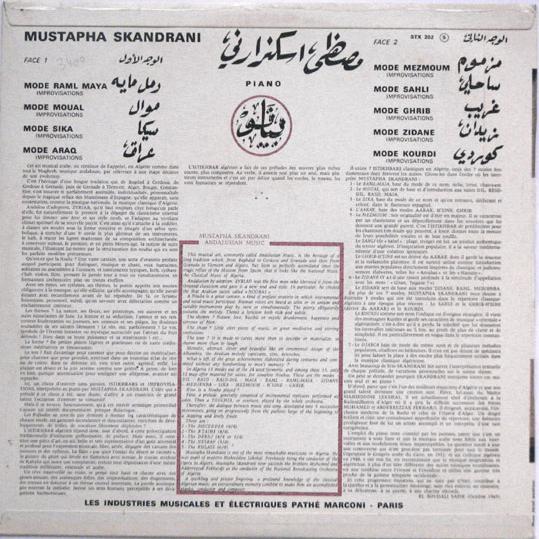
Cheikh Mustapha Skandrani ~ Musique Classique Algérienne: Stikhbar LP [EMI Pathé Marconi, 1965]


Mustapha Skandrani

Musique Classique Algérienne
Stikhbar LP
Les Industries Musicales Et Electriques Pathé Marconi, Pathé
STX 202, STX 202
1965

a1 Stikhbars: Raml Maya 5:05
a2 Stikhbars: Moual 4:06
a3 Stikhbars: Sika 4:04
a4 Stikhbars: Araq 5:08


b1 Stikhbars: Mezmoum 2:16
b2 Stikhbars: Sahli 4:59
b3 Stikhbars: Ghrib 4:00
b4 Stikhbars: Zidane 4:19
b5 Stikhbars: Kourdi 4:20

Mustapha Skandrani [November 17, 1920 - October, 2005] was a musician, composer, conductor & teacher of Algerian chaâbi of Algiers. Monument to the genre & Andalusian musique, the history of Algerian musique is intimately linked to his personality. It retains its virtuosity of Cheiikh Pianoriental and his compositions are highly appreciated by fans of this music.

Cheikh Mustapha Skandrani was born in the Lower Casbah in Algiers of a family from Cherchell (Tipasa). According to him, his origins are Iskander, a town in Turkey. He grew up and attended school in the ancient Casbah and its winding roads that take us back in Algiers and mysterious magic of another time. The lower part of the Casbah is where he was born near the sea and the port of Algiers & was at the time of the splendor of the city, a major commercial district. There remains today little trace except for a flea market in a bustling shopping ancient streets.

At an early age, Mustapha's uncle Habib Skandrani, noticing his nephew's interest in the piano - an instrument still disregarded by both chaâbi and art music ensembles - took it upon himself to teach him the rudiments. Mustapha has also his uncle to thank for getting interested in such instruments as the mandoline, guitar and kuweitra often heard in the ensembles of that time. He mastered playing them as well as his beloved piano, in no time. Sid-Ali, his father was also a passionate Andalusian music & it was in this atmosphere conducive to music that Mustapha began his musical career in 1938. First with Ahmed Sebti, a master of Andalusian music & then with Hadj M'Rizek, grand master of the song Hawzi who mastered all sorts of musical instruments, such as derbouka, piano, violin, mandolin & was not afraid of promoting the piano as a way to modernize the chaâbi and hawzi genres.

His radio debut was made with the composer and his partner Rasheed Ksentini Marie Soussan. Mahieddine Bachtarzi singer nicknamed "The Caruso of the desert by the French press discovered and hired him to replace the Jewish pianists. This resultedin a major tour of Algeria in 1940 with Oum Kalthoum, Mahieddine Bachtarzi , Driscar, Mustapha Kateb and others. Upon his return from tour, he accompanied all the stars who took part in concerts including Dahmane Ben Achour , El Hadj Menouar and dean of the Chaabi Mohammed El Anka.

In 1939, Mohammed Salah Arzour who was in charge of the musical programmes on the radio, had the first of a series of art music concerts broadcasted. As soon as Mustapha Skandrani had come back to Algiers, he was engaged to accompany, on the piano, such famous singers as: Dahmane Ben Achour, Hadj M'Rizek, Hadj Mahfoud, Hadj Menouar, Bachtarzi Mahieddine and Hadj M'Hamed Elanka.

Then the "Orchestre des sociétés réunies" came into existence with such masters as Ahmed Sebti, Mahieddine Lak'hal, Mohammed Benteffahi, the brothers Fakhardji and their most brilliant pupils; Mustapha Skandrani, at the piano, gave that orchestra the specific 'colour' still found in the way Andalusian music is played today, and thus founded the Andalusian School of Algiers.

In the years 1941 to 1945, he participated in the tours arranged by Mahieddine, entertained the guests of sport clubs, played for audiences at the "Padovani" - the music hall of Algiers - during the month of Ramadan and, on the radio, accompanied such great masters of art music and chaâbi as Elanka, Hadj M'Rizek, Hadj Mahfoud and Dahmane Ben Achour.

In 1945 he accompanied Salim Halali at the great gala performance given at the 'Forum', a public square in central Algiers, and also Lili Boniche at her gala performances in Algiers, Oran and Casablanca.

Besides, Mustapha Skandrani conducted the orchestra of the Algiers opera house every time a new play in Arabic was put on the stage, forty-six in all until 1956.

In 1956 Boudali Safir created the several ensembles of 'Radio Alger'. Mustapha Skandrani was to be in charge of the urban ensemble, conduct the folk music ensemble in the place of M. Elanka, and be the piano soloist of the art music ensemble conducted by M. Fakhardji. This prevailing position on the radio he kept until Algeria was independent. In independent Algeria he can boast of being the greatest Algerian pianist alive despite the fact there are many pianists nowadays. He also goes on conducting both the chaâbi and Andalusian ensembles.

From 1966 -1981, he devoted himself to teaching, taking a class at the Conservatoire d'Algiers. In 1981, Mustapha Skandrani directed the conservatory. Mustapha Skandrani was a master veteran who encouraged his students to the originality and development of their personality & often required them to submit to examinations & competitions with other works than those of the late Mohamed El Anka. Since 1938, Mustapha Skandrani has composed over 300 songs or modern chaabi and 187 compositions and Qasidah songs including 'Youm El Djemaa,' 'El Haraz', 'kifechhilti', 'Qahoua or Latey', 'A bouya Hnin'' filaati wool. He died in October 2005 at his home in Algiers after a long and painful illness. He was 85 & a one of a kind talent. There will never be another brother like him. May his eternal soul rest in peace.


marvelously unique recordings of a singular talent, generously bestowed upon us by an autodidactique musicologue extraordinaire who wishes to remain anonymous. a thousand thanks for this glorious gift. tis indeed a rare & wondrous treasure