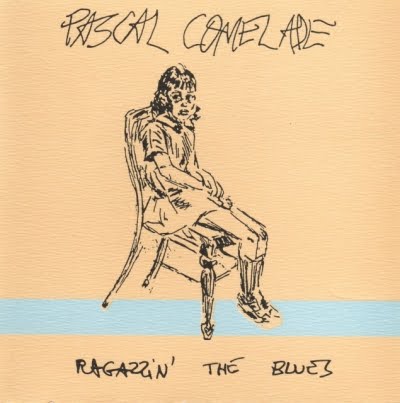
01 Patafisiskal Polska 02 Cafe, Copa, Puro 03 Neo-Realismo Del'Habanera 04 Midnight To Six Hands 05 A Glass Of Gaz 06 Return Of Johnny Guitar 07 4 Rroses Pour Marie 08 Valse De L'Aiguille Creuse 09 La Plaza D'Orient As Locus Solus 10 Waiting For Mister Motch On Beyrouth 66 11 Ava, In A Palindromic Garden 12 Patafisiskal Re-Polska
the arrangements & instrumentation on this album are more fleshed out than the compartively sparse Haïkus, but retain his singular style of repetitive melancholique simplicity in the most sublime way. nuff said. 320 remerciements à l'uploader d'origine. s'il vous plaît soutenir l'artiste
01. Tango del Rosselló 02. Smoke on the Water 03. Egyptian Reggae 04. Let me try 05. Alifib 06. Rue des soeurs noires 07. Your labios as tulips 08. Put a straw under baby 09. C'era una volta il West 10. Love theme from Ben Hur 11. Mexican theme frome Rio Bravo 12. Nocturn, a Joan Salvat-Papasseit 13. Souvenir de Vernet-Les-Bains 14. The sad skinhead 15. Good-bye pork-pie hat 16. Greenlands 17. Abril 74 18. Valse de l'aiguille creuse 19. 4 Roses pour Marie 20. Marcha mora 21. Amarcord 22. I surrender 23. Besame mucho 24. 96 tears 25. Les humeurs
Pascal Paul Vincent Comelade [born June 30, 1955], is a French Catalan musician. Comelade born was in Montpellier, France. After living for several years in Barcelona, he made his first album, Fluence, influenced by electronic music and by the group Heldon. Subsequently, his music has become more acoustic and is characterised by the sounds of toy instruments, used as solo-instruments and as an integral part of the sound of his group, the Bel Canto Orquestra.
Each new album by Pascal Comelade is in itself a bit of an event. The man makes himself rare in France and is much more prolific in Catalonia, where he is considered to be an essential musician. In France, he is seldom mentioned in the media, and, in record shops, his music is often to be found in the film score section, with experimental music or even with world music. The last time he really got the attention of the critics was for his musical show Psicotic Music-Hall in 2002, a tribute to La Bodega Bohemia, a historical cabaret in Barcelona.
"I did a series of concerts in Tokyo in 1991 and played at the French-Japanese Institute. In the sixties, Yves Klein was there, giving French lessons in order to pay for his own judo lessons. My first record for DSA, 'Détail Monochrome' [1984] was - with its title and its cover [a monochrome blue one] - an involuntary tribute to Yves Klein. A second luck was that I found in Tokyo a toy piano from the same manufacturer of the piano which is in the CCAM Studio. With both pianos, I recorded 'Haïkus de pianos' as a special thank you to all the nice Japanese people I met in Tokyo." ~ pc
one of the most innovative french composers unfurls a sublimely short but super sweet set of unlikely covers & strong originals for grand & toy piano :) thoughtful sequencing & continuity demand repeated listening, with only about half the tunes featuring the prominent ticklin of toy ivories. 320 remerciements à l'uploader d'origine
01 L'emporda 02 El cant dels Ocells 03 La Reina de les fleurs 04 La Unica [obligada de tible] 05 Per tu ploro 06 Joquines d'una Pastora 07 Devant de la Verge 08 L'arc de Sant Marti 09 Bona Festa 10 Escolte'm [obligada de tible] 11 La processo de Sant Bartomeu 12 El Saltiro de la cardina 13 Maria de les Trenes 14 Els Degotalls 15 Encisadora 16 Caquetage [valse pour tenora] 17 Sangre Morena [paso doble] 18 La scintillante [valse pour tenora] 19 Pescadors bons catalans 20 Juny 21 Sol Ixent 22 La noia alegre que no sap plorar 23 La Santa Espina
The 'cobla' is a uniquely Catalan wind band comprising 11 instrumentalists, which emerged at the same time as the new 'sardana' [circular, open dance], the Sardana Llarga [long sardana] during the second half of the 19th century. This transformation of Catalan music was born out of important movements of the time - the 'modernist' movement which accompanied the change from traditional, essentially rural, society to the modern, industrial society. The second was the Catalan Renaixenca concerned with linguistic conservation and political autonomy.
Old instruments such as the 'sac de gemecs' [bagpipes] and 'tarota' [rustic oboe] disappeared and were replaced in the 'cobla' by: the 'flabiol' [short wooden flute]; the 'tambori' [small drum]; two 'tible' [woodwind, similar to clarinet]; two 'tenora' [woodwind, similar to clarinet or oboe]; 2 trumpets; 1 trombone; 2 'fiscorn' [similar to small tuba] & 1 double bass.
This release compiles arkhival historic recordings by various bands first issued on 78rpm records between 1920 & 1930. sounds like somethin i heard in my childhood, but i can't trace time. 320 remerciements à mon cher frère espilos. plus