Showing posts with label gloops n' gleeps. Show all posts

Tuesday, April 12, 2011

Gil Trythall - Luxikon II • Echospace [Pandora, 1980] 320k


Pandora 801

A. Luxikon II 14:39
B. Echospace 12:34

mr. trythall’s two late-60’s 'country' themed moogsploitation lps are of course the gilded arches that keep the genre airborne, but it’s this 1980 collection [on the miniscule, west virginia-based pandora records imprint] that’s always been the real show of trythall’s creative vision ...

while 'luxicon ii' ‘s gorgeous deep-bass filtering, runaway arpeggiations, & spot-on 'electro' -tinged drum-machine gork is the stuff of legend ... i maintain that 'echospace' beats a good chunk of time-lag architect terry riley’s synth/ organ / tape-echo work at it’s own game ; it’s a sublimely deep aggregate of flowing sections, each involving pristine, fluttering auto-quantized flights of fancy

Gilbert Trythall, synthesist and composer, was raised in knoxville, tennessee. after studying composition at the university of tennessee with david van vactor, northwestern university with wallingford riegger, and cornell university with robert palmer, gil began composing electronic music in 1966 using a war surplus oscillator, two home tape recorders, patch cords, and a splicing bar. he now teaches at west virginia university.

in 1970, gil synthesized an album of country music classics, country moog which reached the country charts. country moog, and a sequel, nashville gold, were synthesized with moog modular equipment.

here, gil synthesizes two original compositions, luxikon ii and echospace.

luxikon ii was commissioned as a multimedia dance composition by the georgia united arts conference and premiered in atlanta on february 2, 1980. the first performance included projected lissajous laser patterns with choreography by catherine schane of georgia state university.

principal instrumentation for luxikon ii includes: moog iiic modular synthesizer, two interconnected micromoogs, eml 400 sequential sequencer, multivox analog echo, and a farfisa combo organ.

the revised version recorded here was first presented june 21, 1980 in an evening outdoor performance by the parthenon in nashville's centennial park as a part of a multimedia concert featuring multiple films by don evans in a production by the little marrow bone repair corporation.

echospace was commissioned by the atlanta contemporary dance company, joanne mcghee, choreographer, and frequently performed by that group.

echospace is repetitive and trance like. short motives return through a tape delay system developing a rich sonority of multiple echoes. the composition consists of thirteen sections, each based upon a six-note chord which is systematically related to the next. when the pattern returns to the beginning chord (the thirteenth section), the piece is concluded. instrumentation includes a moog illc modular synthesizer and a farfisa combo organ

one of the less academic [read: instantly gratifying] of the in miniature electronic lp as cdr reish's on keith fullerton whitman's creel pone imprint. a fine choice for the attention deficient among you as the compositions are relatively short & thoroughly compelling. echospace in particular is perfect in every way & reminiscent to mine ears of david berman moves. this upgrade made possible by the great Tom7865, 320 gleeps later

Sunday, March 27, 2011

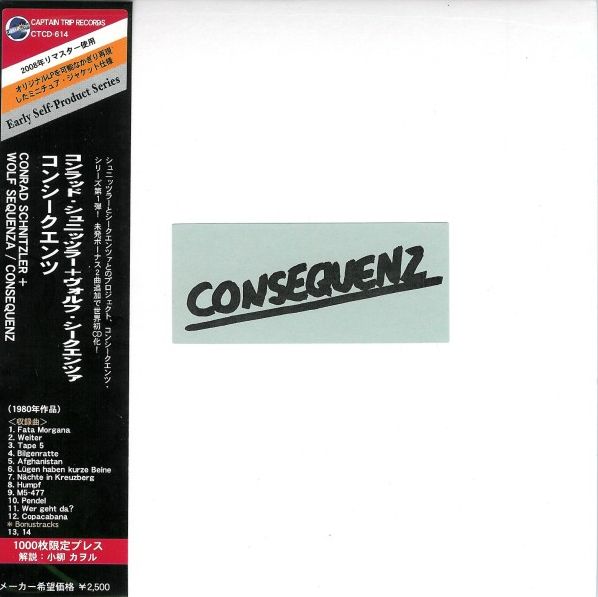
Conrad Schnitzler & Wolf Sequenza ~ Consequenz [1980, Captain Trip, 2008]


CTCD-614

01 Fata Morgana 5:13
02 Weiter 4:20
03 Tape 5 3:37
04 Bilgenratte 2:33
05 Afghanistan 5:31
06 Lügen Haben Kurze Beine 3:33
07 Nächte In Kreuzberg 3:48
08 Humpf 2:51
09 M5-477 4:39
10 Pendel 4:16
11 Wer Geht Da? 3:46
12 Copacabana 5:17

Bonus
13 Untitled 10:03
14 Untitled 8:25

Composed By - Conrad Schnitzler, Wolfgang Sequenza
Remastered By [Digital] - Souichirou Nakamura

Reissue of the 1980 private release with two bonus tracks in the 'Remastered & LP Cover Reissue Series' and the 'Early Self-Product Series'.

Recorded in 1980 except tracks 13 & 14 in 1982
Digital remastered at Peace Music Tokyo, Japan


by request & one of con's best. fun & catchy exploratory tron, 256 gleeps later. further

Saturday, February 12, 2011

Arsène Souffriau - Expériences Bimes 3xLP [Metaphon, 2010]


002

A1. Trois Études Pour Maldoror (1) 3:57 1962
A2. Feu D'Artifice 8:13 1963
A3. Trois Études Pour Maldoror (3) 4:21 1962

B1. Metastasis 14:07 1963
B2. Étude N°2 Pour 2 Pianos Préparés 9:00 1964/71

C1. Un Monde En Création 11:13 unknown
C2. AS980804 9:00 1998

D1. Mutations (1) 3:56 1979
D2. Incantation 13:14 1981
D3. Rosio Kama (3) 3:32 1988

E. Imaginaires Irisées 25:33 1982

F. Attente 23:55 1992

Music By, Producer, Liner Notes [Track Notes], Score - Arsène Souffriau


'titanic triple-lp-box ltd to 200 copies; gorgeous, embossed blue linen box with the credits screen-printed on the inside cover, along with the three audiophile-grade lps each housed in their own poly-lined sleeve, offering a treasure-chest of unreleased music from belgian early electronic & experimental music composer arsene souffriau....

even for someone well-versed in 60’s electronic music, souffriau’s name only rings a bell due to his contributions to the moogsploitation lp 'free pop electronic concept' ... whereas his work there is relegated to only ancillary bleep-out, the fully realized musique concrète & dark tape-music compositions here paint a much broader picture of souffriau, a veritable renaissance man, working well into present day at his 'private' bimes studio, chugging out pieces along the lines of contemporaries such as andre almuro and luis de pablo, yet entirely without academic or commercial support...

making him of course the perfect candidate for a boutique compiling such as this, ranging from some particularly woolly early-60’s flare-out [much of which matches the mutant energies of oosterlynck’s 'outsider' prepared-piano takes] through his dalliances with electro-acoustic improv in the 70’s & 80’s [spiky, clangorous group-sound] straight up through a peppering of 90’s 'digital' work [heavy, spectral hysteresis] ...

trust me, once you see this thing, you’ll be able to justify the (admittedly, hefty) price tag ; i can’t think of another edition that even comes close to the production-value / detail-obsessing-over that clearly went into this thing ... highly recommended !!!' ~ mimaroglu

yea, i like it. crazy, cost-prohibitive package of monstrous gloops n' gleeps that are strangely compelling & listenable. have seen this bra likened to daphne oram as well, but he seems slightly more sinistral to my ears. 320 rips later

Saturday, October 9, 2010

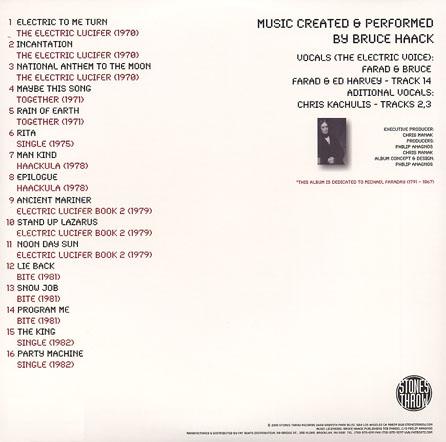
Bruce Haack ~ Farad: The Electric Voice [Stones Throw, 2010]


released & unreleased vocoder recordings, 1970-1982

'Bruce Haack's music is rooted in the idea that humans and electronic machines share a reciprocal relationship that manifests itself through sounds. In order to further explore this dynamic, Haack dropped out of Juilliard to pursue a more experimental course in, surprisingly, educational children's music. Haack released material off his own label Dimension 5 Records in 1962, which allowed him to mix kinetic energy, infuse psychedelic philosophy, and pluck sounds from various genres across the board. Adding to his musical pastiches, Haack used home-made modular synthesizers, proto-vocoders, and the heat-touch sensitive Dermatron to expand his music into the technological realm of creativity.

After contributing to commercials, TV shows such as Mister Rogers, and theatre productions, Haack released the acid-rock-techno gem Electric Lucifer, a conceptual masterpiece that maps out a war between heaven and hell, and where notions of "powerlove" are mediated through Moog synths.

Farad serves as a glowing primer of Haack's work throughout his career. Touching on the lush, pysch-electronic grooves of the Electric Lucifer period and extending to his more abstract, angular works, this compilation highlights his use of the Farad, one of the first musical vocoders invented at the time. Yet amidst echoey reverb and haunting drones, Haack himself manages to create something primal and human, not necessarily conflating human and electronic but posing them as compatible partners.' ~ press hype

'Amazing electric grooves from synth innovator Bruce Haack – whose pioneering use of analog synths and vocoder vocals in the service of great, if far out songcraft was pretty much unrivaled in the 70s and into the early 80s – the period in which this excellent compilation on Stones Throw highlights! Haack's earlier successes were children's music in the 60s, and one of the coolest aspects of his 70s recordings was how that somewhat bright-eyed and innocent sing-song-y approach moved into more surrealist, weirder realms on albums like Electric Lucifer, that album's lesser known, still quite brilliant sequel, and albums like Haackula and Bite. Choice cuts from those albums as well as rare singles are rounded up for Stones Throw's impeccably curated overview. The electric voice and synth errata brings an otherworldly vibe to catchy songs – and Haack's use of the vocoder was followed by so many others who would become household names, from Kraftwerk to Pink Floyd to Moroder.' ~ dusty

snap up the re-ish

pretty slammin correction of uncle brucie's vocoder steez, even a couple we'd never heard before. for the uninitiated, it's highly recommended you trace both 'electric lucifer' lp's as well. they're owl up in the interwebs, just perform a quick search with yr favourite engine

Wednesday, September 8, 2010

Karlheinz Stockhausen ~ Opus 1970 - Stockhoven/Beethausen [Deutsche Grammophon,1969]


side 1 ~ 28:24
side 2 ~ 25:07

Created during a production between the 10th and 14th December 1969 in the Godorf/Cologne Studio

'Based formally on the composition of 'Kurzwellen': material is obtained from a regulating system [radio short waves], selected freely by the player and immediately developed. By 'developed' is meant: spread, condensed, extended, shortened, differently coloured, more or less articulated, transposed, modulated, multiplied, synchronized.

from the attached sleeve text [translated from German, i imagine]:
'This classic live electronic improvisation work [which grew out of Stockhausen's Kurzwellen] is actually a great noisy atonal tribute to Beethoven's Opus 212b. Stockhausen's Opus 1970 was composed to mark the 200th anniversary of Beethoven's birth, but curiously suppressed in the official list of Stockhausen works.
Stockhausen serves as sound-director of Aloys Kontarsky [piano], Johannes G. Fritsch [electric viola], Harald Bojé [Elektronium early electronic keyboard instrument], and Rolf Gehlhaar [tam-tam]. The players activate tapes containing abstract fragments of Beethoven's music as they perform and improvise in response, with Stockhausen electronically processing and mixing the group's output.'

most impressive group sounds from 69. originally dropped by the noble ooliver[thanks!] of avaxhome fame in .ape format & converted to 320 mp3 utilizing this piece of freeware. highly recommended

Friday, July 2, 2010

Daphne Oram ~ Oramics [Paradigm]


keepin it reel to reel


paintin on film


oramics machine


knob twiddlin with petey sellers


Daphne Oram [1925 – 2003] was a pioneering British composer & electronic musician. The first woman to create & run a sound studio & subsequently design & build an entirely new sound recording medium, she created the 'Oramics' technique at the BBC Radiophonic Workshop in England. This method of musique composition & performance was intended by Oram to allow a composer to be able to draw an 'alphabet of symbols' onto a set of ten sprocketed synchronised strips of 35mm film which covered a series of photo-electric cells that in turn generated an electrical charge to control the sound frequency, timbre, amplitude & duration & feed it through a machine that would, in turn, produce the relevant sounds on magnetic tape. The output from the instrument was only monophonic relying on multitrack tape recording to build up polyphonic textures.

Educated at Sherborne School For Girls, Oram was, from an early age, taught piano & organ as well as musical composition. In 1942 she was offered a place at the Royal College of Music but instead took up a position as a Junior Studio Engineer and 'musique balancer' at the BBC. During this period she became aware of developments in "synthetic" sound and began experimenting with tape recorders. She also spent some time in the 1940s composing music, which remained unperformed, including an orchestal work entitled Still Point. In the 1950s she was promoted to become a music studio manager and, following a trip to the RTF studios in Paris, began to campaign for the BBC to provide electronic music facilities for composing sounds and music, using electronic music and musique concrète techniques, for use in its programming. In 1957 she was commissioned to compose music for the play Amphitryon 38. Using a sine wave oscillator, an early tape recorder & some self-designed filters, she produced the score from only electronic sources; the first of its kind at the BBC. Along with fellow electronic musician and BBC colleague Desmond Briscoe, she began to receive commissions for many other works - including a significant production of Samuel Beckett’s All That Fall. As demand grew for these electronic sounds, the BBC gave Oram and Briscoe a budget to establish the BBC Radiophonic Workshop in early 1958, where she was the first Studio Manager.In October of that year, she was sent by the BBC to the "Journées Internationales de Musique Expérimentale" at the Brussels World’s Fair [where Edgard Varèse demonstrated his Poème électronique]. After hearing some of the work produced by her contemporaries and being unhappy at the BBC's music department's lack of interest, she decided to resign from the BBC less than one year after the workshop was opened, hoping to develop her techniques further on her own.

In 1959 she installed her Oramics Studios for Electronic Composition in Tower Folly, a converted oast house at Fairseat, near Wrotham, Kent. Her output from the studio, mostly commercial, covered a far wider range than the Radiophonic Workshop, providing background music for not only radio and television but also theatre and short commercial films. She was also commissioned to provide sounds for installations and exhibitions. Other work from this studio included electronic sounds for Jack Clayton's 1961 horror film The Innocents, concert works including Four Aspects and collaborations with opera composer Thea Musgrave and Ivor Walsworth

In February 1962, she was awarded a grant of £3500 from the Gulbenkian Foundation to support the developments and research of her "Oramics" drawn sound technique. A second Gulbenkian grant of £1000, awarded in 1965, enabled the Oramics composition machine to be completed. The first drawn sound composition using the machine, entitled 'Contrasts Essonic' was recorded in 1968

Throughout her career she lectured on electronic music and studio techniques. In 1971 she wrote An Individual Note of Music, Sound and Electronics which investigated electronic music in a philosophical manner. Besides being a musical innovator her other significant achievements include being the first woman to direct an electronic music studio, the first woman to set up a personal studio and the first woman to design and construct an electronic musical instrument

In the 1990s she suffered two strokes and was forced to stop working, later moving to a nursing home. She died in 2003, aged 77. r.i.p. Daphne Oram 1925-2003. further

dubble disque set from this amazing human being. i think she raised goats too. what a babe. it should be noted that in the first trauqe, 'introduction', her voice gets slightly truncated toward the end. they probably could have done a fade-out or something but this is exactly how the original release sounds, so please don't let it discourage you from hearing the remainder of these compositions. 320 thanks to espilos.